









Consumer behavior fundamentally dictates marketing strategies by influencing audience segmentation, channel selection, and pricing models. In the current US market, shifts toward value-driven spending (the “trade-down” effect) and privacy-first preferences force brands to abandon broad demographic targeting in favor of first-party data strategies and Generative Engine Optimization (GEO). Successfully adapting to these behaviors, specifically the demand for hyper-personalization combined with ethical alignment, is the primary driver of customer retention and conversion in the modern digital economy.
Table of Contents
The New Rules of Engagement
The American marketplace has split in two. On one side, we see resilient luxury spending where affluent buyers continue to pay premiums for exclusive experiences. On the other side, the mass market is engaged in a high-stakes game of economic survival. This “bifurcation” is the defining characteristic of the current landscape. It challenges every assumption we previously held about the marketing funnel.
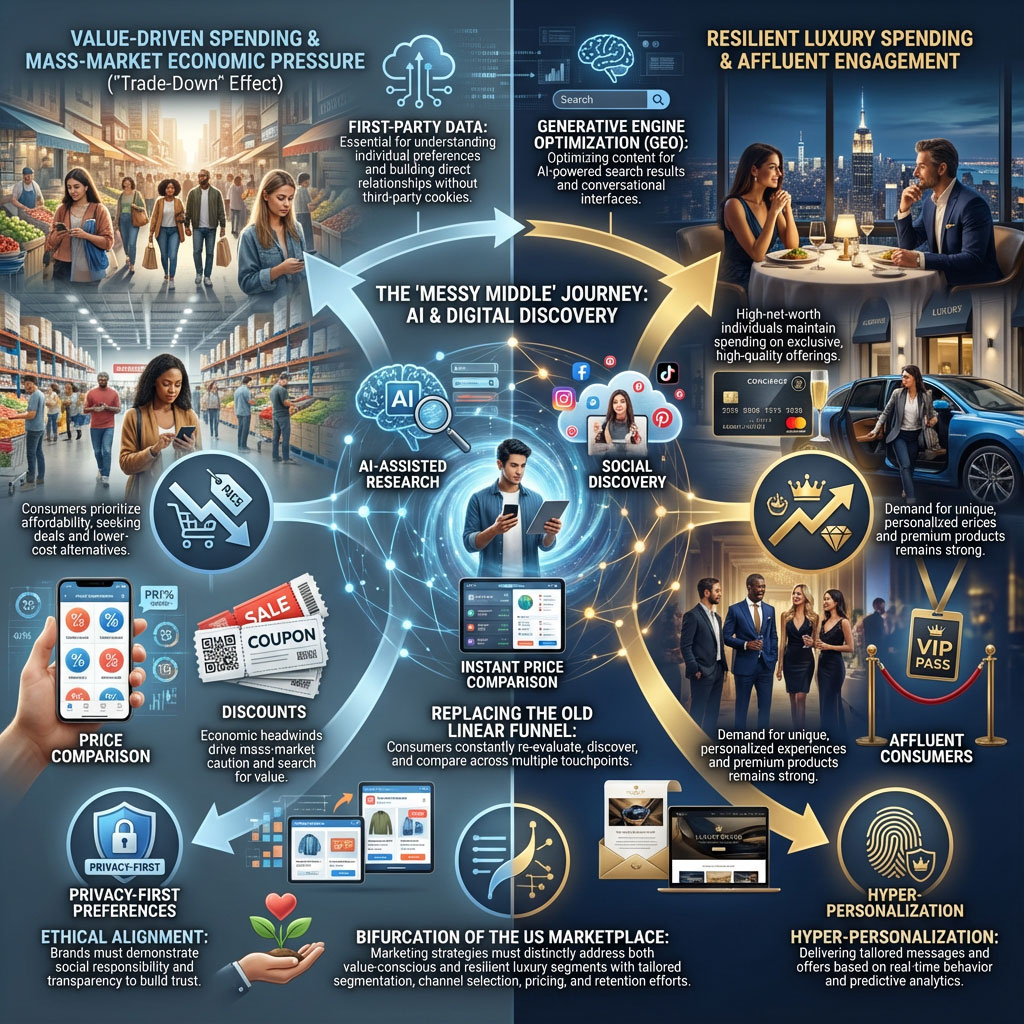
For decades, the path to purchase was linear. A customer saw an ad, searched for the brand, and bought the product. That model is obsolete. The modern journey is a “messy middle” of AI-assisted research, social discovery, and instant price comparison.
To survive this shift, marketers must move from reacting to historical data to predicting future actions. We must understand how consumer behavior impacts marketing strategies not as a theoretical exercise but as a survival mechanism. If you are still relying on third-party cookies or broad demographic buckets like “Millennials,” you are marketing to a ghost. The reality is that consumer behavior impact on marketing strategies is now immediate and unforgiving. One misalignment in pricing or values can trigger a mass exodus of loyal customers.
This guide explores the psychological and technological shifts rewriting the playbook. We will dissect current consumer trends USA and provide a blueprint for navigating the “discount chicken” economy, the rise of AI search, and the privacy paradox.
The Core Context: Why the US Consumer Changed (And Won’t Go Back)
The fundamental problem with traditional marketing is its reliance on stability. We assume that if a customer bought premium coffee yesterday, they will buy it tomorrow. Current data proves this false.
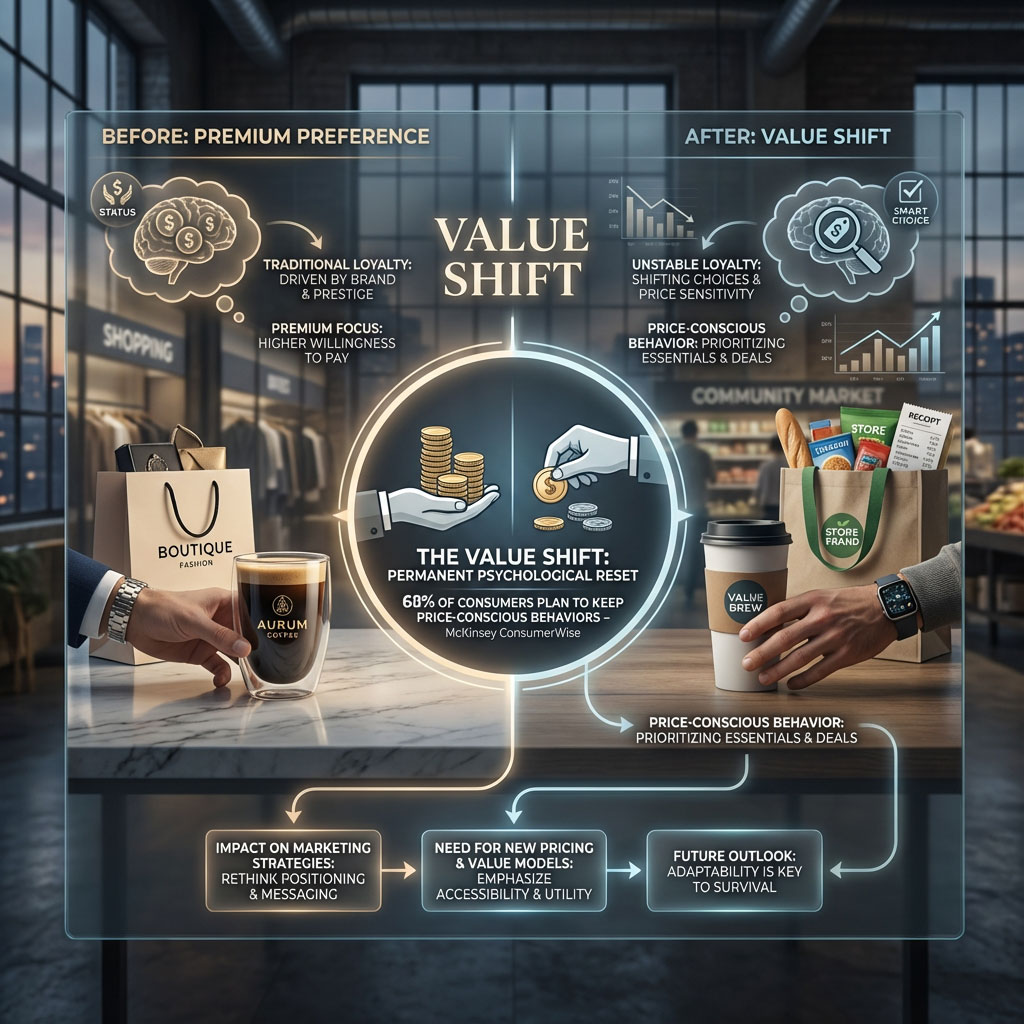
Consumer behavior impact on marketing strategies is most visible in the erratic nature of loyalty. The “Value Shift” is not a temporary reaction to inflation or economic uncertainty. It is a permanent psychological reset. According to recent McKinsey ConsumerWise reports, approximately 68% of global consumers have adopted new, price-conscious behaviors that they intend to keep regardless of future economic recovery. This requires a complete overhaul of how we approach pricing and value proposition.
The Psychology of “Discount Chicken”
Retailers and shoppers are currently locked in a standoff often referred to as “discount chicken.” Consumers have learned through years of training by e-commerce algorithms that patience pays off. They fill carts and abandon them, waiting for the inevitable “we miss you” coupon.
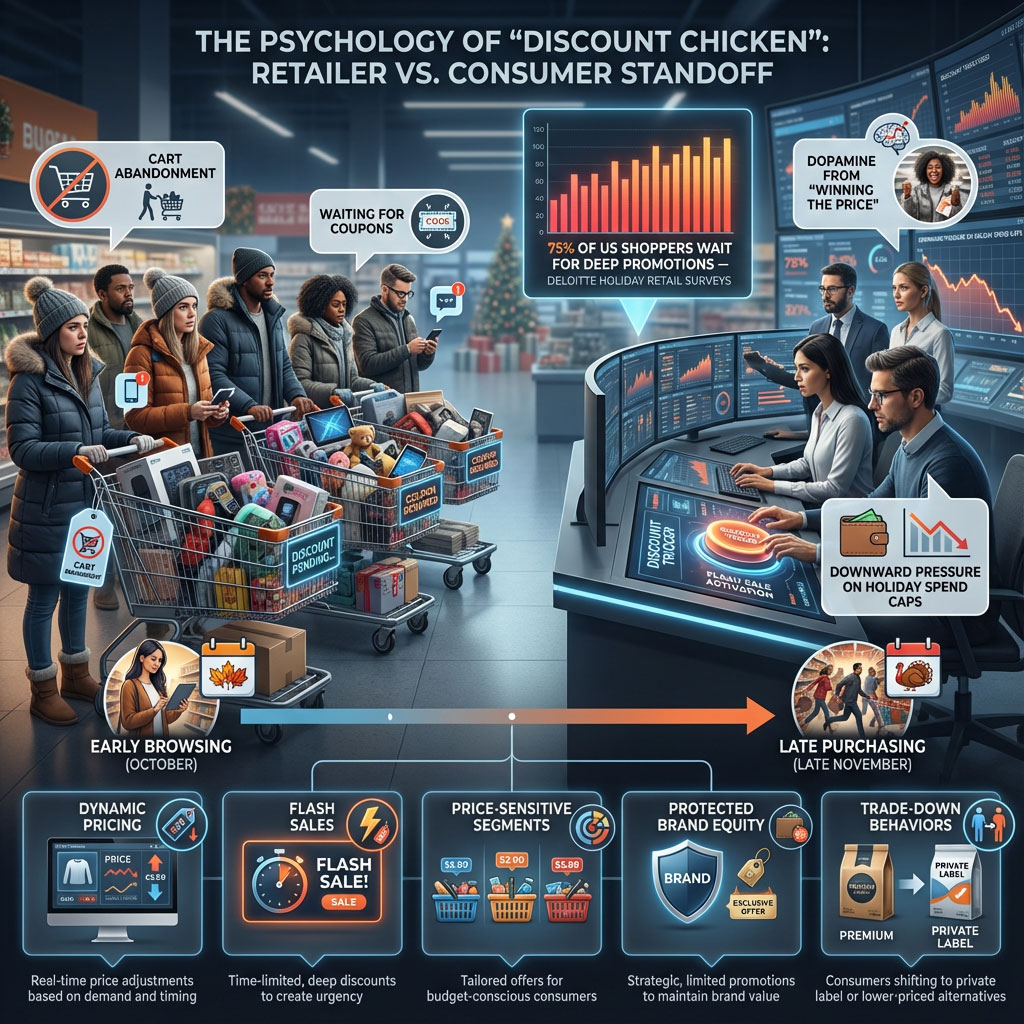
Deloitte’s Holiday Retail Surveys reveal a stark reality: 75% of US shoppers explicitly state they wait for deep promotions before converting. Furthermore, average holiday spend caps have seen significant downward pressure in recent cycles. This is not just about saving money; it is about the psychology of winning the transaction. The modern consumer feels a dopamine hit not just from acquiring the product, but from acquiring it at a perceived victory price.
For marketers, this consumer behavior impact on marketing strategies is profound. You cannot rely on a standard seasonal calendar anymore. The consumer trends USA indicate that shoppers start looking early in the season (often October) but do not buy until late November. If you discount too early, you lose margin. If you wait too long, you lose the customer to a competitor who blinked first.
To adapt, brands must utilize dynamic pricing tools. These tools allow for “flash sales” that target specific price-sensitive segments without lowering the floor price for everyone. This tactic protects brand equity while catering to the price conscious consumers driving the trade-down behaviors. The goal is to gamify the purchasing process for the consumer, allowing them to feel they have “won” the discount, while the brand maintains profitability through calculated inventory management.
The Trust Deficit & The Privacy Paradox
Here lies the greatest contradiction in modern marketing. Consumers do not trust brands with their data, yet they demand experiences that require deep data integration.
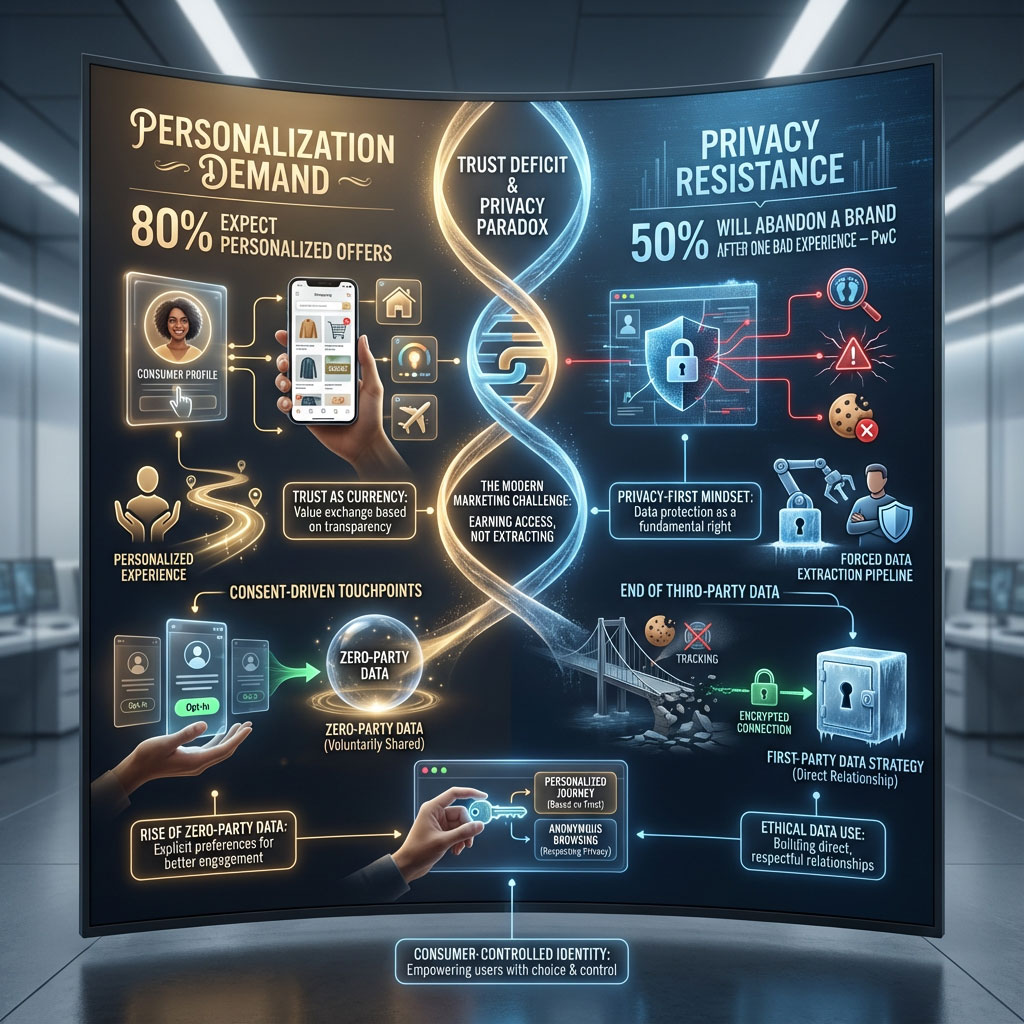
PwC’s Voice of the Consumer reports highlight this paradox. Over 50% of consumers say they will abandon a brand after a single bad experience. Conversely, 80% expect personalized offers tailored to their specific needs. They want you to know them, but they do not want you to track them.
This specific consumer behavior impact on marketing strategies kills the viability of third-party data. You can no longer buy your way into a customer’s life. You must be invited. The marketing strategy changes required here involve a pivot to “Zero-Party Data.” This is data a customer gives you willingly and proactively, usually in exchange for value.
When we analyze evolving consumer trends, we see that trust is the new currency. If a consumer suspects you are using their data unethically, the backlash is instant. This is why first-party data strategy is mentioned so frequently in boardrooms today. It is the only legal and ethical path forward. Marketers must now operate as stewards of identity, ensuring that every data point collected delivers a direct, tangible benefit back to the user.
Strategy 1: Data Infrastructure & Personalization
The death of the cookie was not an apocalypse. It was a correction. It forced marketers to build direct relationships. Consumer behavior impact on marketing strategies has moved the power from the advertiser to the user. To succeed, you must build a “walled garden” of your own data.
From Cookies to First-Party Data Strategy
A robust first-party data strategy is no longer optional; it is the engine of modern retention. This involves collecting data directly from your audience via owned channels through a clear value exchange.
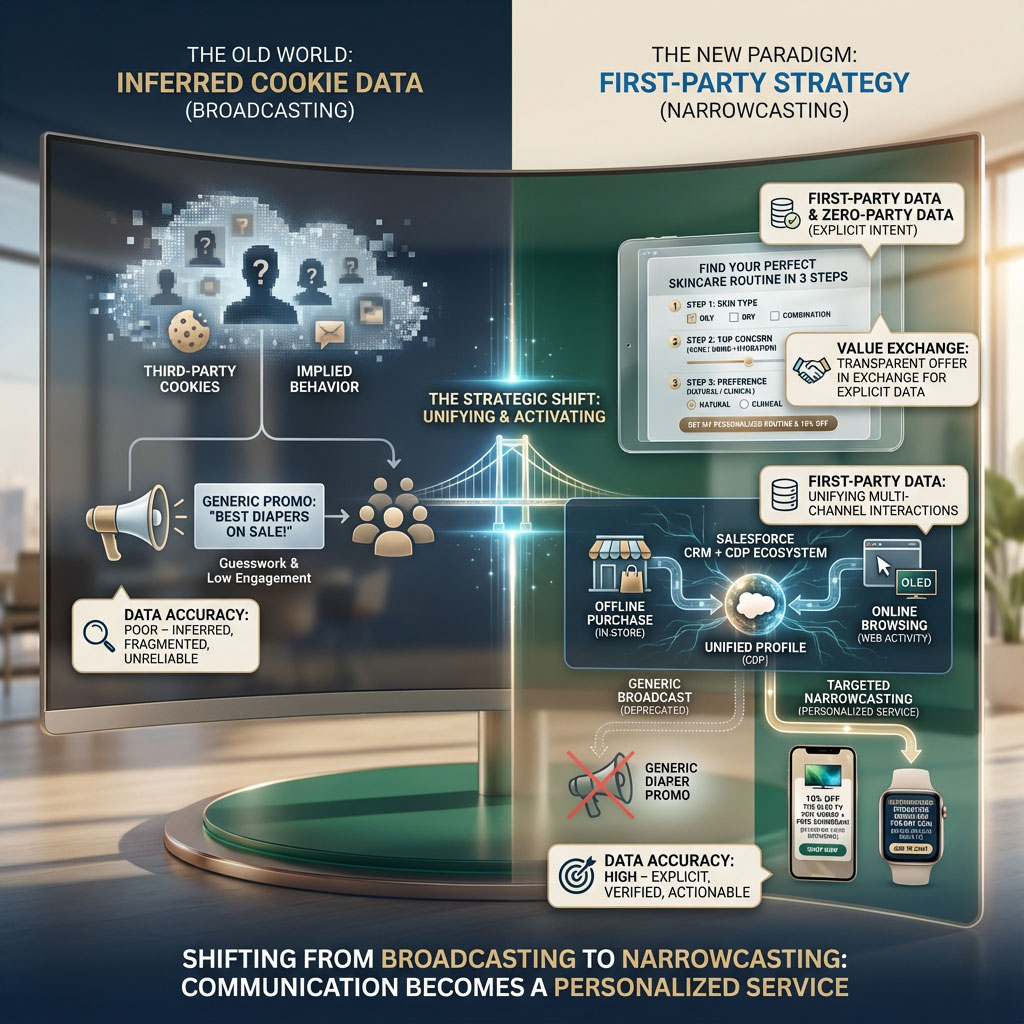
Ideally, when a customer visits your site, they shouldn’t just see a generic “Sign up for updates” pop-up. Instead, they should encounter an interactive element, such as a quiz titled “Find your perfect skincare routine in 3 steps.” By answering questions about their skin type, budget, and concerns, they provide Zero-Party Data. You know exactly what they want because they told you, not because you inferred it from a cookie. This distinction is critical. Inferred data is often wrong—just because someone buys a baby shower gift does not mean they are a parent. Explicit data, however, is the gold standard of intent.
Consider, for example, a major US retailer using a Salesforce CRM and CDP (Customer Data Platform). By unifying offline purchase data with online browsing behavior, they can see that a customer buys diapers in-store every month but browses high-end electronics online.
The consumer behavior impact on marketing strategies here allows the retailer to send a highly targeted email: “Get 10% off that OLED TV you looked at,” which is far more effective than a generic “Diaper Sale” email. This level of precision is only possible with a dedicated first-party data strategy. The strategy shifts from “broadcasting” to “narrowcasting,” where communication is treated as a service rather than an interruption.
AI-Driven Hyper-Personalization
Once you have the data, you need AI to activate it. AI personalization marketing is the difference between a static website and a living storefront.
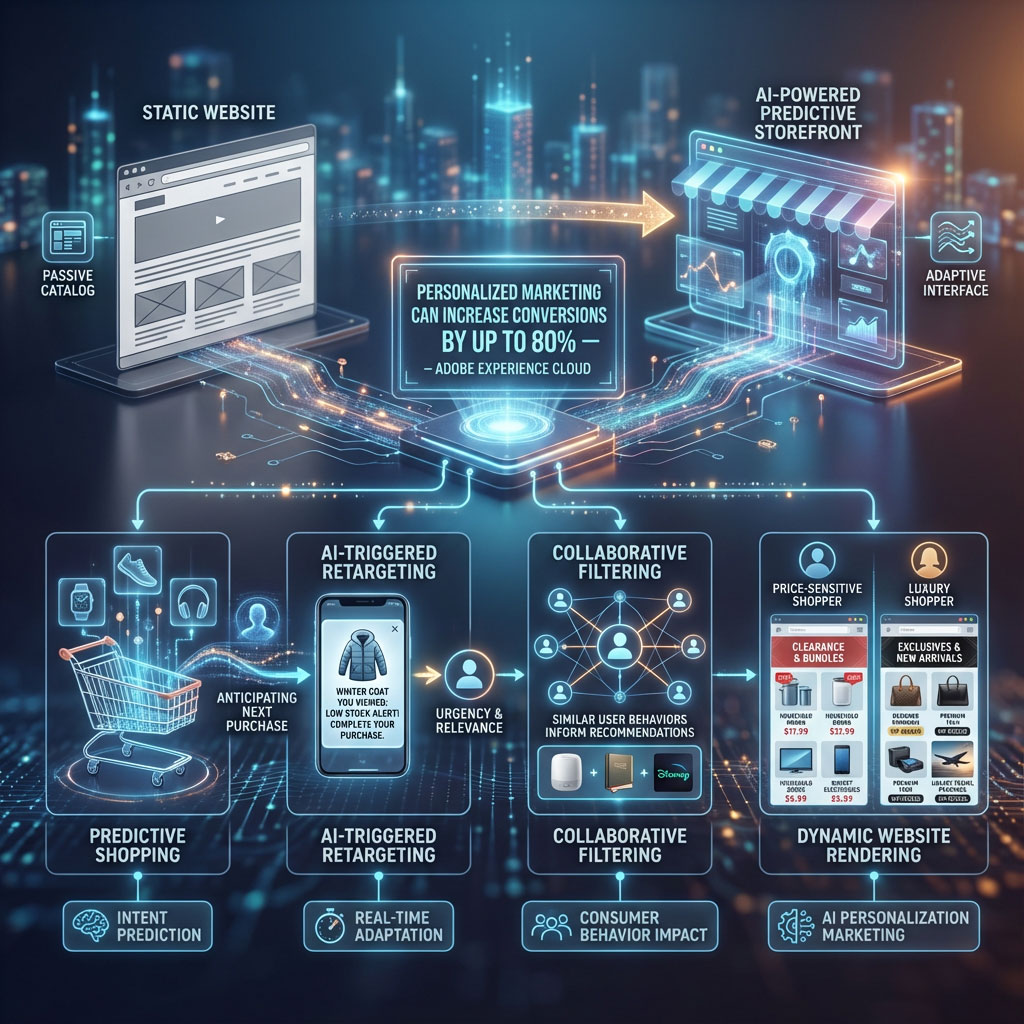
Adobe Experience Cloud statistics show that personalized marketing executions can boost conversion rates by up to 80%. But “personalization” in the modern era does not mean using a first name in an email subject line. It means predictive shopping.
AI personalization marketing tools analyze thousands of data points to predict intent. If a user hovers over a winter coat but leaves, AI can trigger a retargeting ad on Instagram showing that specific coat with a “Low Stock” warning.
To capitalize on this, brands should implement recommendation engines similar to Amazon. These engines do not just look at purchase history; they utilize “collaborative filtering.” If User A and User B have similar tastes, and User A buys a new gadget, the AI recommends that gadget to User B. This leverages buyer psychology to create desire before the customer even knows they have a need.
The consumer behavior impact on marketing strategies is clear. Passive catalogs are dead. Active, predictive interfaces are the future. The website must morph in real-time. For a price-sensitive shopper, the homepage should highlight clearance and bundles. For a luxury shopper, the same homepage should highlight new arrivals and exclusives. This dynamic rendering is the pinnacle of current personalization technology.
Strategy 2: The Evolution of Search (SEO to GEO)
The way consumers find information has fundamentally changed. We are witnessing the migration from Search Engine Optimization (SEO) to Generative Engine Optimization (GEO).
Generative Engine Optimization (GEO)
Generative Engine Optimization (GEO) is the practice of optimizing content for AI-driven answer engines like ChatGPT, Perplexity, and Google AI Overviews.
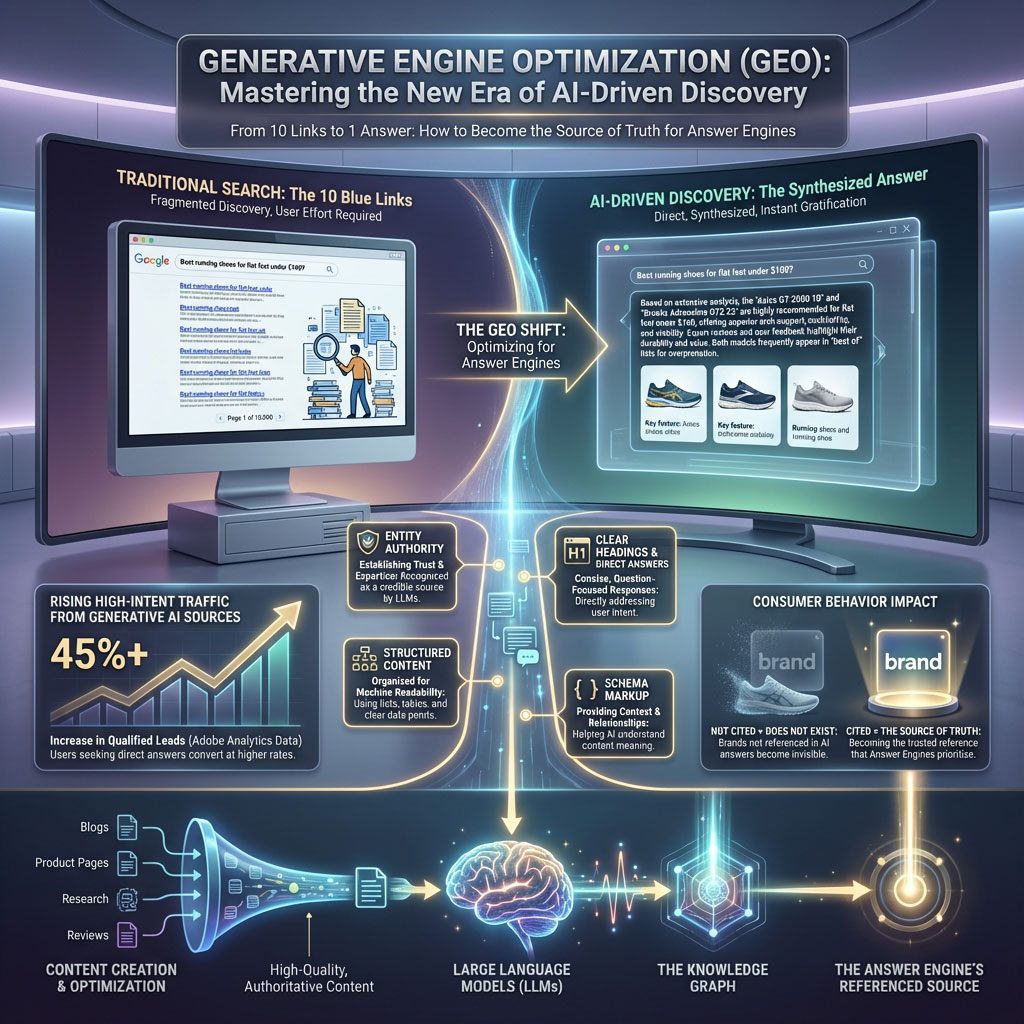
In the past, a user searched “best running shoes,” received ten blue links, clicked three, read reviews, and decided. Today, they ask an AI: “What are the best running shoes for flat feet under $100?” The AI gives a single, synthesized answer.
Consumer behavior impact on marketing strategies implies that if your brand is not cited in that single answer, you do not exist. Adobe Analytics reports a massive increase in traffic to e-commerce sites from generative AI sources. This traffic is often higher intent than traditional search traffic because the user has already refined their query through conversation with the AI.
To win at Generative Engine Optimization (GEO), content must be structured for machines. Use clear headings, provide direct answers to questions immediately, and use schema markup to help AI understand your product data. The goal is to be the “source of truth” that the AI cites. You must move away from “keyword stuffing” and toward “entity authority.” You need to convince the Large Language Model (LLM) that your brand is the definitive entity associated with a specific topic.
Mastering Long-Tail Intent
Broad keywords are becoming irrelevant. The consumer trends USA data shows that 91.8% of searches are now long-tail. Consumers are asking specific, complex questions.

Instead of searching for generic terms like “marketing software,” a buyer searches for “marketing automation tools for small business with CRM integration.” Consumer behavior impact on marketing strategies means you must create content that answers these specific queries. This is where AI in content marketing becomes useful. You can use tools to identify these long-tail questions and generate comprehensive FAQ sections that address them.
A practical step is to audit your top-performing pages and add an FAQ section at the bottom filled with the specific long-tail keywords consumer intent SEO requires. This increases the likelihood of capturing a “Featured Snippet” or being picked up by an AI answer engine. Furthermore, consider the “Zero-Click” future. Even if the user does not click your link, if the AI reads your answer to them, you have built brand awareness. Optimizing for “brand mentions” within AI answers is the new brand building.
Strategy 3: Channel Dynamics & Social Commerce
The sales funnel is flattening. For millions of Americans, social media is no longer just for brand awareness. It is the point of purchase.
Gen Z and the “No-Buy” Movement
Gen Z social media shopping habits are reshaping the landscape. However, this generation is also leading the charge on “de-influencing” and the “No-Buy” movement. They are skeptical of polished, corporate influencers.
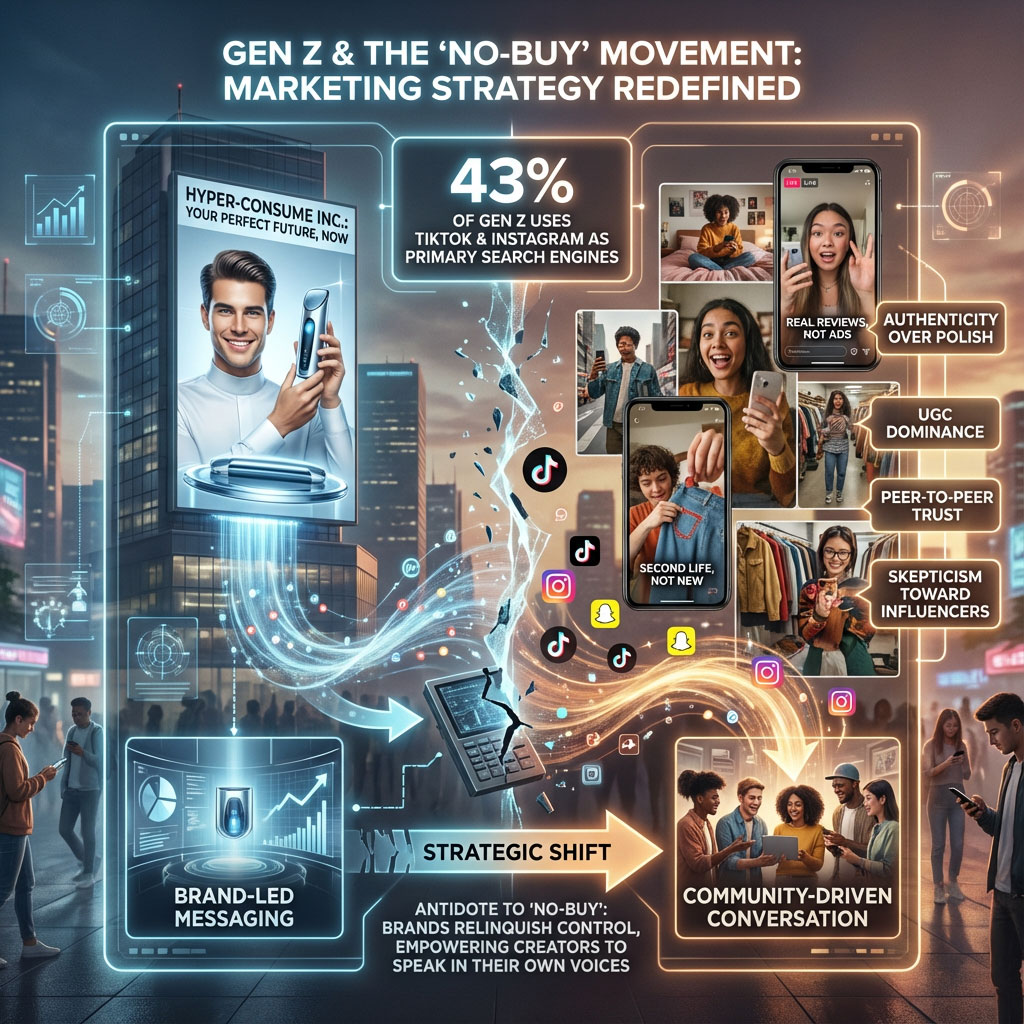
Surprisingly, 43% of Gen Z users utilize TikTok and Instagram as their primary search engines. They trust a random user’s video review more than a Google ad.
Consumer behavior impact on marketing strategies dictates a shift in creative strategy. Brands must pivot to User-Generated Content (UGC). Raw, unpolished videos shot on smartphones perform better than studio-quality commercials because they feel authentic. The “lo-fi” aesthetic signals to the consumer that the content is peer-to-peer recommendation rather than corporate propaganda.
Marketing strategy changes here involve relinquishing control. You cannot script every word. You must empower creators to speak in their own voice. This authenticity is the antidote to the skepticism driving the “No-Buy” trend. Brands must learn to participate in the conversation rather than trying to lead it.
The Social Commerce Boom
Social commerce trends indicate that the US market has surpassed $100 billion in sales directly through social apps.
Take the example of a beauty brand launching a new serum. Instead of driving traffic to their website, they use TikTok Shop. A user sees a video, clicks the orange basket icon, and pays with Apple Pay—all without leaving the app.
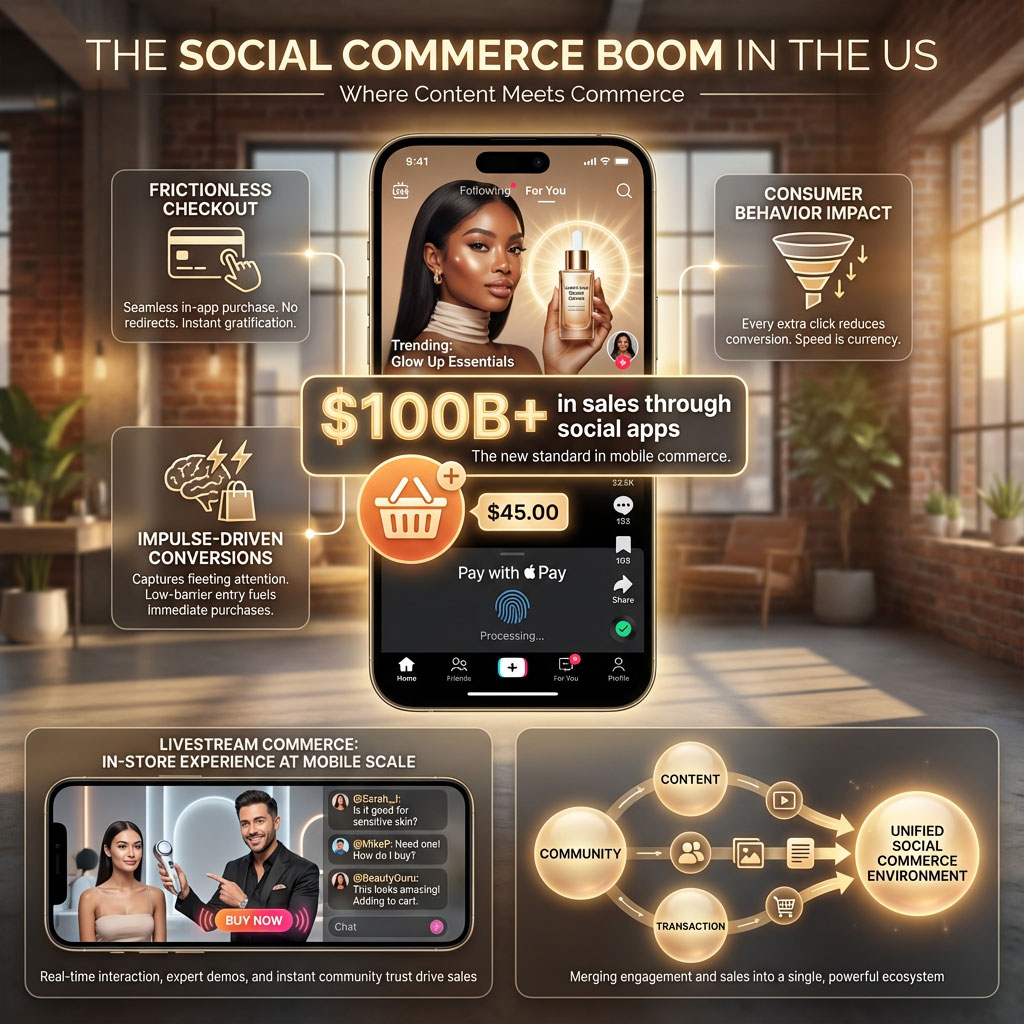
This removal of friction is critical. Consumer behavior impact on marketing strategies shows that every additional click reduces conversion by significant margins. By integrating social commerce trends into your strategy, you capture impulse buys that would otherwise be lost in a slow mobile checkout process. However, social commerce is not just about the transaction; it is about the community. Features like live shopping (Livestream commerce) allow for real-time interaction. A host can demonstrate a product, answer questions in the chat, and drive sales instantly. This mimics the in-store experience of asking a sales associate for help, but it happens at scale on a mobile device.
Deep Dive: The B2B Consumerization
It is critical to note that consumer behavior impact on marketing strategies is not limited to B2C (Business to Consumer). The “consumerization of B2B” is a massive trend. B2B buyers are humans too, and they bring their B2C expectations to the office.
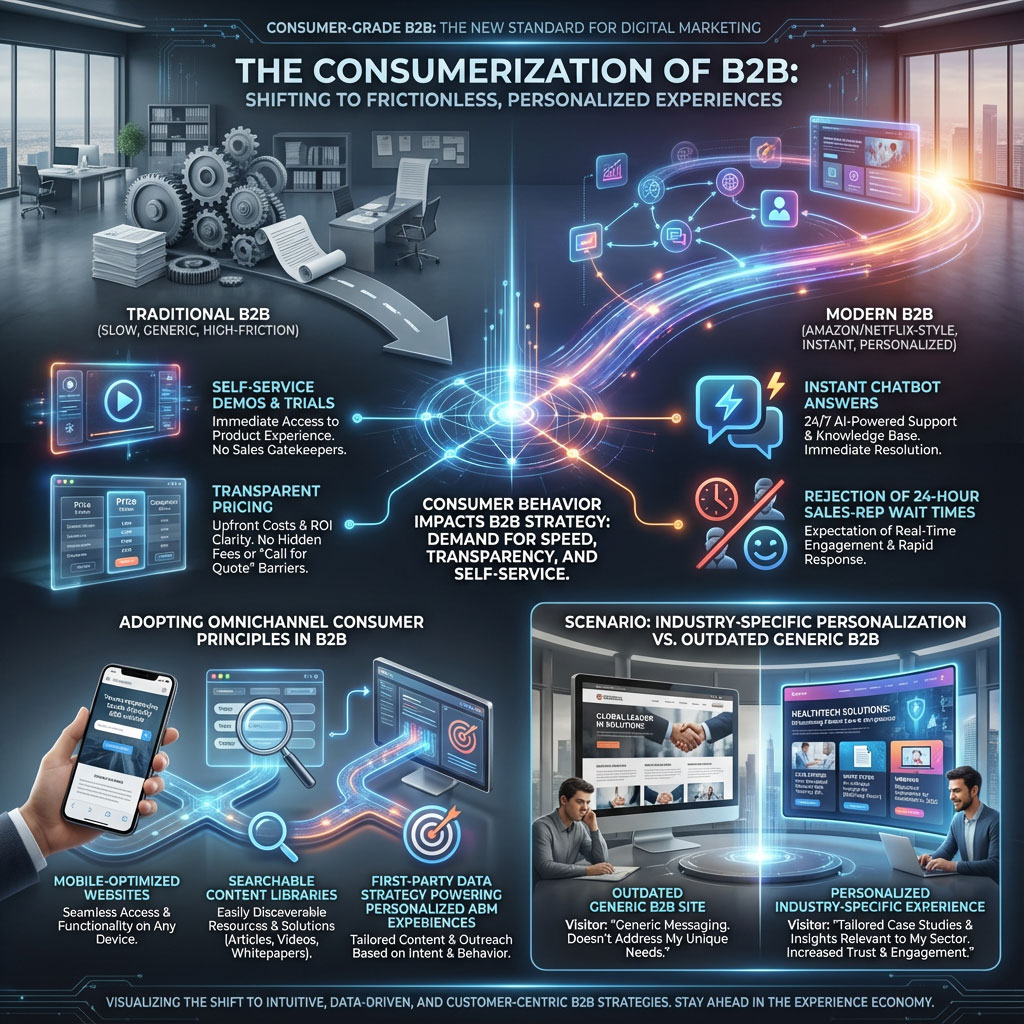
B2B buyers now expect the same frictionless, personalized, and digital-first experiences they get from Amazon or Netflix. They do not want to fill out a form and wait 24 hours for a sales rep to call. They want self-service demos, transparent pricing, and instant answers via chatbots.
If you are in the B2B space, you must adopt omnichannel consumer shopping principles. Your website must be mobile-optimized, content must be easily searchable, and you must use first-party data strategy to personalize the account-based marketing (ABM) experience. If a prospect from a specific industry visits your site, the case studies they see should be relevant to that industry. The days of the generic “one size fits all” B2B website are over.
Comparative Analysis: Old Playbook vs. Modern Strategy
To fully grasp consumer behavior impact on marketing strategies, we must contrast the traditional approach with the necessary adaptations for the current era. The following table breaks down the granular differences between the legacy “Mad Men” era tactics and the data-driven “Math Men” strategies of today.
| Feature | Traditional Marketing (The Old Way) | Behavioral Marketing (The Modern Way) |
| Targeting Logic | Broad Demographics (Age, Zip Code, Gender) | Psychographics, Intent Signals & Life Events |
| Pricing Model | Static, Calendar-Based Seasonal Discounts | Dynamic, AI-Driven & Real-Time Price Optimization |
| Channel Focus | Single Channel Silos (Store OR Online) | Omnichannel Ecosystem (Mobile-First Integration) |
| Content Goal | Keyword Stuffing for Search Rankings | Generative Engine Optimization (GEO) for AI Answers |
| Data Source | Third-Party Cookies (Surveillance) | First-Party & Zero-Party Data (Consent & Value) |
| Creative Style | Polished, Corporate Studio Productions | Authentic, Lo-Fi User-Generated Content (UGC) |
| Conversion Path | Linear Funnel (Awareness > Interest > Buy) | Messy Middle (Discovery > Verification > Impulse) |
| Retention | Generic Email Blasts | Predictive “Next Best Action” Modeling |
This table illustrates the magnitude of marketing strategy changes required. The shift from “Demographics” to “Psychographics” is particularly vital. Knowing a customer is a 35-year-old male is useless. Knowing he is price-sensitive, values sustainability, and just moved houses is actionable. The “Life Event” trigger is often the strongest predictor of purchase behavior, yet it is invisible to traditional demographic targeting.
Technical Implementation: Tools & Tactics
Understanding how consumer behavior impacts marketing strategies is half the battle. You need the right technology stack to execute. Without the proper infrastructure, these strategies remain theoretical.
| Behavior Trend | Required Tool/Tech | Strategic Outcome |
| Price Sensitivity | Dynamic Pricing AI (e.g., Prisync, Competera) | Protect margins while capturing value-shoppers; automate competitive response. |
| Privacy Concerns | CDP (e.g., Salesforce Data Cloud, Segment) | Compliance with US privacy laws (CCPA) + Data ownership and identity resolution. |
| Social Discovery | Social Listening (e.g., Sprout Social, Brandwatch) | Identify “de-influencing” trends early; monitor brand sentiment in real-time. |
| AI Shopping | Schema Markup / Structured Data | Appear in AI Search (Google Gemini, ChatGPT) results as a structured entity. |
| Personalization | Recommendation Engine (Adobe Target, AWS Personalize) | Increase Average Order Value (AOV) via predictive suggestions and bundles. |
| Content Scale | AI Content Assistants (Jasper, Copy.ai) | Scale production of long-tail content while maintaining human oversight for E-E-A-T. |
Consumer behavior impact on marketing strategies requires investment in these tools. You cannot do AI personalization marketing manually, nor can you track social commerce trends without listening tools. The investment in tech is an investment in relevance. Furthermore, the integration of these tools is key. Your CDP must talk to your email platform, which must talk to your ad platform. Data silos are the enemy of behavioral marketing.
Case Studies & Real-World Application
Theory is useful, but real-world application proves the rule. Let us look at how major players are navigating consumer behavior impact on marketing strategies.
Retail Sector – The “BOPIS” Effect
Omnichannel consumer shopping has saved physical retail. The concept of “Buy Online, Pickup In-Store” (BOPIS) bridges the gap between digital convenience and physical gratification.

Major US retailers like Target and Walmart have heavily invested in this. Their data shows that consumer behavior impact on marketing strategies via BOPIS is twofold. First, it saves shipping costs, which improves margin in an inflationary environment. Second, and more importantly, it drives foot traffic. When a customer enters the store to pick up an order, basket size increases by approximately 25%. They remember they need milk, or they see a display of seasonal items.
This validates the importance of omnichannel consumer shopping. It is not about online vs. offline. It is about using one to fuel the other. The store becomes a fulfillment center, and the app becomes a remote control for the physical shopping experience.
Luxury Market – Value Alignment
Values-driven marketing is tricky but essential. Recent examples involving corporate responses to DEI (Diversity, Equity, and Inclusion) initiatives highlight this.

Coverage from the Washington Post detailed how specific consumer segments organized “buycotts” (buying from brands that support their values) and boycotts against those that retreated. Brands that stood firm in their values, despite controversy, often saw a deepening of loyalty among their core demographic. Conversely, brands that flip-flopped managed to alienate both sides.
This illustrates consumer behavior impact on marketing strategies regarding reputation. You cannot please everyone. Marketing strategy changes must align with the core values of your specific audience, not the general public. In a polarized market, neutrality is often viewed as complicity. Brands must know who they serve and be willing to lose customers who do not align with their mission.
The AI Writer Integration in Financial Services
Brands utilizing AI in content marketing are seeing massive efficiency gains. However, the winners are not letting AI write the final draft.

A mid-sized financial services firm, for example, used generative AI for SEO to create hundreds of “definition” pages for complex financial terms. This captured top-of-funnel traffic. However, they utilized human experts to review and add “expert take” sections to each article. This hybrid approach satisfied Google’s E-E-A-T (Experience, Expertise, Authoritativeness, Trustworthiness) requirements while leveraging the speed of how to use AI writers. The result was a 40% increase in organic traffic without a drop in trust metrics.
Psychological Triggers in Marketing
To truly master consumer behavior impact on marketing strategies, one must understand the cognitive biases that drive decisions.

- Loss Aversion: The pain of losing is psychologically about twice as powerful as the pleasure of gaining. Marketers use this by framing offers as “Don’t miss out” rather than “Gain this.”
- Social Proof: In an era of skepticism, we look to others. This is why User-Generated Content (UGC) is so powerful. It validates the decision through the herd mentality.
- Anchoring: Consumers rely heavily on the first piece of information offered. By showing a “compare at” price, retailers anchor the consumer’s expectation of value, making the selling price seem like a steal.
- Decision Fatigue: US consumers are overwhelmed. Brands that simplify the choice (e.g., “Best Seller,” “Editor’s Pick”) reduce the cognitive load and increase conversion.
Conclusion: The Consultant’s Action Plan
The era of “set it and forget it” marketing is over. Consumer behavior impact on marketing strategies is dynamic, fluid, and often contradictory. We are dealing with a consumer who wants privacy but expects you to know their size. They want low prices but demand high ethical standards. They are digitally native but crave physical connection.
To succeed in this environment, you must operationalize the insights from this guide. You cannot simply read about these trends; you must build the infrastructure to respond to them.
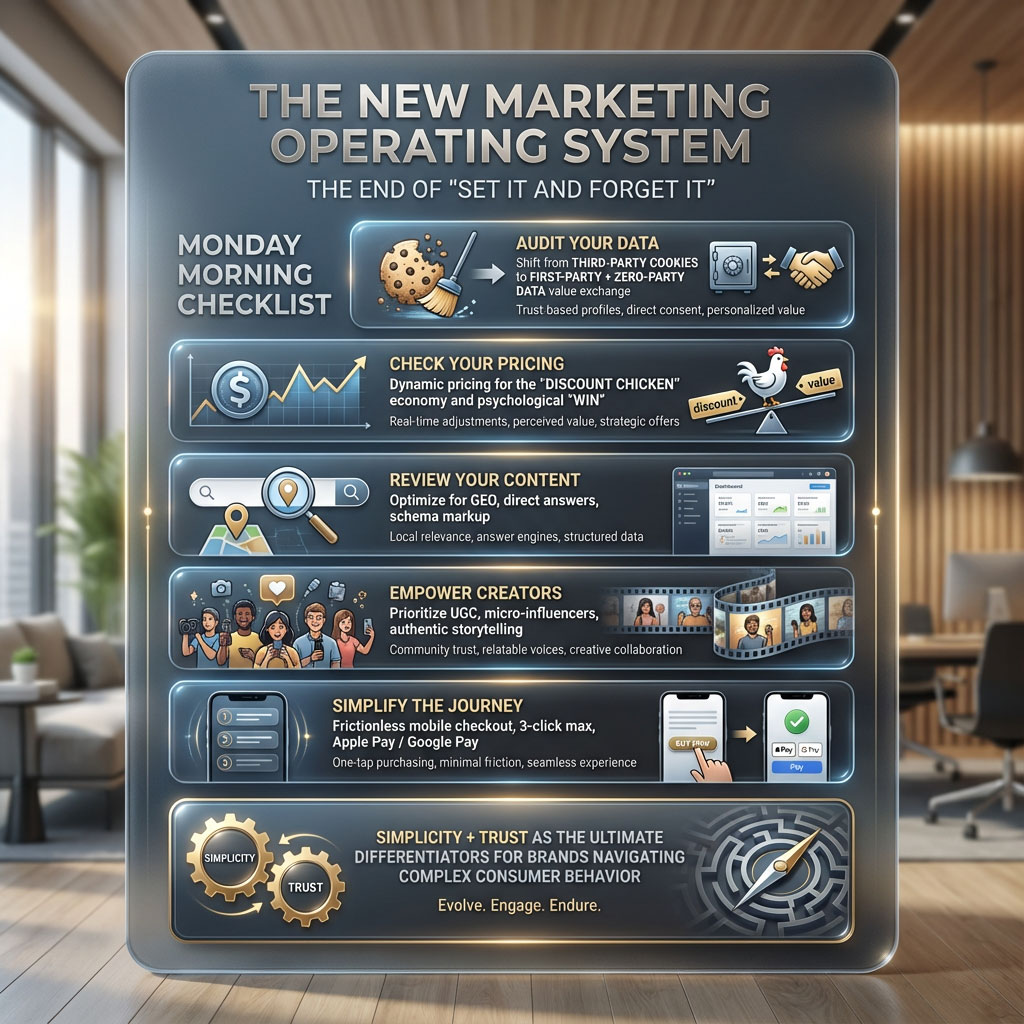
The Monday Morning Checklist:
- Audit Your Data: Are you still reliant on third-party cookies? If so, begin your first-party data strategy implementation immediately. Create a value exchange plan to collect zero-party data.
- Check Your Pricing: Is your pricing static? Investigate dynamic pricing tools to compete in the “discount chicken” economy without sacrificing margin. Ensure your pricing strategy accounts for the psychological “win” the customer needs.
- Review Your Content: Is your content optimized for Generative Engine Optimization (GEO)? Ensure you are answering questions directly to appear in AI results. Add schema markup to all product pages.
- Empower Creators: Shift budget from polished ads to User-Generated Content. Let your customers tell your story. Identify micro-influencers who align with your brand values and give them creative freedom.
- Simplify the Journey: Audit your mobile checkout flow. If it takes more than three clicks to buy, you are losing the impulse purchaser. Implement digital wallets (Apple Pay, Google Pay) immediately.
The brands that win in this new era will not just sell products. They will solve the decision paralysis caused by information overload. They will use consumer behavior impact on marketing strategies to create seamless, intuitive, and valuable experiences. They will understand that in a world of infinite choice, the ultimate luxury is simplicity and trust.
Frequently Asked Questions (FAQs)
How does consumer behavior influence marketing strategy today?
Consumer behavior now drives strategy through data. Marketers must use real-time behavioral signals (clicks, dwell time, cart abandonment) to adjust pricing, messaging, and channels instantly. The shift to value-based spending and privacy concerns forces a move to first-party data and dynamic pricing models.
What is the impact of inflation on US buyer psychology?
Inflation has created a “bifurcation” in the market. Mass-market consumers are “trading down” to private labels and delaying purchases until promotions appear, while wealthy consumers continue luxury spending. This forces brands to adopt tiered pricing strategies to serve both segments effectively.
Why is First-Party Data essential for modern marketing?
With privacy laws tightening and third-party cookies disappearing, first-party data is the only legal way to build the hyper-personalized experiences that increase conversion rates. It builds a direct asset that the brand owns, reducing reliance on “rented land” like Meta or Google ads.
What is Generative Engine Optimization (GEO)?
GEO is the evolution of SEO. It involves optimizing content to be cited by AI search engines like ChatGPT and Google Gemini. It focuses on providing direct, authoritative answers and structured data rather than just including keywords for traditional search links.
How do Gen Z shopping habits differ from Millennials?
Gen Z uses social media (TikTok/Instagram) as their primary search engine rather than Google. They prefer authentic User-Generated Content (UGC) over polished ads and are more likely to make impulse purchases directly within social apps via social commerce features.
What is the “trade-down” effect in retail?
The “trade-down” effect occurs when consumers switch from premium name brands to cheaper alternatives, such as store brands or private labels, to save money while maintaining their consumption levels. This is a dominant trend among price-conscious consumers in the US.
How can AI tools help analyze consumer behavior?
AI tools analyze vast amounts of data to identify patterns humans miss. They can predict “churn” (when a customer is about to leave), recommend products based on “lookalike” audiences, and optimize pricing in real-time based on competitor data and demand.
What is the role of social commerce in the US market?
Social commerce reduces friction in the buying process. By allowing users to discover and purchase products without leaving an app like TikTok or Instagram, brands can capture sales at the moment of discovery, capitalizing on high-intent impulses.
How do “buycotts” affect brand loyalty?
“Buycotts” are the opposite of boycotts; consumers intentionally support brands that align with their political or social values. In the US, this has become a powerful tool for building deep loyalty among specific values-driven demographics, though it risks alienating opposing groups.
Why is omnichannel marketing crucial for retention?
Omnichannel marketing ensures a seamless experience across mobile, desktop, and physical stores. Data shows that customers who engage across multiple channels have a 30% higher lifetime value than single-channel shoppers because the brand is always accessible and convenient.
How does price sensitivity impact holiday marketing strategies?
High price sensitivity means shoppers start researching early (October) but wait for “peak deals” (Black Friday/Cyber Monday) to buy. Marketers must balance early awareness campaigns with aggressive, targeted offers late in the season to convert these “wait-and-see” shoppers.
What are the best tools for tracking consumer trends?
Top tools for tracking behavior include Google Trends for search interest, McKinsey ConsumerWise for macro-economic sentiment, Salesforce CDP for individual customer data, and Adobe Analytics for real-time website behavior tracking.
Disclaimer: This article provides strategic insights into marketing and consumer behavior. Market trends are volatile and subject to change. Readers should conduct their own due diligence before implementing significant financial or operational changes based on this information.
References
- McKinsey & Company. “ConsumerWise: State of the Consumer Reports.”
- Deloitte. “Holiday Retail Survey: The Value Shift.”
- PwC. “Voice of the Consumer Survey: Trust and Personalization.”
- Adobe. “The Future of Digital Experience: AI and Personalization Reports.”
- Washington Post. “The Economics of Values-Driven Buying in the USA.”