









To build a strategic content plan for SEO growth, prioritize a Topic Cluster and Pillar Page architecture to establish topical authority. Implement an AI-assisted production workflow with Human-in-the-Loop (HITL) editing to maintain quality standards while increasing content velocity. Leverage Programmatic SEO for long-tail query dominance and utilize Content Decay remediation to refresh existing assets. Finally, optimize all content for Zero-Click results and Answer Engine Optimization (AEO) to capture traffic from AI overviews.
Search behavior has fundamentally shifted. We are currently witnessing approximately 16.4 billion daily searches globally. The sheer volume of information being queried is staggering, yet the opportunity for organic capture has never been more nuanced. The barrier to entry in digital marketing is no longer production capacity; anyone can generate text. The new barrier is architectural integrity and signal quality. Most enterprise marketing teams fail at SEO not because they lack writers or budget. They fail because they treat content creation as a series of linear tasks rather than an exponential ecosystem.
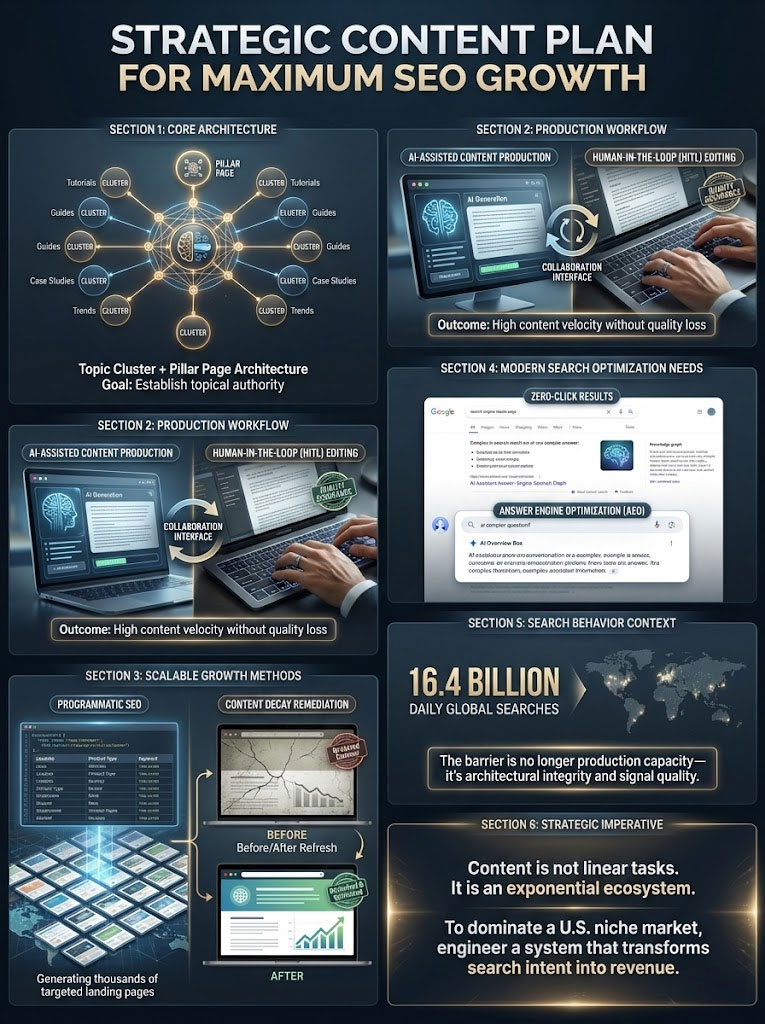
If your objective is to dominate a market niche in the United States, you cannot simply write more blog posts. You must engineer a system that transforms search intent into revenue. This guide details exactly how to build a strategic plan to scale content for maximum SEO growth without sacrificing the quality signals search engines demand. We will dismantle the traditional editorial calendar and replace it with a scale content strategy driven by semantic data, automation, and human expertise.
The Core Concept: Moving From “Blogging” to “Media Scaling”
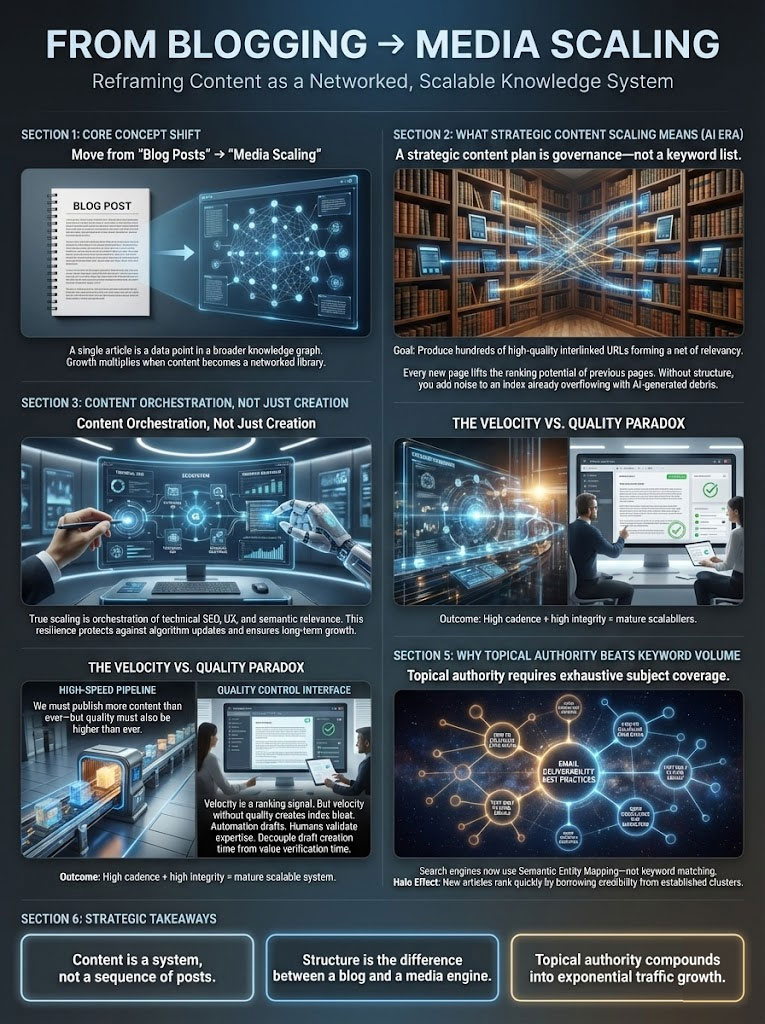
Scaling is effectively an operations challenge. It requires a fundamental shift in how you view a piece of content. A single article is no longer a standalone asset; it is a data point within a broader knowledge graph that defines your brand’s expertise. When you stop viewing content as individual posts and start viewing it as a networked library, your potential for growth multiplies.
Defining Strategic Content Scaling in the Age of AI
A strategic content plan for SEO growth is not merely a list of keywords to write next month. It is a governance model. It dictates how you will produce hundreds of high-quality URLs that interlink to form a net of relevancy.
The difference between a blog and a media engine is structure. When you execute a proper SEO content scaling plan, you are building a library where every new page lifts the ranking potential of the pages that came before it. This compounding effect is the only way to achieve exponential traffic growth. Without this plan, you are simply adding noise to an index that is already overflowing with AI-generated debris.
True scaling requires a shift in mindset from “creation” to “orchestration.” You are not just creating words; you are orchestrating a complex interplay of technical SEO, user experience, and semantic relevance. This orchestration ensures that your content ecosystem is resilient against algorithm updates and capable of sustaining long-term organic growth.
The Velocity vs. Quality Paradox
There is a natural tension between content velocity and quality. In the past, increasing velocity usually meant hiring more junior writers, which often diluted the brand voice and factual accuracy. Today, the equation has changed.
We now face a paradox where we must produce more content than ever to cover the expanding long-tail of search, yet that content must demonstrate higher “Experience” and “Expertise” than ever before to survive scrutiny.
Recent data suggests that content velocity, the rate at which you publish high-quality pages, is a direct ranking signal for freshness and authority. However, velocity without quality leads to “index bloat.” This happens when you publish thin content that Google refuses to index or rank. A robust content production workflow solves this by using automation for the heavy lifting and humans for the high-value signaling.
The goal is to decouple the time it takes to produce a draft from the time it takes to verify its value. By doing so, you can maintain a high publishing cadence without compromising the integrity of your information. This balance is the hallmark of a mature scale content strategy.
Why Topical Authority Wins Over Keyword Volume
Search engines have moved beyond simple keyword matching. They now rely on Semantic Entity Mapping. This means Google looks at your site to see if you are an authority on a “Topic,” not just a “Keyword.”
To achieve topical authority, you must cover a subject exhaustively. If you are a SaaS company selling email marketing software, you cannot just rank for “best email tool.” You must also answer “how to calculate open rates,” “email deliverability best practices,” “text-only vs HTML emails,” and “GDPR compliance for marketers.”
When you achieve true topical authority, your strategic content plan for SEO growth pays dividends. You will find that new articles rank on Page 1 almost immediately after publishing because they are borrowing credibility from your existing cluster of content. This phenomenon is often referred to as the “halo effect” of SEO. By establishing dominance in the core concepts of your industry, you signal to search algorithms that your domain is a trusted source of information, thereby reducing the friction for ranking new content.
The Architecture: Topic Clusters and Semantic Mapping
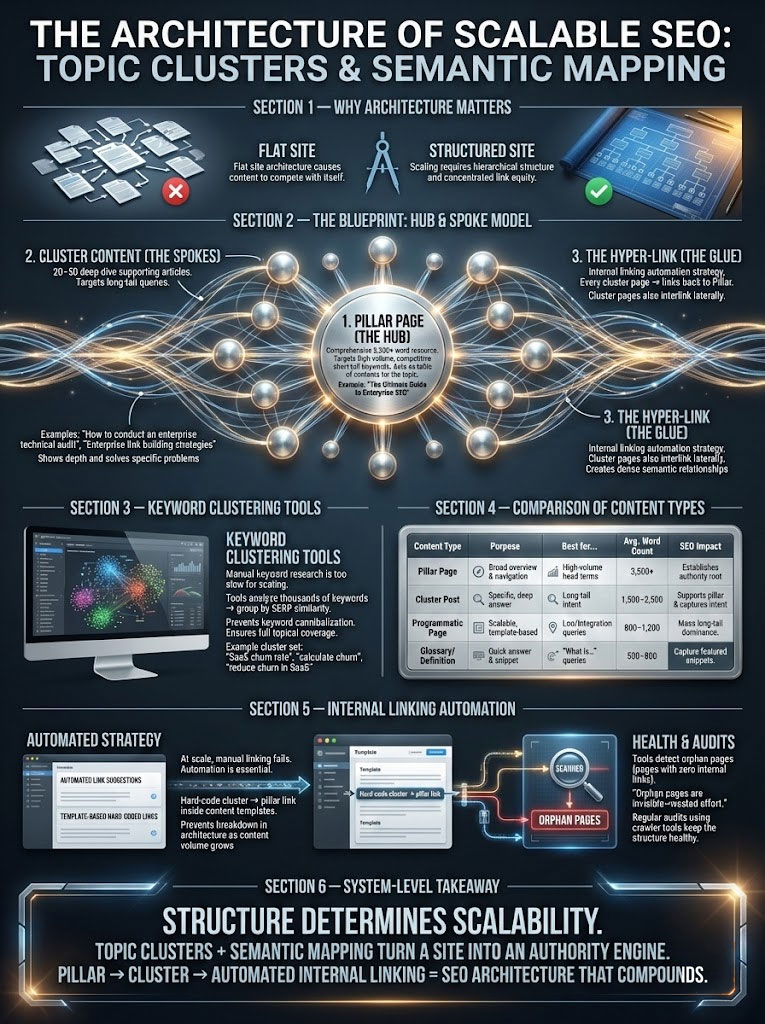
Before you write a single word, you must build the blueprints. The most common failure point in a scale content strategy is a flat site architecture. Without a hierarchical structure, your content competes against itself, and link equity is diluted across thousands of disconnected pages.
The Blueprint: Pillar Pages and Topic Clusters
The most effective structure for scaling is the “Hub and Spoke” model. This involves three distinct layers of content that work in unison to signal authority.
1. The Pillar Page (The Hub)
This is a comprehensive resource, usually over 3,500 words, that covers a broad topic at a high level. It targets high-volume, competitive short-tail keywords. For example, “The Ultimate Guide to Enterprise SEO.” This page serves as the entry point for the topic. It introduces the core concepts but links out to specific sub-pages for deeper analysis. The Pillar Page is your “table of contents” for the subject matter.
2. The Cluster Content (The Spokes)
These are 20 to 50 supporting articles that dive deep into specific sub-topics mentioned in the pillar. They target long-tail keywords. For example, “How to conduct an enterprise technical audit” or “Enterprise link building strategies.” These pages are where you demonstrate depth. They answer specific questions and solve specific problems. Collectively, they support the broad claims made on the Pillar Page.
3. The Hyper-Link (The Glue)
This is the internal linking automation strategy. Every cluster page must link back to the Pillar page. This concentrates PageRank equity back to your most valuable asset. Additionally, cluster pages should link to one another where relevant, creating a dense web of semantic connections. This structure helps search engine crawlers understand the relationship between pages and creates a seamless user journey.
Using Keyword Clustering Tools
Manual keyword research is too slow for scaling. You need to use topic clusters tools like Ahrefs, Semrush, or Keyword Insights. These tools analyze thousands of keywords and group them based on SERP similarity.
This process, known as keyword clustering, prevents cannibalization. It ensures you do not write two articles that compete for the same ranking. By grouping these keywords, you create a content roadmap that mathematically guarantees you are covering the entire search landscape of your niche.
For instance, if your keyword research reveals “SaaS churn rate,” “calculate churn,” and “reduce churn in SaaS,” a clustering tool will tell you if these should be one article or three separate ones based on what Google is currently ranking. This data-driven approach removes the guesswork from your SEO content scaling plan.
Below is a comparison of the different content types you will deploy in your strategy:
| Content Type | Purpose | Best for… | Avg. Word Count | SEO Impact |
| Pillar Page | Broad overview & navigation | High-volume “Head” terms | 3,500+ | Establishes Authority Root |
| Cluster Post | Specific, deep answer | Long-tail, specific intent | 1,500 – 2,500 | Support Pillar & Capture Intent |
| Programmatic Page | Scalable, template-based | Location/Integration queries | 800 – 1,200 | Mass Long-Tail Dominance |
| Glossary/Definition | Quick answer & snippet | “What is…” queries | 500 – 800 | Capture Featured Snippets |
Integrating Internal Linking Automation
As you execute your strategic content plan for SEO growth, managing links becomes difficult. If you have 500 articles, ensuring the right anchors connect to the right pillars is a logistical nightmare.
Advanced teams use internal linking automation scripts or plugins to suggest relevant connections. However, the most critical links, those from the cluster to the pillar, should be hard-coded into your content templates. This ensures that no matter how fast you scale, your architecture remains intact.
For example, your “Cluster Post” template should explicitly include a section in the introduction or conclusion that references the “Pillar Page.” This guarantees that the link equity flows upwards, reinforcing the authority of your primary keyword targets. Furthermore, automating the detection of “orphan pages” (pages with no internal links) is essential. An orphan page is invisible to users and crawlers; it is wasted effort. Regular audits using tools like Screaming Frog can identify these gaps, allowing you to re-integrate them into your cluster structure.
The Engine: AI-Powered Production Workflows
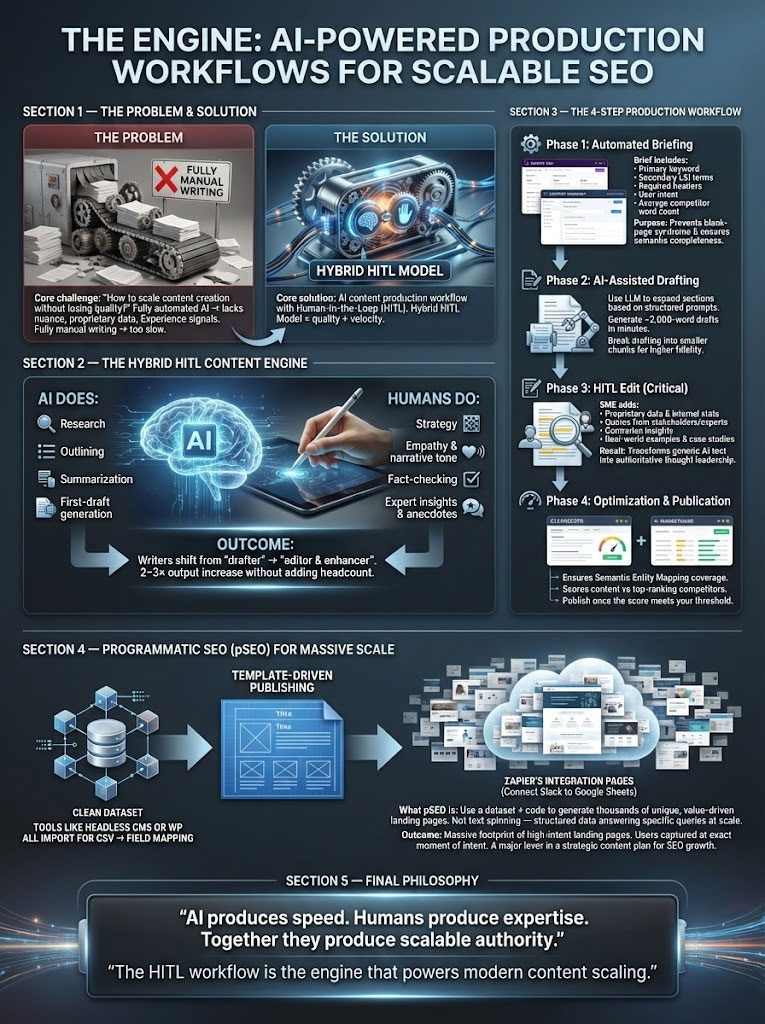
Once the map is drawn, you need an engine to drive the car. The query “how to scale content creation without losing quality” is the primary concern for modern Directors of Content. The answer is an AI content production workflow that centers on human oversight.
Building a “Human-in-the-Loop” (HITL) Content Engine
Fully automated AI content rarely ranks for competitive terms long-term. It lacks the nuance, proprietary data, and “Experience” signals that Google demands. However, fully manual writing is too slow to compete on velocity.
The solution is a Hybrid HITL model. In this content production workflow, AI is used for the tasks that computers are good at: research, outlining, summarization, and first-draft generation. Humans are used for what they are good at: strategy, empathy, fact-checking, and inserting expert anecdotes.
This model transforms the writer’s role from “drafter” to “editor and enhancer.” Instead of spending four hours staring at a blinking cursor, the writer spends two hours refining a structured draft, adding interviews, and ensuring the tone matches the brand guidelines. This effectively doubles or triples output capacity without hiring additional headcount.
The 4-Step Production Workflow
To operationalize your scale content strategy, implement this standard operating procedure. This workflow ensures consistency and quality across hundreds of articles.
Phase 1: Automated Briefing
Never let a writer start from a blank page. Use tools like Surfer SEO or Content Harmony to generate a data-driven brief. This brief should list the primary keyword, secondary LSI terms, required headers, user intent analysis, and the average word count of the top 10 competitors. This ensures the output is SEO-native from the start. A good brief serves as the guardrails for both the AI and the human writer, preventing scope creep and ensuring semantic completeness.
Phase 2: AI-Assisted Drafting
Use an LLM (Large Language Model) to generate the initial structure and prose. This is where AI content production shines. You can use prompt engineering to feed the brief into the AI and get a 2,000-word draft in minutes. The key here is not to ask the AI to “write a blog post.” Instead, ask it to “expand on Section 2 using these specific data points.” Breaking the drafting process into smaller chunks yields higher quality output.
Phase 3: The HITL Edit (Crucial)
This is where quality is applied. A subject matter expert must review the AI draft. They are not checking for grammar; they are checking for truth. They must add:
- Original data or internal statistics that AI cannot access.
- Quotes from internal stakeholders or industry experts.
- Nuanced takes that contradict the generic consensus found in the training data.
- Real-world instances or case studies that demonstrate first-hand experience.
This step is what separates “content” from “thought leadership.” It is the difference between a generic Wikipedia summary and a strategic guide that drives conversions.
Phase 4: Optimization and Publication
Finally, run the content through an optimization tool like Clearscope or MarketMuse. This checks for Semantic Entity Mapping and ensures you haven’t missed any critical topics. These tools score your content against the current top-ranking results, providing a mathematical probability of ranking success. Once the score meets your threshold, the content is ready for final formatting and publication.
Programmatic SEO (pSEO) for Massive Scale
For certain business models, even a hybrid editorial team is too slow. If you need to create 10,000 pages, you need a programmatic SEO strategy.
Programmatic SEO involves creating a database of information and using code to spin up thousands of unique landing pages. This is not about spinning text; it is about structuring valuable data to answer specific queries at scale.
Instance: Consider Zapier. They did not manually write a blog post for “Connect Slack to Google Sheets” and another for “Connect Slack to Trello.” They built a programmatic SEO strategy. They have a database of apps and integration capabilities. They used templates to generate landing pages for every possible combination of apps. This allowed them to rank for hundreds of thousands of high-intent keywords with a single architectural move.
To execute this, you need a clean dataset. If your data is messy, your content will be spam. But if your data is valuable, pSEO is the ultimate lever for a strategic content plan for SEO growth. The technical implementation usually involves a Headless CMS or a tool like WP All Import, which maps columns in a CSV file to fields in a webpage template. The result is a massive footprint of highly relevant landing pages that capture users at the exact moment of intent.
Future-Proofing: Optimization for AEO and Zero-Click
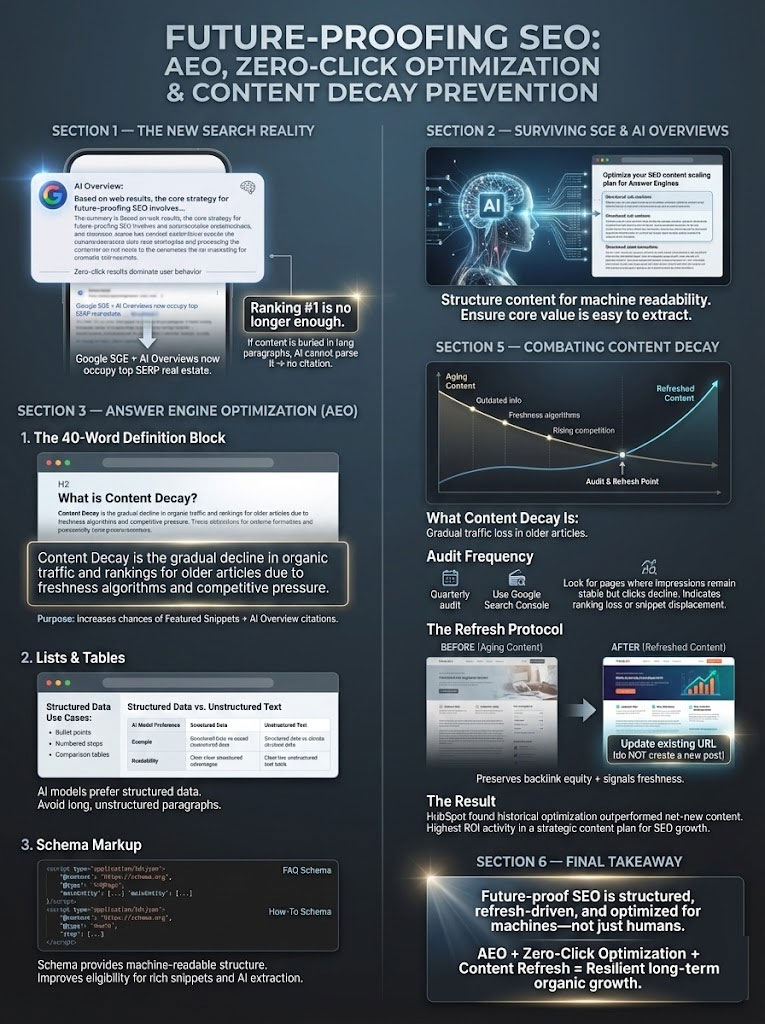
Ranking #1 is no longer the only goal. In many cases, the user never leaves the search results page. This is the era of Zero-click results optimization.
Surviving the SERP Shift: Zero-Click and AI Overviews
With the rollout of Google Search Generative Experience (SGE) and AI Overviews, the top of the SERP is often occupied by an AI-generated summary. If your content is buried in long paragraphs, the AI cannot parse it, and you will not be cited.
To adapt your SEO content scaling plan, you must optimize for the “Answer Engine.” This means structuring your content so that machines can easily read, understand, and extract the core value.
Implementing Answer Engine Optimization (AEO)
Answer Engine Optimization (AEO) requires a specific formatting style that prioritizes clarity and structure over flowery prose.
The 40-Word Definition
Immediately after a Header (H2), provide a direct, concise answer to the question in the header. Use bold text for the core concept. This “definition block” increases the chances of your content being pulled into a Featured Snippet or an AI summary. For example, if the header is “What is Content Decay?”, the very next sentence should be “Content Decay is the gradual decline in organic traffic and rankings for older articles due to freshness algorithms and competitive pressure.”
Lists and Tables
AI models love structured data. Use bullet points and markdown tables frequently. If you are comparing two software tools, do not write five paragraphs of text. Create a comparison table. If you are listing steps in a process, use a numbered list. This structure signals to the search engine that the content is highly organized and valuable.
Schema Markup
Wrap your content in FAQ Schema or How-To Schema. This gives search engines a code-level understanding of your content structure. While invisible to the human reader, Schema Markup is a powerful signal that helps search engines categorize and display your content in rich snippets.
By optimizing for AEO, you increase the likelihood of appearing in the “Featured Snippet” or the AI Overview citation. This is often the only way to drive visibility for informational queries in the modern search landscape.
Combating Content Decay
As you scale, you will face a silent killer: Content Decay. This happens when your older articles slowly lose traffic because they become outdated or competitive intensity increases.
A robust strategic content plan for SEO growth includes a “Refresh Protocol.” You cannot simply publish and forget. You must manage the lifecycle of your content.
Audit Frequency
Every quarter, use Google Search Console to identify pages where impressions are stable but clicks are dropping. This divergence usually indicates that you are losing ranking positions or that a competitor has won the Featured Snippet.
The Refresh
Do not write a new post. Update the existing URL. Update the year in the title. Add new statistics. Refresh the examples. Add a new section covering a recent industry development. By keeping the same URL, you preserve the existing backlink equity while signaling freshness to Google.
The Result
HubSpot famously found that historical optimization of old posts generated more traffic gains than net new content. Remediating content decay is the highest ROI activity in SEO because the asset already exists; it just needs polishing.
Team & Resource Structure
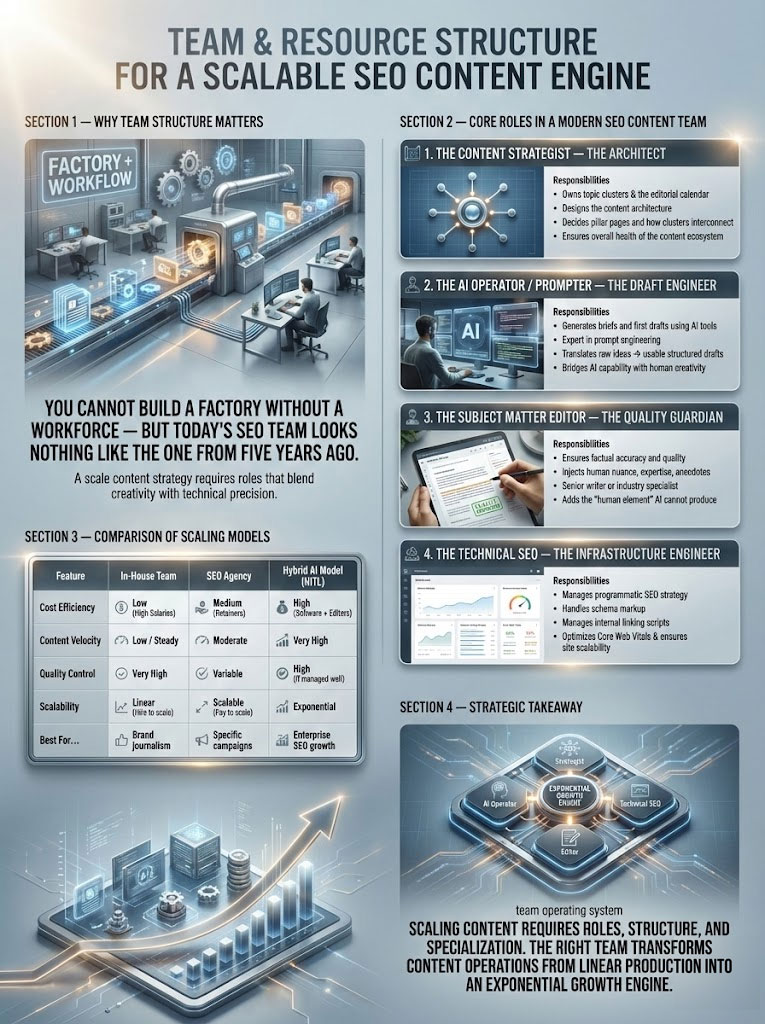
You cannot build a factory without a workforce. However, the structure of a modern SEO team looks very different from five years ago.
Structuring Your SEO Content Team for Scale
To execute a scale content strategy, you need specific roles that blend creative skill with technical aptitude.
The Content Strategist
This person owns the topic clusters and the calendar. They are the architect. They decide which pillars to build and how the clusters connect. They are responsible for the overall “health” of the content ecosystem.
The AI Operator/Prompter
A new role in the industry. This person generates the briefs and the first drafts using AI tools. They are experts in prompt engineering and understand how to get the best output from LLMs. They bridge the gap between the raw idea and the working draft.
The Subject Matter Editor
The guardian of quality. They ensure compliance with quality standards. They are likely a senior writer or an industry expert who can spot a factual error from a mile away. Their job is to inject the “human element” that AI misses.
The Technical SEO
Manages the programmatic SEO strategy and site health. They handle the schema markup, the internal linking scripts, and the Core Web Vitals. They ensure the infrastructure can support the weight of the new content.
Below is a comparison of different scaling models to help you decide how to resource your SEO content scaling plan:
| Feature | In-House Team | SEO Agency | Hybrid AI Model (HITL) |
| Cost Efficiency | Low (High Salaries) | Medium (Retainers) | High (Software + Editors) |
| Content Velocity | Low/Steady | Moderate | Very High |
| Quality Control | Very High | Variable | High (If managed well) |
| Scalability | Linear (Hire to scale) | Scalable (Pay to scale) | Exponential |
| Best For… | Brand journalism | specific campaigns | Enterprise SEO growth |
Measurement: ROI and Key Metrics
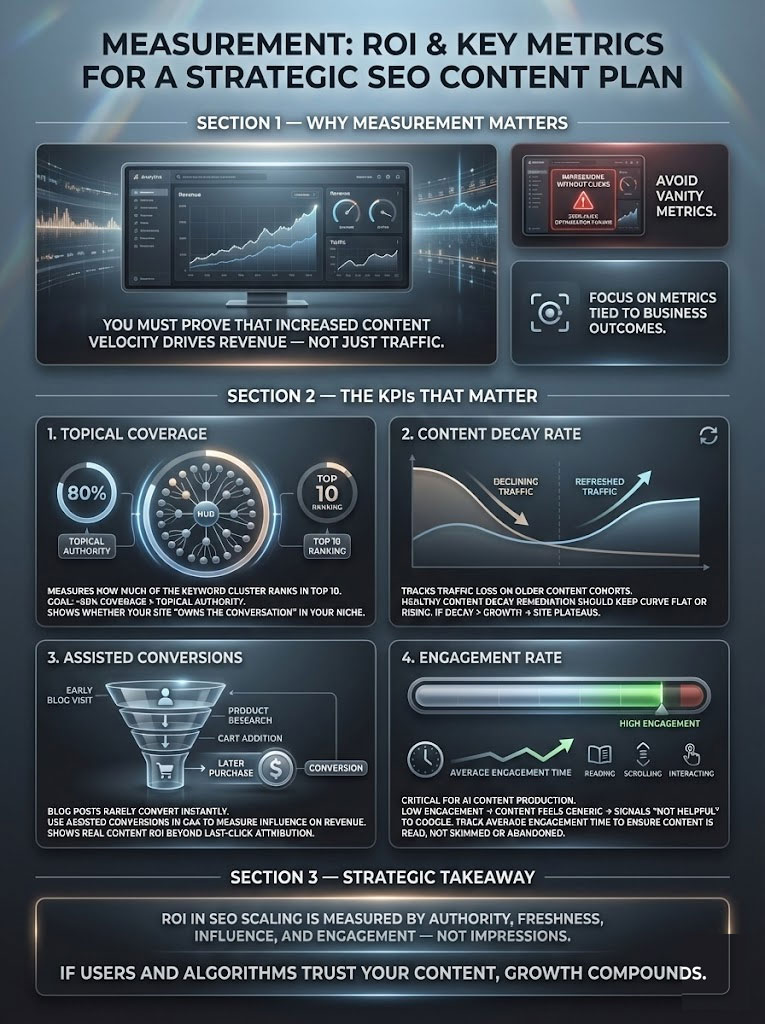
The final piece of your strategic content plan for SEO growth is measurement. You must prove that the increase in content velocity is driving revenue, not just traffic.
Measuring ROI from Scaling SEO Content
Do not get distracted by “Vanity Metrics” like gross impressions. High impressions with low clicks usually indicate a failure in Zero-click results optimization. You need metrics that tie to business outcomes.
The KPIs That Matter
1. Topical Coverage
Are you ranking for the entire cluster? Use your SEO tool to track the percentage of keywords in a cluster where you rank in the Top 10. If you have 80% coverage, you have achieved topical authority. This metric tells you if you “own” the conversation in your niche.
2. Content Decay Rate
Track the velocity of traffic loss on older cohorts of content. A successful content decay remediation strategy should keep this curve flat or upward. If your decay rate exceeds your new growth rate, your site will plateau.
3. Assisted Conversions
Blog posts rarely generate immediate sales. A user reads a post about “SEO Strategy,” leaves, and returns two weeks later to buy software. Use the “Assisted Conversions” report in GA4. This shows you how many users read a blog post early in their journey and then converted later. This is the true measure of Content ROI measurement.
4. Engagement Rate
For AI content production, you must monitor engagement. If users are bouncing immediately, your content may be too generic. Low engagement signals to Google that the content is not helpful, which will eventually hurt your rankings. Track “Average Engagement Time” to ensure users are actually reading the content you are scaling.
Summary & Key Takeaways
Building a strategic content plan for SEO growth is an exercise in discipline and architecture. The era of random acts of content is over. To win in the current landscape, you must adopt a systems-thinking approach.
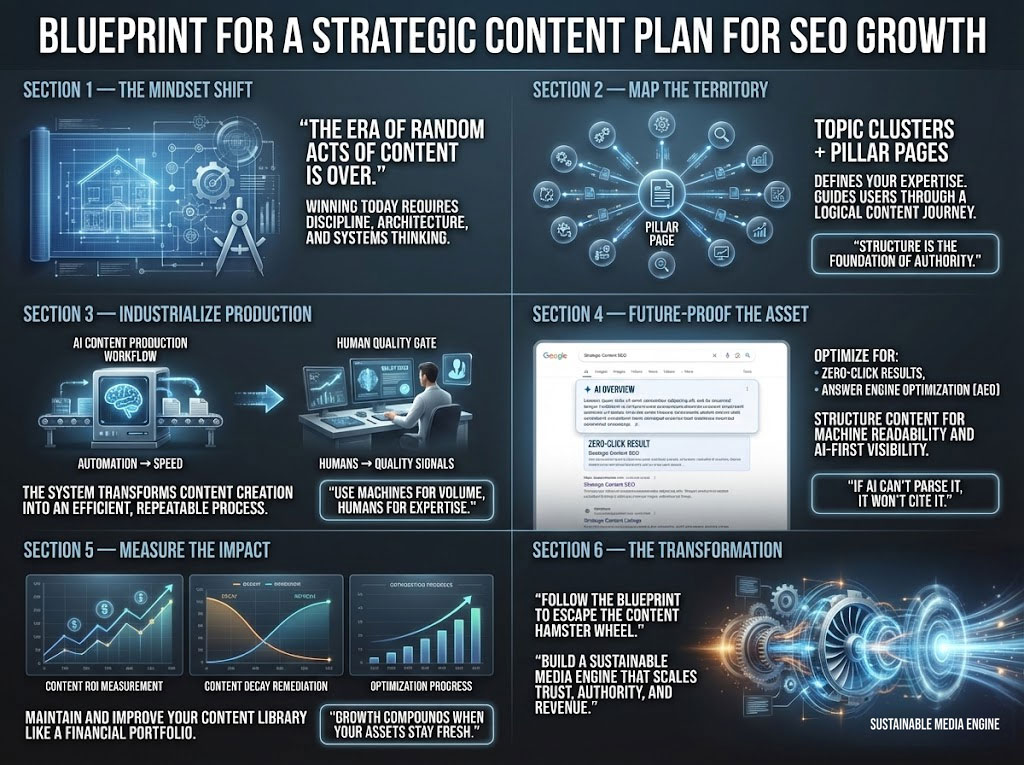
- Map the Territory: Use topic clusters and pillar pages to define your expertise and guide your users through a logical journey.
- Industrialize Production: Build an AI content production workflow that leverages automation for speed and humans for quality signals.
- Future-Proof the Asset: Optimize every pixel for Zero-click results and Answer Engine Optimization (AEO) to remain visible in an AI-first world.
- Measure the Impact: Focus on Content ROI measurement and content decay remediation to keep your asset library appreciating in value like a financial portfolio.
By following this blueprint, you move away from the frantic pace of the hamster wheel and into the sustainable growth of a media engine. This is how you scale trust, authority, and revenue in the modern search landscape.
Frequently Asked Questions (FAQ)
What is the most effective strategic content plan for SEO growth?
The most effective plan combines a Topic Cluster architecture with an AI-assisted, human-edited production workflow. This approach allows you to build Topical Authority rapidly by covering broad subjects with Pillar pages and specific queries with Cluster content, all while maintaining high quality through expert review.
How does a scale content strategy differ from traditional blogging?
A scale content strategy focuses on “Content Velocity” and “Semantic Coverage” rather than individual posts. It treats content as a connected ecosystem designed to dominate entire search categories, whereas traditional blogging often focuses on linear, date-based publishing without architectural interlinking.
How can I use an AI content production workflow without being penalized?
To use AI safely, adopt a “Human-in-the-Loop” (HITL) methodology. Use AI for research, outlining, and drafting, but ensure a human expert reviews every piece for accuracy, tone, and unique insights. This infuses the content with the quality signals that search algorithms require.
Why is Topical Authority critical for an SEO content scaling plan?
Topical Authority signals to search engines that your site is a trusted expert on a specific subject. When you cover a topic exhaustively through interlinked content, search engines are more likely to rank your new pages quickly because they inherit the trust established by your existing library of related content.
What is Programmatic SEO and when should I use it?
Programmatic SEO involves using code and datasets to automatically generate landing pages at scale. It is best used when you have structured data, such as location details, product integrations, or comparative specs, that can populate templates to answer thousands of specific long-tail queries.
How do I optimize for Zero-Click results optimization?
To optimize for Zero-Click results, structure your content to answer questions directly and concisely. Place a direct answer of 40 to 60 words immediately after a relevant heading. Use structured formats like bullet points, numbered lists, and tables, which are easier for algorithms to parse and display.
How do I fix Content Decay remediation?
Fix Content Decay by regularly auditing your older content via Google Search Console to find pages with declining traffic. Refresh these pages by updating the data, improving the depth of the content, adding new FAQs, and updating the “Last Modified” date. This often yields a higher ROI than creating new content.
What role does Internal Linking Automation play in scaling?
Internal linking automation helps maintain site structure as you scale to hundreds or thousands of pages. Tools can suggest relevant links, ensuring that your Cluster content always points back to your Pillar pages. This preserves the flow of authority throughout your site without requiring manual management of every link.
How do I measure Content ROI measurement effectively?
Measure ROI by looking beyond simple traffic numbers. Track “Assisted Conversions” in Google Analytics 4 to see how content contributes to the buyer’s journey. Also, monitor “Topical Coverage” and the cost-per-acquisition reduction that comes from organic traffic growth.
What is the ideal Content Velocity for a new site?
There is no single magic number, but consistency is key. A “Content Sprint” strategy, publishing 20 to 30 interconnected articles in a short period, is often more effective for establishing initial authority than drip-feeding one article a week. However, never prioritize velocity over the quality standards required by search engines.
How do quality signals impact my SEO content scaling plan?
Quality signals act as a filter. If you scale content that lacks expertise or trust, search engines may classify it as low-value. Your plan must include steps for expert review and authorship verification to ensure your scaled content satisfies these quality requirements.
Can I use AI for Answer Engine Optimization (AEO)?
Yes, AI tools are excellent for AEO. You can prompt AI to summarize your complex paragraphs into concise, snippet-ready definitions. However, a human should verify these summaries to ensure they are factually watertight, as errors in Featured Snippets can severely damage user trust.
Disclaimer: The strategies outlined in this guide regarding SEO, AI tools, and search engine algorithms are based on current industry best practices and the search landscape as of late 2025. Search engine algorithms are proprietary and subject to change without notice. Results from implementing these strategies may vary based on your specific industry, domain authority, and execution.