









The primary difference between SEO and GEO is the end goal. SEO optimizes content to rank on a search engine results page (SERP) to drive clicks. In contrast, GEO optimizes content to be cited and synthesized by AI engines like SearchGPT and Gemini, focusing on authority and relevance to capture visibility in a zero-click environment.
Table of Contents
The Era of the Answer Engine
The decade of chasing ten blue links is effectively over. For twenty years, the contract between a user and a search engine was simple: the user types a query, and the engine provides a list of options. The user does the heavy lifting of clicking, reading, and synthesizing information. That model is obsolete.
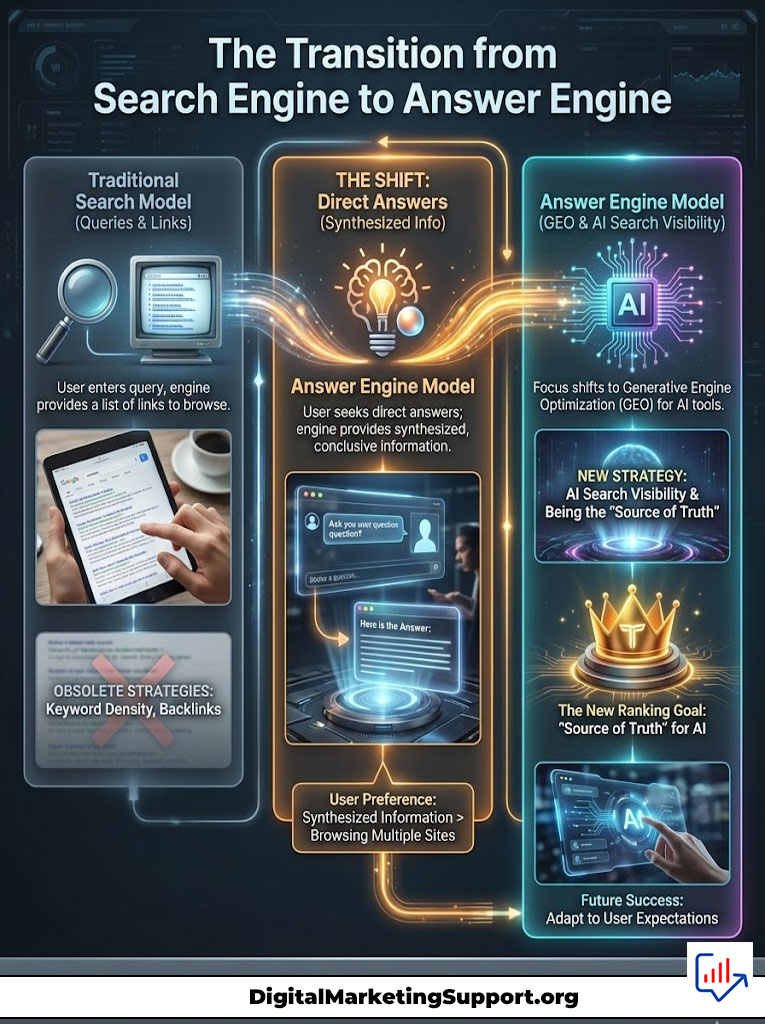
We have moved from the “Search Engine” to the “Answer Engine.” Users in the USA no longer want a list of websites; they want a direct, synthesized answer. This shift has birthed GEO vs SEO as the primary debate in boardrooms across the country. Generative Engine Optimization (GEO) is not just a buzzword; it is the survival mechanism for brands in 2026.
If your strategy is still solely focused on traditional keyword density and backlink volume, you are optimizing for a ghost town. The traffic is there, but the clicks are gone. The new battleground is AI Search Visibility, where success is not measured by ranking position #1, but by being the single “Source of Truth” cited by SearchGPT and Google Gemini.
The Evolution of Search: From Blue Links to Answer Engines
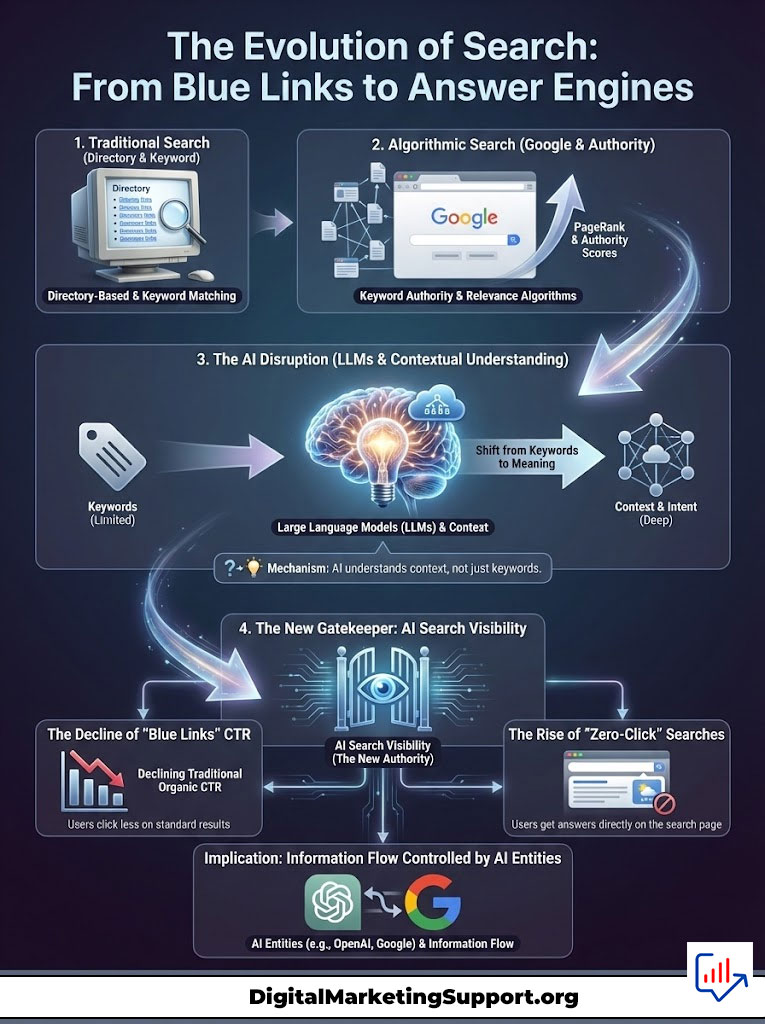
Search has always been about retrieval. In the early 2000s, it was directory-based. Then came the algorithmic era of Google, where links and keywords dictated authority. Now, we face the third and most disruptive phase: the age of Large Language Models (LLMs).
The Mechanism of Disruption
Traditional search engines indexed the web. They created a map. SearchGPT and similar platforms read the web. They understand the territory. When a user asks a complex question, the AI doesn’t just look for matching keywords. It reads millions of pages, understands the context, and generates a novel answer.
This is where the concept of AI Search Visibility becomes critical. The AI is the gatekeeper. It decides which information is factually accurate enough to present to the user.
The Data Reality
Recent industry data indicates a sharp decline in traditional organic Click-Through Rates (CTR) for informational queries. In the USA, “Zero-Click” searches have surpassed 60% for specific verticals. This isn’t because people aren’t searching. It is because Google Gemini and other AI overlays are answering the question before the user ever sees a website link.
The entities controlling this flow—OpenAI, Perplexity AI, and Google—prioritize direct answers. If your brand is not structured to feed these engines, you simply do not exist in the answer layer.
Core Concepts: Defining GEO vs SEO in 2026
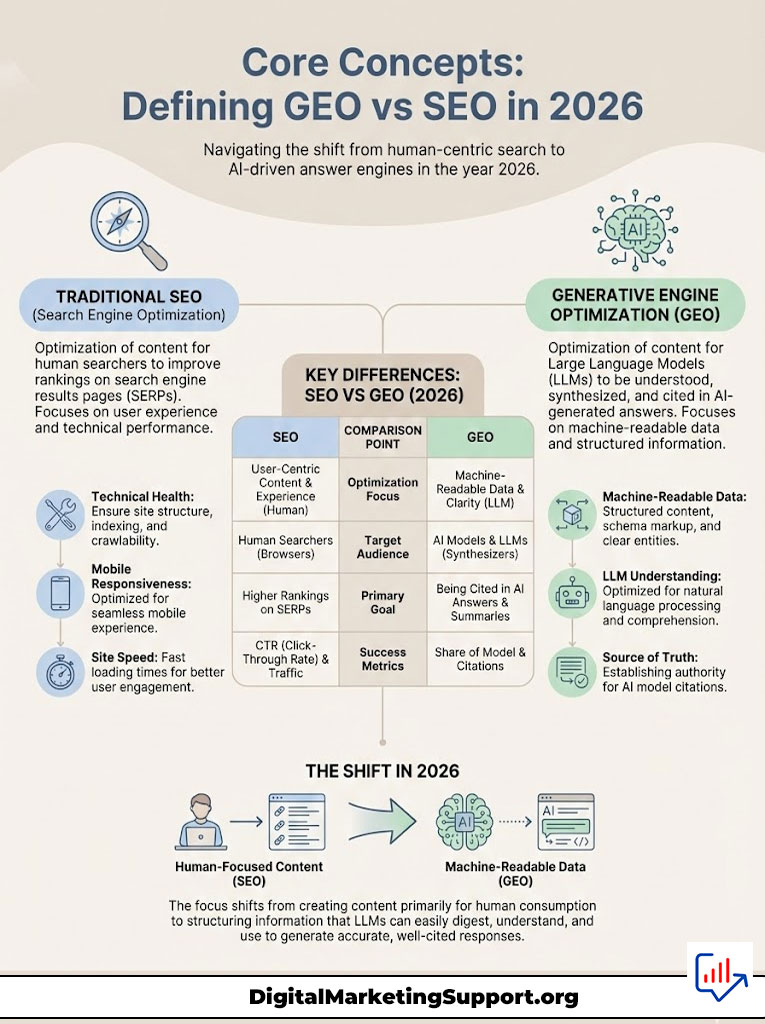
To navigate the 2026 Strategy Shift, we must clearly define the separation between the old world and the new. GEO vs SEO is not a binary choice where one dies and the other lives; it is a layering of strategies.
What Remains of Traditional SEO?
SEO is the foundation. An AI bot must still be able to crawl your site. Technical health, mobile responsiveness, and site speed remain non-negotiable. If Google Gemini cannot access your code, it cannot read your content. However, traditional SEO stops at the ranking. It assumes the user will click.
What is Generative Engine Optimization (GEO)?
Generative Engine Optimization (GEO) is the art of training the AI on your brand. It focuses on how Large Language Models (LLMs) perceive your content’s quality and accuracy.
In a GEO strategy, you are not writing for a human to read a 2,000-word intro. You are writing for a machine to extract a specific fact. You are optimizing for Retrieval-Augmented Generation (RAG), ensuring your content is the most logical piece of data for the AI to fetch.
SEO vs. GEO: The Strategic Divergence
| Feature | Traditional SEO | Generative Engine Optimization (GEO) |
| Primary Goal | Rank #1 on SERP Blue Links | Be the Cited Source in AI Answers |
| Success Metric | Click-Through Rate (CTR) & Traffic | Share of Model (SoM) & Citations |
| Content Focus | Keyword Density & Search Intent | Information Density & Authoritative Fluency |
| User Interaction | User clicks to read more | User reads answer on the platform (Zero-Click) |
| Key Tactic | Backlinks & On-Page Optimization | Entity Associations & Statistical Proof Points |
| Target Audience | The Human Searcher | The Large Language Model (LLM) |
The Science Behind GEO: How AI Search Engines “Think”
Understanding GEO vs SEO requires looking under the hood of the technology. AI engines do not “think” like humans, nor do they “index” like old Google bots. They operate on probability and retrieval.

Retrieval-Augmented Generation (RAG) Explained
Retrieval-Augmented Generation (RAG) is the backbone of modern search. When a user queries SearchGPT, the model does not rely solely on its training data, which might be outdated. It reaches out to the live web to “retrieve” current information.
This implies a massive shift for content creators. Your content must be “fetch-ready.” It needs to be the easiest, most accurate data point for the RAG system to grab. If your answer is buried under five paragraphs of fluff, the RAG system will skip you and fetch a competitor’s concise answer.
The Role of Natural Language Processing (NLP)
Natural Language Processing (NLP) allows engines to understand intent. In the past, you needed to type “best running shoes men 2026.” Now, you ask, “What are the best running shoes for a marathon if I have flat feet?”
The engine looks for semantic relationships. It looks for content that connects “flat feet,” “marathon,” and “shoe stability.” Generative Engine Optimization (GEO) demands that you cover these semantic clusters deeply rather than just repeating the primary keyword.
Understanding the “Black Box” of Rankings
We now have data on what makes AI tick. A landmark study from researchers at Princeton, Georgia Tech, and IIT Delhi shed light on Generative Engine Optimization (GEO). They tested different content modifications to see what influenced AI visibility.
The findings were clear. Adding relevant citations and quotations from trusted sources improved AI Search Visibility by up to 40%. The AI interprets citations as a signal of verification. It trusts content that trusts others.
Furthermore, the study highlighted “Fluency Optimization.” Content that was easier to read but rich in facts outperformed complex, academic text. The AI prefers clarity.
The 2026 Strategy Shift: Why You Must Pivot Now
The pivot to Generative Engine Optimization (GEO) is driven by user behavior. The patience for browsing is gone.

The Decline of the Click
The “Zero-Click” reality is the single biggest threat to traditional publishers. When a user asks Google Gemini, “How do I fix a leaking faucet?”, the AI provides a step-by-step guide. The user fixes the faucet. No website is visited. No ad is viewed.
However, the AI must get that step-by-step guide from somewhere. In a Zero-Click Search Strategy, your goal is to be the brand mentioned in that summary: “According to [Your Brand], step one is…”
This brand impression is the new click. It builds trust. The next time that user needs a plumber or a wrench, they recall the brand that gave them the answer.
Trust and Authority as the Ultimate Gatekeeper
In the GEO vs SEO landscape, trust is a technical metric. Google Knowledge Graph acts as a verification layer. If Google does not understand who you are as an Entity, it will rarely cite you.
High-quality AI Search Visibility is reserved for domains that demonstrate immense expertise. The AI evaluates your entire digital footprint. If you claim to be a medical expert but have no citations from medical journals or associations, the Large Language Models (LLMs) will classify you as a hallucination risk and suppress your content.
Practical Strategies for Generative Engine Optimization
To win in 2026, you need a tactical overhaul. You must write for the machine that serves the human.

Optimizing for “Citation Boost”
The most powerful lever in Generative Engine Optimization (GEO) is the citation. You must become a hub of data.
Strategy: Do not just write opinions. Publish proprietary data. If you are a marketing agency, release a report on “Ad Spend Trends 2026.” When you provide unique statistics, SearchGPT and Perplexity AI are forced to cite you because you are the primary source of that data.
Implementation: Update your old blog posts. Add specific statistics. Link to high-authority external sources (government sites, educational institutions) to create a “neighborhood of trust” around your content.
Structuring for Machines: Schema and Formatting
Schema Markup is the language of the Google Knowledge Graph. It is no longer optional. You must use structured data to explicitly tell the AI what your content is.
Use Article, FAQPage, and Person schema. But go deeper. Use mentions schema to link your content to other known entities.
Formatting Tip: AI models digest bullet points and numbered lists faster than dense paragraphs. Look at this article. It uses short paragraphs and clear headers. This is optimized for Retrieval-Augmented Generation (RAG).
The Power of “Authoritative Language”
Authoritative Language is a ranking factor in GEO. The Princeton study confirmed that “persuasive” and “confident” text ranks higher.
Eliminate weak phrases like “We believe,” “It is possible that,” or “In our opinion.” Replace them with “Data shows,” “The evidence confirms,” or “Analysis indicates.”
Generative Engine Optimization (GEO) rewards assertiveness. If you sound unsure, the AI will not risk citing you as a fact.
Comparison: Writing for Humans vs. AI + Humans
| Element | Old Way (SEO Writing) | New Way (GEO Writing) |
| Structure | Long intros to keep time-on-page | BLUF (Bottom Line Up Front) for instant retrieval |
| Keywords | Repetitive placement for density | Semantic variations & LSI for context |
| Complexity | Simple language (Grade 6 level) | High fluency & technical accuracy (Expert level) |
| Data Usage | Vague claims (“Many people say…”) | Specific stats (“74% of users prefer…”) |
| Tone | Passive and descriptive | Active, authoritative, and decisive |
Building Topical Authority in the Age of AI
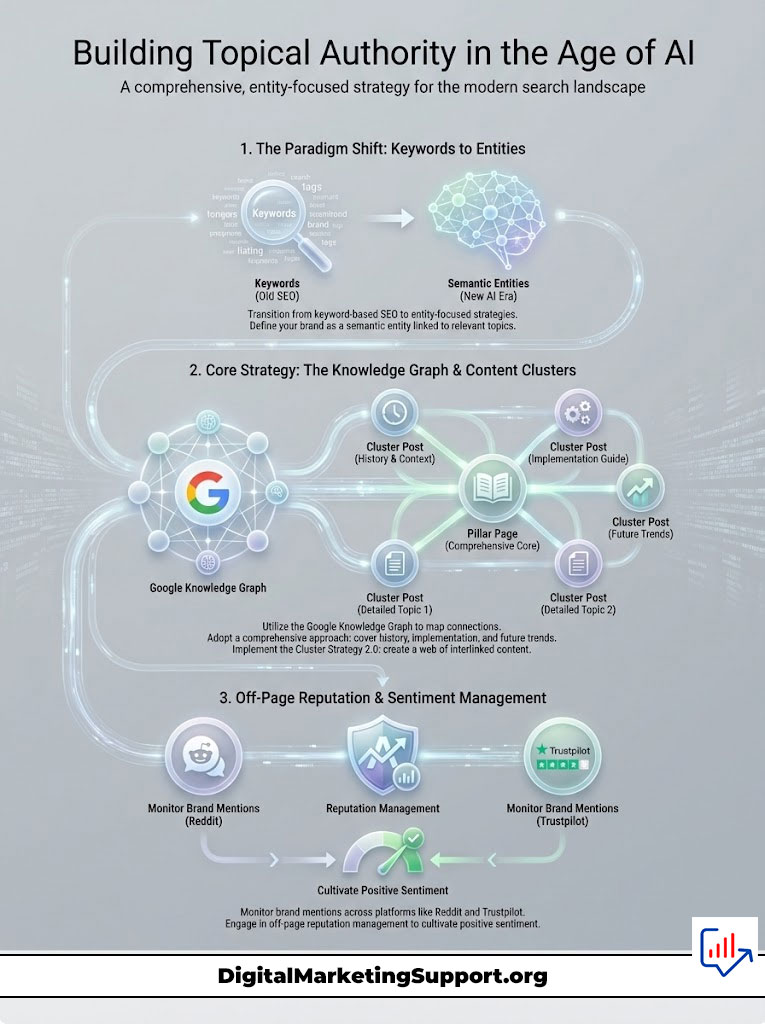
You cannot trick an LLM. You can only convince it of your expertise. This requires a shift from keyword hunting to entity building.
Moving from Keywords to Entities
In traditional SEO, you targeted “best CRM software.” In GEO vs SEO, you must establish your brand as an Entity that is semantically linked to “Customer Relationship Management.”
The Google Knowledge Graph maps these connections. You build this by covering the topic exhaustively. You do not just write about the software; you write about the history of CRM, the technical implementation, the API integrations, and the future trends.
The Cluster Strategy 2.0
Your content must form a dense web of information. Generative Engine Optimization (GEO) favors sites that cover a topic from every angle.
If SearchGPT receives a multi-part question, it looks for a domain that can answer all parts. If your site has a “pillar page” supported by twenty detailed “cluster posts,” the AI sees you as a comprehensive resource. This increases your AI Search Visibility significantly.
Brand Mentions and Sentiment Analysis
The AI reads the whole web. It reads Reddit. It reads news forums. It reads Trustpilot.
Your Generative Engine Optimization (GEO) strategy must include off-page reputation management. If users on Reddit consistently describe your brand as “unreliable,” the sentiment analysis in the LLM will associate your brand entity with “unreliable.” This creates a ceiling on your visibility. You must actively cultivate positive brand mentions across the web.
Case Studies and Proof Points
Let us look at how this applies in the real world. These examples demonstrate the power of GEO vs SEO in action.
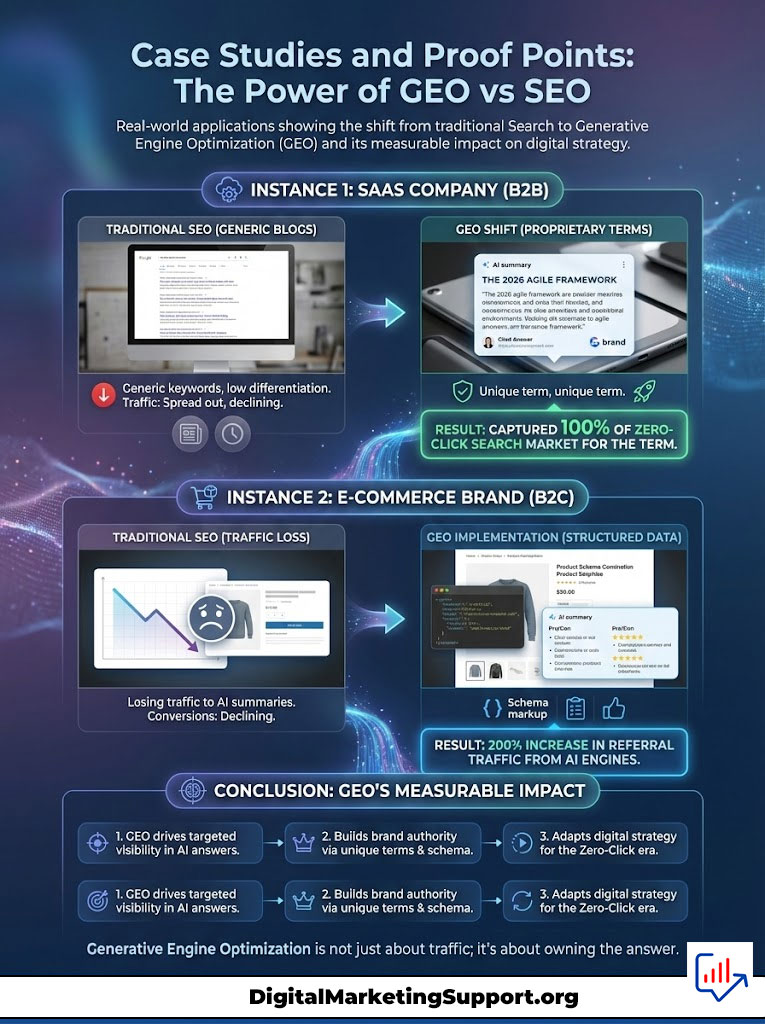
Instance 1: SaaS Company (B2B)
A leading project management SaaS company stopped writing generic “How to manage time” blogs. Instead, they focused on defining proprietary industry terms. They created a definitive guide called ” The 2026 Agile Framework.”
The Action: They used Authoritative Language and included unique survey data from their user base.
The Result: Within three months, Google Gemini began citing their definition when users asked, “What is the modern agile framework?” They captured 100% of the Zero-Click Search Strategy market share for that term.
Instance 2: E-commerce Brand (B2C)
A running shoe retailer realized they were losing traffic to AI summaries. They implemented extensive Product Schema and “Pro/Con” summaries at the top of every product page.
The Action: They rewrote descriptions to focus on Information Density, removing marketing fluff.
The Result: Perplexity AI started pulling their “Pro/Con” lists directly into its shopping recommendations. Their referral traffic from AI engines increased by 200%, compensating for the loss in traditional organic clicks.
These instances prove that Generative Engine Optimization (GEO) is not theoretical. It is measurable.
Measuring Success: KPIs for the New Era
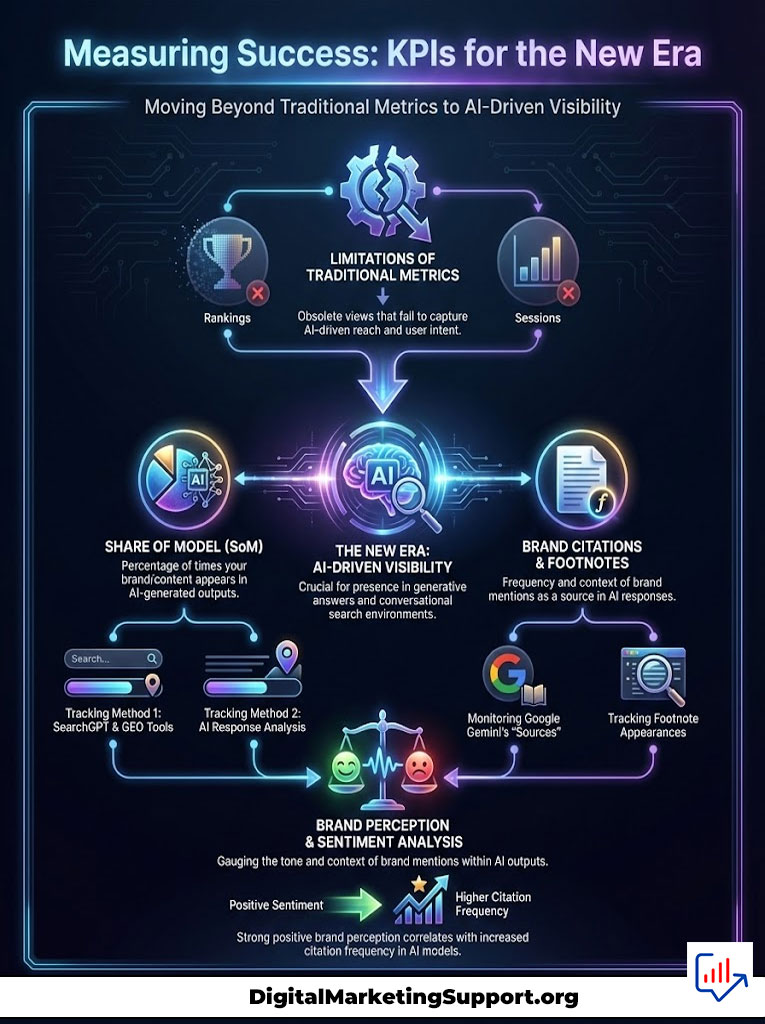
The old dashboard of “Rankings” and “Sessions” is insufficient for GEO vs SEO. You need new metrics.
Beyond Rank Tracking
Ranking #1 is irrelevant if the AI Overview answers the question without showing your link. You might be technically #1, but practically invisible.
New Metrics to Watch
Share of Model (SoM): This is the new Share of Voice. It measures how frequently your brand is cited in AI responses for your core keywords. You can track this by manually querying SearchGPT or using emerging GEO tracking tools.
Brand Citations: Monitor how often your brand name appears in the “Sources” footnote of Google Gemini.
Sentiment Score: Use NLP tools to analyze the sentiment of the text surrounding your brand mentions. Positive sentiment correlates with higher citation frequency.
Future-Proofing: The Road Beyond 2026
The shift to Generative Engine Optimization (GEO) is just the beginning. The technology is accelerating.
Multimodal Search (Video and Image)
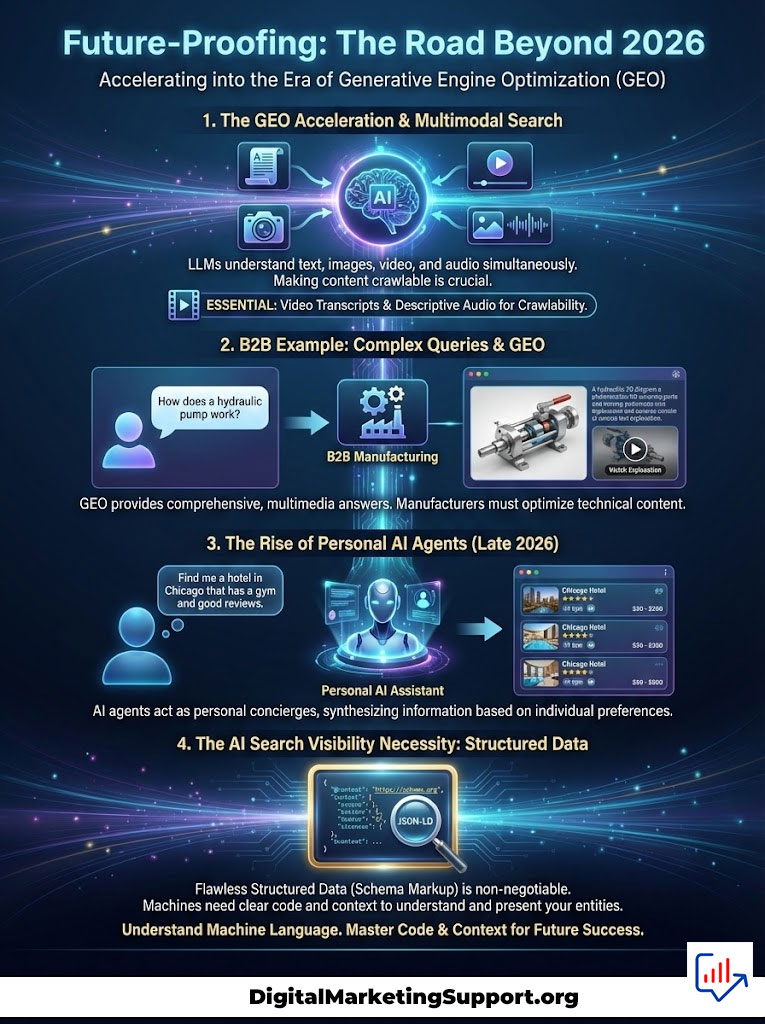
Large Language Models (LLMs) are becoming multimodal. They can “watch” video and “see” images. If you are a B2B manufacturer, your YouTube videos are now crawlable content.
Your strategy must include clear transcripts and descriptive audio. If a user asks, “How does a hydraulic pump work?”, the AI might pull the answer from the transcript of your technical video.
Voice and Personal Agents
By late 2026, users will rely heavily on personal AI agents. They will say, “Find me a hotel in Chicago that has a gym and good reviews.” The agent will query the web.
To be the chosen hotel, your structured data must be flawless. Your AI Search Visibility depends on your ability to speak the machine’s language through code and context.
Summary & Key Takeaways
The transition from GEO vs SEO is the defining challenge for marketers in the USA. We are moving from a world of keywords and clicks to a world of entities and citations.

Generative Engine Optimization (GEO) requires a fundamental shift in mindset. You are no longer trying to trick an algorithm; you are trying to educate an artificial intelligence.
Key Action Items:
- Prioritize Information Density: Remove the fluff. Give the answer immediately.
- Leverage RAG: Structure your content so it is easily retrievable by AI bots.
- Build Entity Authority: Use Schema and consistent branding to cement your place in the Google Knowledge Graph.
- Own the Data: Publish original statistics to secure the Citation Boost.
The brands that embrace AI Search Visibility today will own the narrative of tomorrow. The blue links are fading. The answer is everything.
Frequently Asked Questions (FAQ)
What is the core difference between SEO and GEO in 2026?
The core difference lies in the objective. SEO targets ranking positions on a traditional results page to drive clicks. GEO vs SEO focuses on having your content synthesized and cited within an AI-generated answer, prioritizing brand visibility in a zero-click ecosystem.
Does Generative Engine Optimization require different tools than SEO?
Yes. While traditional tools like Semrush or Ahrefs are useful for keyword data, Generative Engine Optimization (GEO) requires tools that analyze Brand Authority, Entity sentiment, and Share of Model (SoM) inside platforms like SearchGPT.
Will AI Search replace traditional websites completely?
It is unlikely. While AI Search Visibility dominates informational queries, users still need traditional websites for transactional tasks and deep-dive research. GEO handles the “what” and “how,” while websites handle the “buy” and “sign up.”
How can small businesses compete in GEO?
Small businesses can compete by dominating a specific niche. Large Language Models (LLMs) prioritize deep expertise. A specialized boutique firm with high E-E-A-T signals can outperform a generalist giant in AI citations for specific topics.
Is keyword density still relevant for AI optimization?
No, keyword density is a legacy metric. Generative Engine Optimization (GEO) values semantic relevance and context. Repeating a keyword often makes content look low-quality to modern AI classifiers, hurting your ranking.
How does RAG technology impact content strategy?
Retrieval-Augmented Generation (RAG) means your content must be structured for machine retrieval. Use clear headings, bullet points, and schema markup to ensure the AI can easily fetch and understand your data points.
Why is “Zero-Click” optimization considered a GEO strategy?
In a zero-click world, the user gets the answer without visiting your site. Optimizing for this ensures your brand name is attached to that answer. This builds brand recall and authority, which is the primary goal of Zero-Click Search Strategy.
Can I optimize existing content for GEO?
Absolutely. You should audit your top-performing pages. Add Authoritative Language, insert proprietary statistics, remove passive voice, and ensure you have clear, direct answers to common questions at the top of the page.
What role do backlinks play in GEO?
Backlinks still signal authority, but in GEO vs SEO, “unlinked mentions” are gaining importance. AI models read the text surrounding your brand name across the web to determine your trustworthiness, even if there is no hyperlink.
How often should I update content for AI visibility?
Frequent updates are crucial. SearchGPT and Google Gemini favor fresh data. If your content cites statistics from 2023, the AI may bypass it in favor of a source with 2025/2026 data.
Is GEO more expensive than traditional SEO?
It can be more resource-intensive because it requires higher levels of expertise. You cannot outsource Generative Engine Optimization (GEO) to low-quality writers. It requires subject matter experts, which increases the cost of content production but improves ROI.
What is the first step in starting a GEO strategy?
The first step is to audit your “Brand Entity” in the Google Knowledge Graph. Search for your brand and see if Google understands who you are. If there is no Knowledge Panel, focus on Schema Markup and About Page optimization immediately.
References
- Princeton University, Georgia Tech, & IIT Delhi Study on Generative Engine Optimization (GEO).
- Search Engine Land: The Rise of Answer Engines & Zero-Click Data.
- Google Search Central: Creating Helpful Content & E-E-A-T Guidelines.