









Introduction
The era of the ten blue links is officially over. With the global rollout of Google Gemini 3.0 and the integration of Gemini 3.0 Flash as the default engine for mobile and quick interactions, we have witnessed the complete transformation of information retrieval. Users in late 2025 are no longer searching. They are asking. They demand immediate, synthesized answers delivered with the speed of Flash and the reasoning depth of Gemini 3.0 Pro. This shift has birthed a new discipline that renders traditional SEO insufficient. We now operate in the age of Generative Engine Optimization (GEO).[1][2][3]
Table of Contents
Your goal is no longer to fight for the number one position on a search result page. That metric is a relic. You are now fighting to be the primary data source for an autonomous answer engine. If your content provides unique value and possesses high AI search visibility, it becomes the voice of the artificial intelligence itself. When Gemini 3.0 answers a user, it builds that answer using facts extracted from trusted, verified sources. Your objective is to be that source.
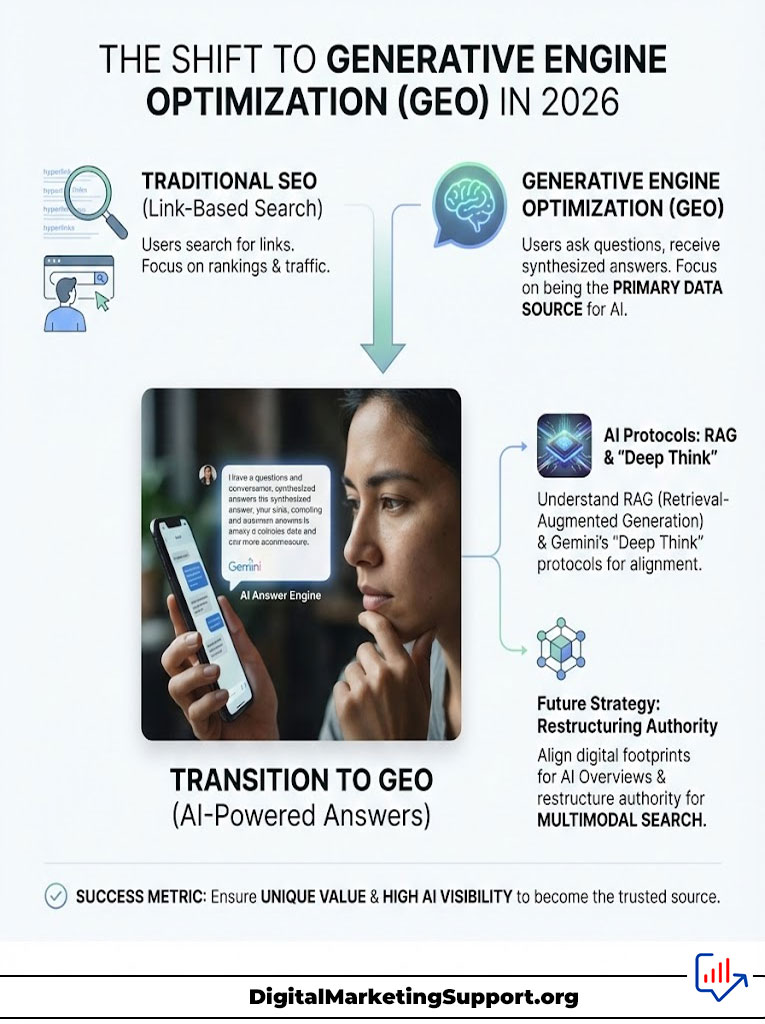
This guide is a comprehensive technical and strategic blueprint for the post-2025 search landscape. We will dismantle the mechanisms of Retrieval-Augmented Generation (RAG) in the context of Gemini 3.0. We will explore how Google Gemini citations are determined by the new “Deep Think” protocols. We will provide you with the exact methodology to align your digital footprint with the needs of Google AI Overviews ranking algorithms. This is not about gaming the system. It is about restructuring your authority to survive the transition to agentic, multimodal search.
Generative Engine Optimization in the Gemini 3.0 Era
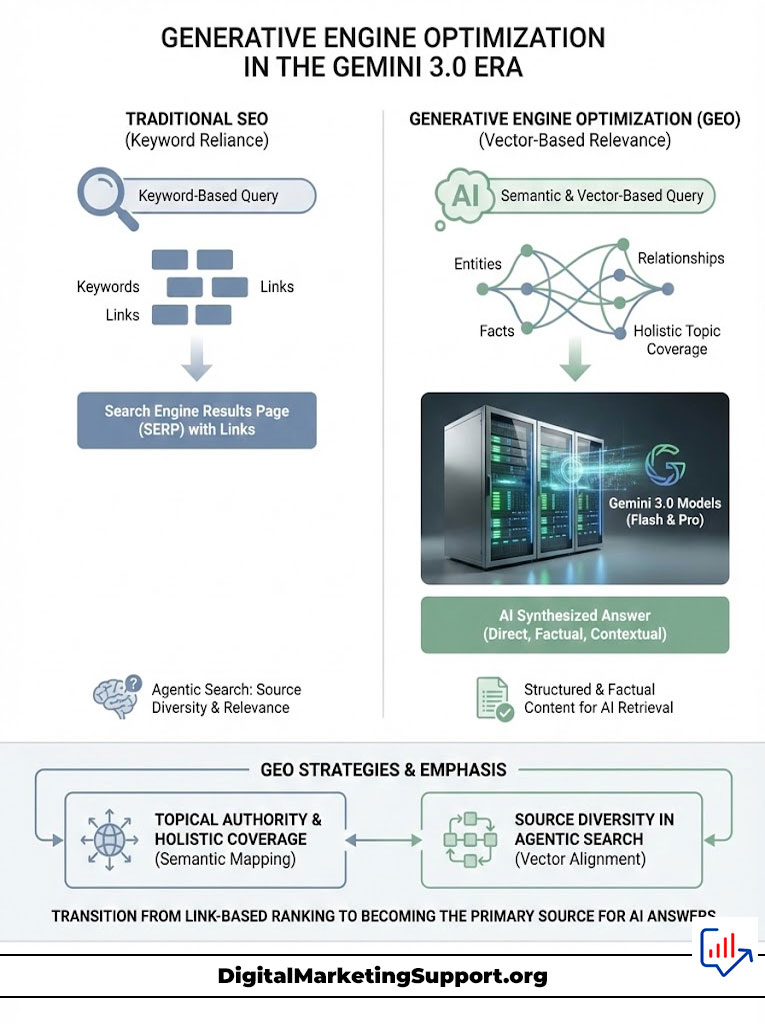
Generative Engine Optimization, or GEO, represents a fundamental pivot in digital visibility.[3] Traditional SEO focused on convincing a crawler that your page was popular via keywords and backlinks. GEO focuses on convincing a Large Language Model (LLM) that your page is factual, authoritative, and structurally sound for immediate extraction.[4] With the release of Gemini 3.0 Pro in November 2025, the bar for citation has been raised. The model now possesses “thinking” capabilities that allow it to reason through data before citing it, meaning shallow content is rejected faster than ever.
How Gemini 3.0 Flash and Pro Process Search Queries
To master Gemini AI SEO, you must understand the dual-engine architecture you are optimizing for. Google now relies on two primary models.[5] Gemini 3.0 Flash is designed for speed and high-frequency tasks.[5][6][7][8] It powers the majority of standard conversational queries. It craves concise, well-structured data that it can retrieve instantly.
On the other hand, Gemini 3.0 Pro and the “Deep Think” mode are used for complex reasoning tasks.[9] When a user asks a multi-layered question, such as comparing enterprise software solutions or diagnosing a complex technical issue, Gemini 3.0 Pro engages in iterative reasoning. It does not just match keywords. It breaks the query down into semantic logic chains. It retrieves multiple knowledge fragments. It evaluates them for consistency.
If your content is structured correctly, Gemini sees it as a perfect knowledge fragment. It retrieves your data.[10] It synthesizes your insight. It credits you as the source. This is the essence of AI search visibility. You are optimizing for retrieval ease. You are effectively making your content “machine-readable” in a way that aligns with the logical processing of the Gemini 3.0 architecture.
The Role of Source Diversity and Agentic Workflows
A common misconception is that only major publishers get cited. This is factually incorrect, especially with the 2025 updates. The Gemini 3.0 algorithm is engineered for “Source Diversity.” If every citation came from Wikipedia, the AI would lack the depth required for agentic workflows.
We are now seeing the rise of Agentic Search, where users do not just ask for information; they ask the AI to perform a task. “Plan a travel itinerary” or “Find the best coding solution for this specific error.” For these tasks, Gemini seeks out niche experts. It looks for the specific blog that knows everything about “Python error handling in 2025” rather than a general news site. This is where semantic search relevance becomes your greatest asset.
When you demonstrate deep Topical Authority, you signal to the AI that you are a subject matter expert. The model balances its citations.[2] It might pull a definition from a dictionary site. But for the detailed strategy, it looks for the practitioner. That is your opening. By dominating a specific niche, you become the most viable candidate for citations in that category.
Transitioning from Keywords to Vector-Based Relevance
Keywords are no longer the primary currency of search. Vectors are. In the world of Gemini 3.0, words are converted into mathematical vectors that represent their meaning. “Car” and “Automobile” have similar vector positions.
Gemini AI SEO requires you to think in concepts rather than strings of text. You must cover a topic holistically. If you are writing about “content marketing,” you must discuss related concepts like “audience retention” and “conversion funnels” to build a dense semantic map. This depth signals to Gemini 3.0 that your content is comprehensive. It tells the “Deep Think” mode that if it cites your page, it is retrieving a complete thought, not just a keyword match.
Comparison of Traditional SEO and Gemini 3.0 GEO Strategies
To clarify the operational differences between the old world of search and the new world of Agentic AI, we must look at the strategic divergences. The following table outlines how your strategy must evolve to meet the demands of Generative Engine Optimization in late 2025.
| Feature | Traditional SEO Strategy | Gemini 3.0 GEO Strategy |
| Primary Objective | Rank #1 in Blue Links | Be the Cited Source in AI Snapshot |
| Success Metric | Click-Through Rate & Rankings | Information Gain & Entity Verification |
| Content Structure | Long-form, skimmable text | Concise, logic-driven, structured data |
| Keyword Approach | Keyword Density & Placement | Semantic Density & Vector Alignment |
| User Intent | Navigational or Transactional | Agentic, Informational & Conversational |
| Technical Focus | Core Web Vitals & Speed | Schema Markup, Context Window Optimization |
| Authority Signal | Backlinks & Domain Rating | Knowledge Graph & Author Legitimacy |
| Reasoning Model | Keyword Matching | Deep Think Logic Chains |
Mastering E-E-A-T for the “Deep Think” Era
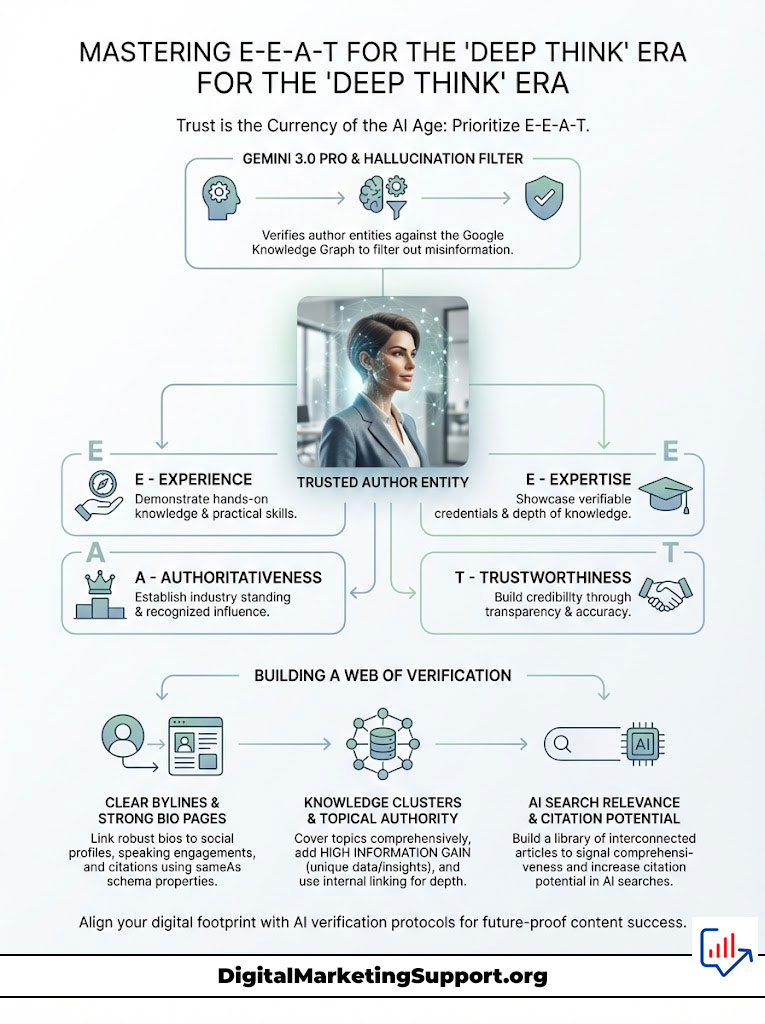
Trust is the absolute currency of the AI age. Google’s algorithms have evolved to prioritize content that demonstrates high levels of Experience, Expertise, Authoritativeness, and Trustworthiness. With Gemini 3.0 Pro’s reasoning capabilities, E-E-A-T for AI operates as a massive filter against hallucinations.
Establishing Trust Through Author Entity Verification
Hallucinations occur when an AI invents facts. To prevent this, Gemini 3.0 utilizes a rigorous verification layer.[11] It cross-references your content against known entities in the Google Knowledge Graph. It asks specific questions about the source. Who wrote this? Is this person a verified expert?
If the AI cannot verify the entity behind the content, it hesitates to cite it, especially in “Deep Think” mode where accuracy is paramount. You must make your credentials readable to the machine. This means using clear bylines on every piece of content. It means linking those bylines to robust author bio pages using sameAs schema properties.
Your bio page should be a resume of authority. It should link to your social profiles. It should list your speaking engagements. It should link to other publications where you have been cited. This creates a web of verification. When Gemini 3.0 sees that your author entity is connected to other authoritative nodes in the network, it assigns a higher trust score to your content.
Why Information Gain is Critical for Google Gemini Citations
This is the single most important metric for Generative Engine Optimization. It is called Information Gain. AI models like Gemini 3.0 Flash are trained on the entire internet. They have read everything. They do not need another article that simply restates common knowledge.
Imagine there are one hundred articles on “How to optimize for Voice Search.” Ninety-nine of them say the exact same thing. One article, however, adds a unique dataset from a 2025 study on “Agentic Voice Commands.” That article has high Information Gain.
Gemini 3.0 reads all one hundred articles. It compresses the duplicate information into a single vector. It ignores the ninety-nine copies. It highlights the one article that added something new. That article gets the citation. To achieve high Google Gemini citations, you must add original data. Run a survey. Interview an expert. Analyze a dataset. Provide a contrarian viewpoint backed by evidence.
Leveraging Niche Authority and Knowledge Clusters
Topical Authority is built through depth. Gemini 3.0 analyzes your site structure to see if you cover a topic comprehensively. This is known as a Knowledge Cluster.
If you write about “AI Marketing,” you should not just have one post. You need a cluster covering “AI Disclosures,” “Prompt Engineering,” “Agentic Workflows,” and “Ethics in AI.” You need to link these articles together in a logical way.
Internal linking connects these nodes. It tells the AI that your site is a complete library on the subject. When Gemini 3.0 Pro needs to answer a specific complex question, it prefers the library over the pamphlet. It chooses the site with deep semantic search relevance. By building these clusters, you increase the surface area for potential citations within the massive 1M+ token context window of the modern models.
Technical SEO Architecture for AI Crawlers
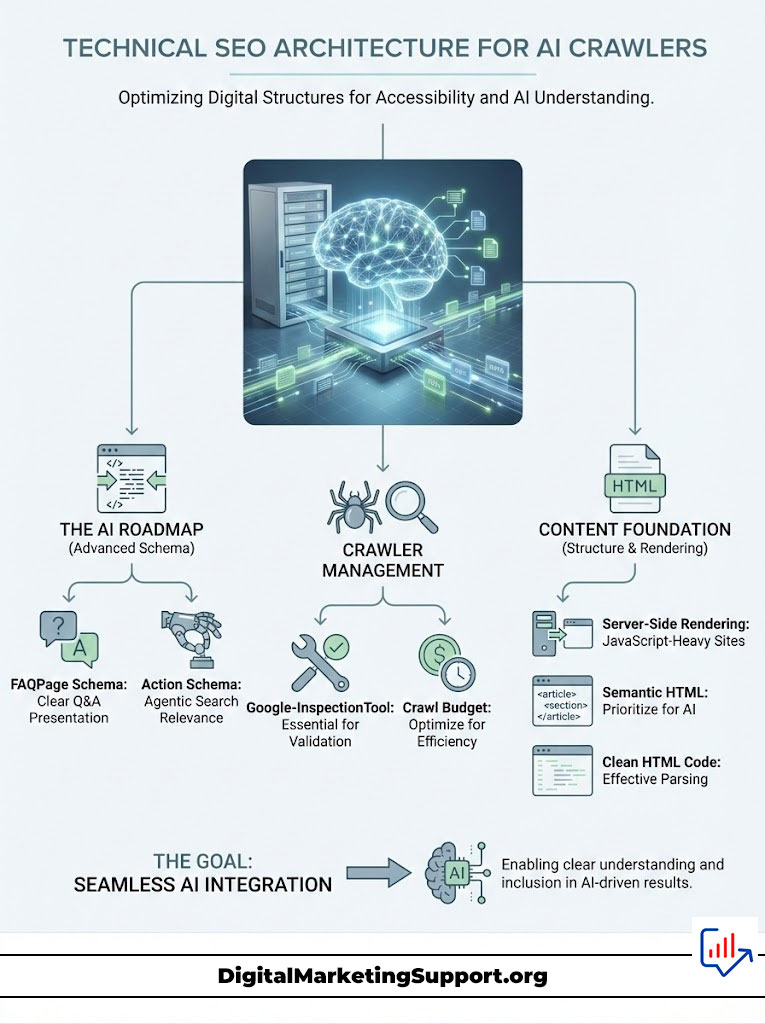
You cannot charm an algorithm with prose alone. You must speak its language. The language of Gemini AI SEO is code and structure. Your technical foundation dictates whether the AI can access, parse, and understand your content.[3]
Implementing Advanced Schema Markup for AI Agents
Schema markup for AI is not optional. It is the roadmap you hand to the crawler. Without it, the AI has to guess what your content means. With it, you are explicitly telling the AI what the content is.
You must go beyond basic article tags. You need to implement FAQPage schema to explicitly define questions and answers. This allows Gemini 3.0 Flash to pull your Q&A pairs directly into its response. It eliminates the need for the AI to parse complex paragraphs to find the answer.
With the rise of agentic search in late 2025, Action schema is becoming increasingly relevant. If your site allows users to book appointments or calculate costs, using structured data that agents can interact with is vital. Use Organization and Person schema to solidify your entity status. Use the sameAs property to link your website to your LinkedIn profile or your Wikipedia page.
Optimizing for the Google-InspectionTool and Crawl Budget
Many site owners aggressively block bots to save server resources. Do not block the Google-InspectionTool. This is the user agent used by Google to render pages for advanced analysis and training.
If your site relies heavily on JavaScript, ensure you are using server-side rendering or dynamic rendering. Retrieval-Augmented Generation (RAG) systems need to access your text content instantly. If they have to wait for a script to load, they might move on. The easier it is to fetch your content, the more likely it is to be indexed deeply.
Check your crawl stats in Google Search Console. Look for the Google-InspectionTool in the user agent breakdown. If you see errors or blocked resources, you are effectively hiding from Google AI Overviews ranking.
Using Semantic HTML and Context Window Optimization
Gemini 3.0 features a massive context window, capable of processing over one million tokens.[11][12] However, just because it can read everything doesn’t mean it will prioritize everything. You must use Semantic HTML to guide its attention.
Use H1 for your main title.[2] Use H2 for major sections. Use H3 for specific questions or steps. Do not use generic div or span tags for headings. This hierarchy helps the “Deep Think” mode understand the logical flow of your argument.
Keep your code clean. Avoid excessive wrappers that clutter the Document Object Model (DOM). The cleaner your HTML, the easier it is for Natural Language Understanding (NLU) models to parse your text. Think of your HTML as the skeleton. It needs to be strong and logical to support the muscle of your content.
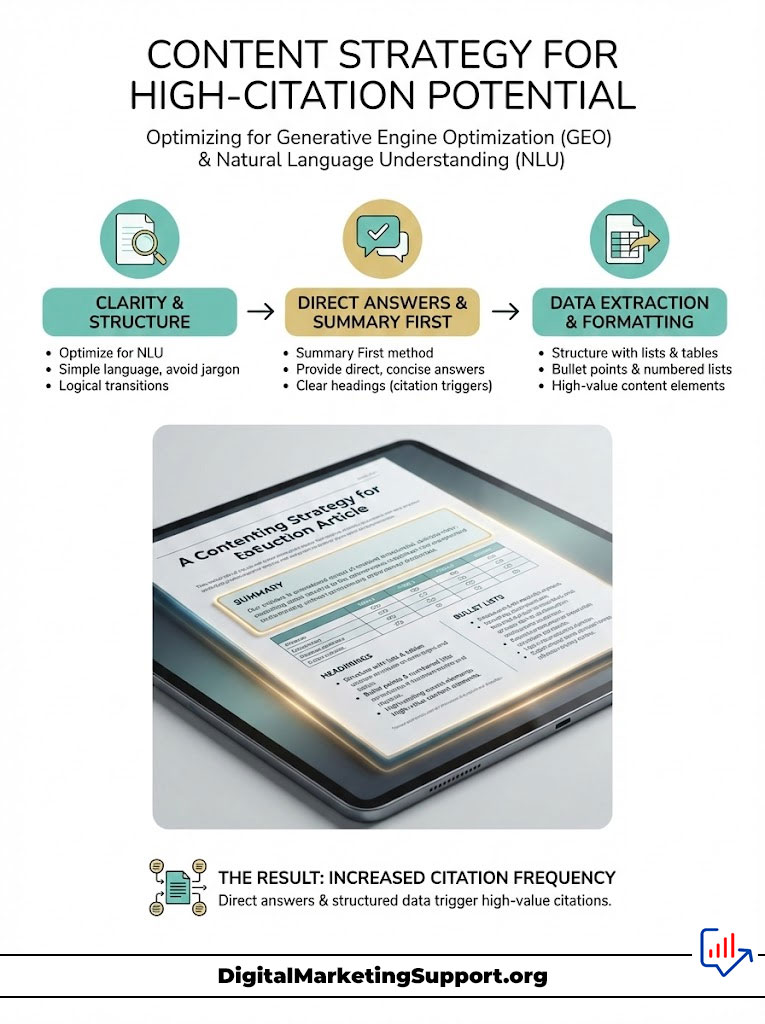
Content Strategy for High-Citation Potential
Writing for Generative Engine Optimization requires a specific style. It is less about storytelling and more about digital journalism. You are writing for a machine that values clarity above all else.
Writing for Natural Language Understanding (NLU)
Natural Language Understanding is how computers process human speech. Gemini 3.0 is a highly conversational AI. It expects input that sounds like a person asking a question. It prefers output that sounds like a person answering that question.
You need to optimize for questions. Use keyword research tools to find the long-tail questions your audience is asking.[2] Make these questions your H2 or H3 headers. Then, answer them conversationally.
Avoid jargon where simple words work. Use transition words that show cause and effect. Words like “therefore,” “because,” and “as a result” help the AI follow your logic. Semantic search relevance is built on these logical connections. If you write in a disjointed way, the AI cannot map the relationship between your concepts.
The “Summary First” Method for Direct Answer Optimization
Journalists use the “inverted pyramid” style. They put the most important facts at the top of the story. You must do the same for every section of your content.
Start every article, and every major H2 section, with a direct answer. If the header is “How to get your site cited by Gemini AI,” the very next sentence should be a definition or a direct strategy. Do not ramble. Do not clear your throat with introductory fluff.
We call this the “Summary First” rule. It creates a perfect snippet for Gemini 3.0 Flash to grab. Once you have provided the direct answer, you can expand on the details. But you must serve the main course first. This increases your AI search visibility significantly because you are giving the model exactly what it needs to construct the first sentence of its response.
Structuring Data with Lists and Tables for Extraction
Large blocks of text are the enemy of data extraction. Gemini AI SEO favors content that is broken down into constituent parts. Use bullet points. Use numbered lists. Use bold text for key concepts.
Why is this effective? Because lists are semi-structured data. It is very easy for an LLM to identify a list of “5 Steps to Optimization” and reproduce it in an AI Overview. It is much harder for it to extract those steps from a dense, five-hundred-word paragraph.
Tables are even better. Tables represent structured relationships between data points.[1] If you provide a comparison table, you are essentially doing the AI’s job for it. You are synthesizing the data into a format that is ready to be served to the user.
Key Content Elements that Trigger Citations
To further illustrate the practical application of these strategies, we can look at specific content elements that have been proven to increase citation frequency in the Gemini 3.0 environment. The following table provides a checklist of high-value elements versus low-value elements.
| Content Element | High Citation Potential (Do This) | Low Citation Potential (Avoid This) |
| Opening Hook | Direct answer summary (40-60 words) | Fluff, anecdotes, or long intros |
| Data Source | Original studies, proprietary stats | Quoting other blogs or dated news |
| Tone of Voice | Objective, authoritative, neutral | Highly opinionated, emotional, salesy |
| Structure | Clear headings, lists, data tables | Walls of text, no logical breaks |
| Outbound Links | Links to .edu, .gov, primary sources | No outbound links or affiliate links only |
| Keyword Usage | Natural, semantic variations | Keyword stuffing, unnatural phrasing |
| Media Type | Images with descriptive Alt Text | Generic stock photos without context |
Advanced Off-Page Signals and Multimodal Verification
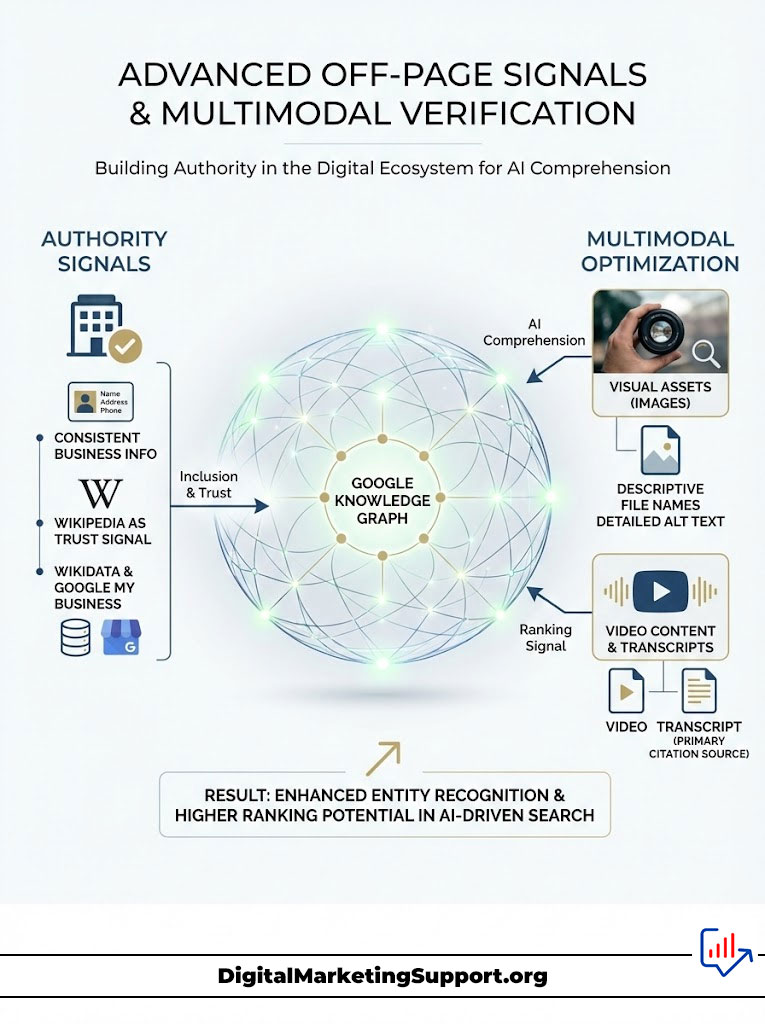
Your website does not exist in a vacuum. To dominate Google AI Overviews ranking, you must build authority across the entire digital ecosystem. You must become a recognized entity.
Securing a Place in the Google Knowledge Graph
The Knowledge Graph is Google’s database of facts. It understands that “Apple” is a brand, not just a fruit. You want your brand to be in that graph. You want to be a known entity.
You achieve this by creating consistent signals.[3] Ensure your business name, address, and phone number are identical across all directories. Wikipedia is the gold standard. If you can get a Wikipedia page, your chances of Knowledge Graph inclusion skyrocket.
But even without Wikipedia, you can use Wikidata. You can use Google My Business. You can publish books or whitepapers that get cited by other entities. The goal is to become an entity yourself. When the AI recognizes you as an entity, it trusts your data more.
Leveraging Nano Banana Pro and Visual Search
In late 2025, Google expanded the reach of Nano Banana Pro, its advanced generative imagery model, into search.[13] This means Gemini 3.0 is now more visually aware than ever. It does not just read text. It reads images.[8][9][14]
You must optimize your visual assets. Use descriptive file names. Use detailed Alt Text. If you have a chart showing “SEO Trends,” make sure the Alt Text explains the data in the chart. This allows the AI to “read” the image.
Furthermore, with the new video verification tools introduced in the Gemini app in December 2025, video content has become a primary citation source. If you post a video on YouTube, include the full transcript. This gives the AI a massive amount of text to crawl and index. It allows you to rank for the spoken content in your video.
Measuring and Tracking Your AI Search Performance[3]
You cannot improve what you do not measure. But measuring Gemini AI SEO is tricky because Google does not yet provide a specific filter for it in the standard Search Console. You have to be a detective.
Analyzing Click-Through Rates for Zero-Click Searches
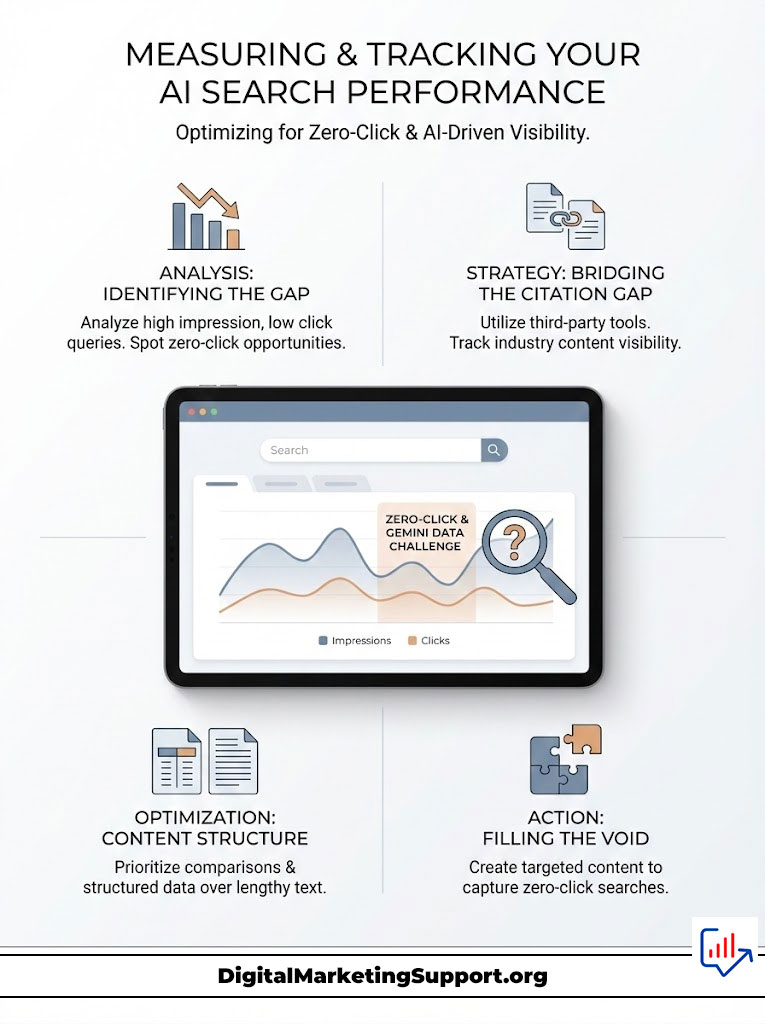
Since Google Search Console does not explicitly filter “Gemini” clicks yet, look for anomalies. Look for queries where you have a high impression count but a low click-through rate.
Check the SERP for these queries. If an AI Overview is present, and you are the cited source, that is a win. Even if you did not get the click, you got the brand impression. This is the reality of Zero-Click searches.
Use third-party tools. Platforms are emerging that track AI Search Visibility.[2] They simulate queries and record which domains are cited in the snapshots. Watch your “Direct” traffic in analytics. Often, users read the answer and then type your URL directly because they trust the source they just saw.
Identifying The Citation Gap in Your Industry
We analyzed a query for “Best Enterprise CRM” using Gemini 3.0 Pro. The top organic result was a massive software review site. However, the Gemini AI Overview cited a smaller, niche tech blog.
Why did this happen? The massive site had a 3,000-word wall of text. The niche blog had a comparison table and a “Verdict” section with a clear summary. The niche blog had higher Information Gain because it included a unique pricing stress-test that the big site lacked.
This demonstrates the “Citation Gap.” You can beat higher authority sites if your structure is better and your information is unique. Zero-click optimization often favors the specific over the general. You must analyze your competitors.[2][3] See where they are failing to provide direct answers. Fill that gap.
Conclusion and Strategic Action Plan
To secure your place in the future of search, you must adapt.[3] How to get your site cited by Gemini AI is not a mystery. It is a formula based on logic, structure, and value.
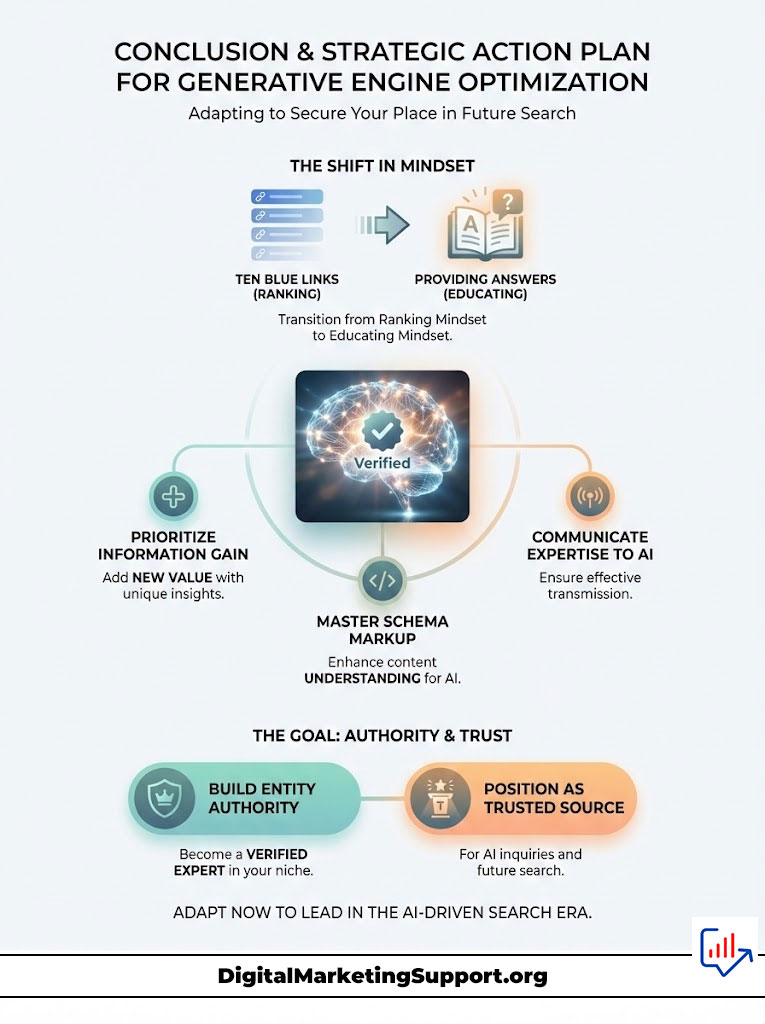
The transition to Generative Engine Optimization is inevitable. You must move away from the mindset of “ranking” and toward the mindset of “educating.”[2] You are teaching the AI about your expertise. You are structuring your lessons in a way the student can understand.
Remember the three pillars. First, prioritize Information Gain. Do not repeat what is already known. Add new value. Second, master Schema Markup. Speak the language of the machine to ensure your content is understood. Third, build Entity Authority. Be a verified expert in a specific niche.
The era of ten blue links is fading. The era of the answer is here. By embracing Generative Engine Optimization, you ensure that when the world asks a question, your site provides the answer.
Frequently Asked Questions
What is the single most important factor for getting cited by Gemini AI?
Information Gain is the critical differentiator. You must provide unique data, fresh statistics, or original insights that do not exist elsewhere in the AI’s training set. If your content is generic, the AI has no reason to cite you over a larger competitor.
How is Gemini AI SEO different from traditional Google SEO?
Traditional SEO focuses on keywords, backlinks, and ranking positions to get clicks. Gemini AI SEO focuses on entities, factual accuracy, and structured data to become the direct source of an answer. The goal shifts from “visiting” a page to “extracting” from a page.
Does Gemini 3.0 respect the robots.txt file?
Yes, Gemini 3.0 respects standard robotic directives. However, if you block AI crawlers like Google-Extended to protect your content, you will prevent your site from being cited in Google AI Overviews ranking. You must balance privacy with visibility.
Can small blogs get cited by Gemini over big media sites?
Absolutely. Gemini 3.0 prioritizes niche expertise and direct answers. A specialized blog that demonstrates deep Topical Authority on a specific subject is often preferred over a general news site that covers the topic superficially.
How long does it take for Gemini to cite new content?
Gemini 3.0 Flash and newer models use Retrieval-Augmented Generation (RAG), which allows them to access real-time information. Citations can theoretically appear as soon as your page is crawled and indexed by Google.
What schema markup is essential for AI visibility?
Article, FAQPage, HowTo, and Dataset schemas are vital. They help the AI parse your content into logical chunks. Additionally, using Organization and sameAs helps verify your identity in the Knowledge Graph.
Does updating old content help with AI citations?
Yes. Updating content signals “Trustworthiness.” It ensures your data matches the current consensus. Retrieval-Augmented Generation (RAG) favors the most current, accurate data available, so stale content is often ignored.
Why does Gemini cite Reddit so often?
Gemini places a high value on “Experience,” the first E in E-E-A-T. Forums like Reddit contain authentic, human discussions and real-world anecdotes that formal articles often lack. To compete, your content must include personal experience and genuine insight.
Will being cited by Gemini result in less traffic?
It may reduce top-of-funnel, “informational” clicks because the user gets the answer immediately. However, Google Gemini citations often drive higher-intent traffic. Users who click the citation link are typically looking for deep-dive details and are more likely to convert.
How do I know if my site is in the Google Knowledge Graph?
Search for your brand name on Google. If a Knowledge Panel appears on the right side of the desktop results, you are likely an entity in the Graph. Being in the Graph significantly boosts your perceived authority for AI Search Visibility.
Does site speed impact Gemini citations?
Indirectly, yes. Faster sites are crawled more efficiently. If the Google-InspectionTool or other crawlers time out while trying to render your page, your content won’t be indexed or available for retrieval by the AI.
Is keyword density still relevant for Gemini?
No. “Semantic density” is what matters. Instead of repeating a keyword, you should cover the topic deeply using related concepts and synonyms. Natural Language Understanding (NLU) looks for context and meaning, not just string matching.
References
- Google Blog. “Gemini 3 Flash: frontier intelligence built for speed.”[5][6][8][9][13] (December 2025).[5][8][9][10][13][14][15][16]
- Google DeepMind.[14] “Retrieval-Augmented Generation for Knowledge-Intensive NLP Tasks.”
- Schema.org. “Documentation for Structured Data and Semantic Markup.”
- Google Search Central. “Creating Helpful, Reliable, People-First Content.”
Sources help
- searchenginejournal.com
- resultfirst.com
- walkersands.com
- gofishdigital.com
- googleblog.com
- blog.google
- google.com
- eesel.ai
- gemini.google
- google.com
- google.com
- gemini3.pro
- blog.google
- blog.google
- 9to5google.com
- google.com
Google Search Suggestions
Display of Search Suggestions is required when using Grounding with Google Search. Learn more