









The era of the “ten blue links” is ending. For over two decades digital agencies built their entire business model on a simple premise: rank a client high on Google and traffic will follow. That reliable pipeline is fracturing. We are witnessing the most significant architectural shift in information retrieval since the invention of the crawler.
Table of Contents
What is the impact of AI search on digital agencies?
AI search fundamentally shifts agency revenue models from driving click-through traffic to managing brand citations within Large Language Models (LLMs). This transition, known as Generative Engine Optimization (GEO), requires agencies to pivot from keyword-based SEO to strategies focused on E-E-A-T, semantic authority, and technical optimization for AI agents like Google Gemini and Perplexity.
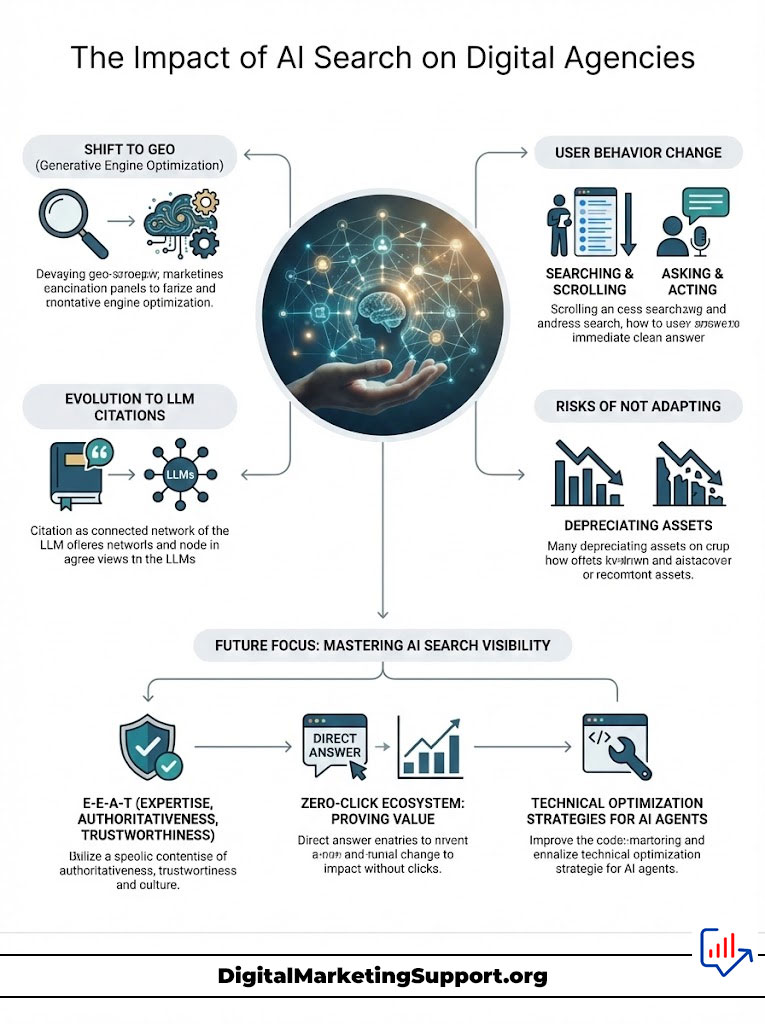
Agencies that fail to adapt their Agency AI strategy risk irrelevance. The user behavior is changing from “searching and scrolling” to “asking and acting.” If your agency is still selling simple rankings you are selling a depreciating asset. The future belongs to those who can master AI search visibility and prove their value in a zero-click ecosystem.
From SEO to Generative Engine Optimization (GEO) in the Modern Agency Landscape
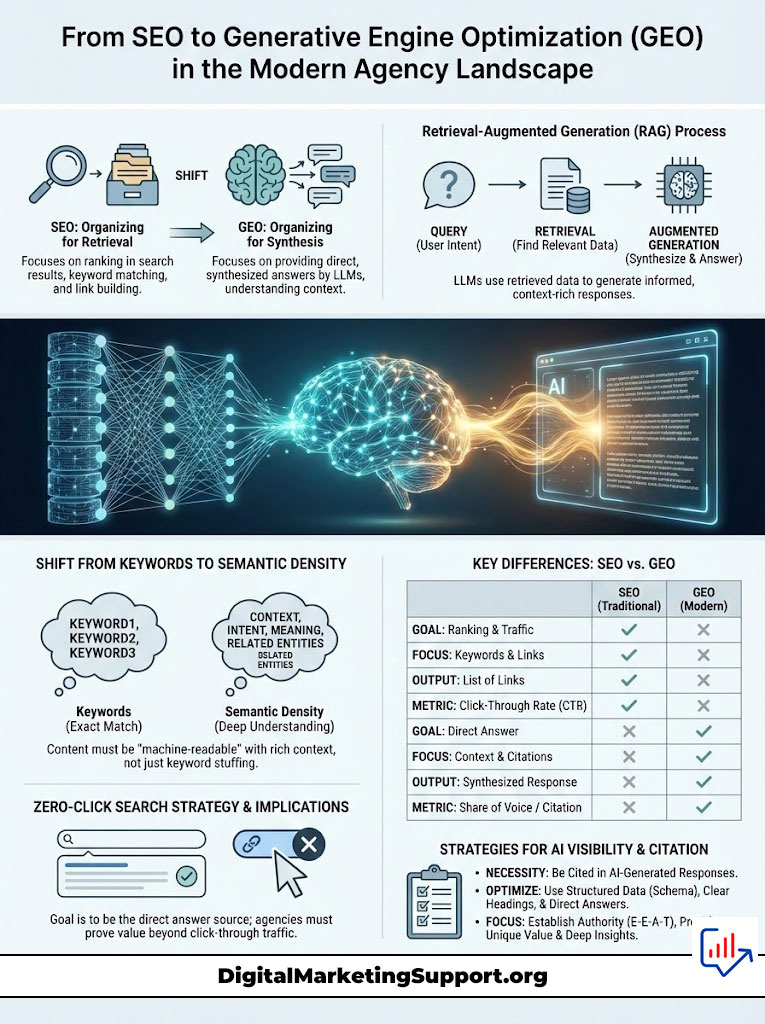
Understanding the mechanics of this shift is the first step to survival. Traditional Search Engine Optimization (SEO) was about organizing information for a retrieval system based on an index. Generative Engine Optimization (GEO) is about organizing information for a synthesis engine based on probability and consensus.
The Mechanics of AI Search and Retrieval-Augmented Generation (RAG)
To build a viable Agency AI strategy you must understand what happens under the hood. Traditional Google search works by crawling the web, indexing pages, and ranking them based on signals like backlinks and keywords.
AI search visibility relies on a different process called Retrieval-Augmented Generation (RAG). When a user asks a question to Perplexity or Google’s AI Overviews the system does not just look for a matching page. It retrieves relevant chunks of data from its vector database and uses an LLM to generate a new, unique answer.
This means Large Language Models (LLMs) act as the final judge. They decide which facts to include and which brands to cite. If your client’s content is not structured in a way that is “machine-readable” and high in “information gain,” the LLM will ignore it. Your client doesn’t just lose a click. They lose the mention entirely.
Why Keywords Are Losing Power to Semantic Density
We used to obsess over keyword frequency. In the world of Generative Engine Optimization (GEO) keywords are secondary to entities. Large Language Models (LLMs) understand concepts, not just strings of text.
They look for semantic density. This refers to the depth and interconnectedness of topics within a piece of content. If an AI is generating an answer about “enterprise cloud security” it looks for a source that covers the entity holistically. It looks for related concepts like “zero trust architecture” or “compliance protocols” and “data sovereignty.”
A shallow 500-word blog post stuffed with the keyword “cloud security” will not be cited. The AI views it as low-value noise. To achieve AI search visibility agencies must produce content that functions as a comprehensive knowledge base.
The New Zero-Click Search Strategy Reality
The most terrifying statistic for many agency owners comes from recent data regarding Search Generative Experience (SGE) and chatbot behavior. Gartner predicted that traditional search engine volume could drop by 25% by 2026 as users migrate to AI assistants.
This necessitates a zero-click search strategy. The goal is no longer just to get the user to leave Google and visit the client’s site. The goal is to influence the user right there on the results page.
If Google’s AI Overview says “The top three recommended CRM tools are Salesforce, HubSpot, and Zoho” and your client is not on that list, you have failed. Even if the user never clicks a link the brand impression is made. Agencies must now optimize for that top-level summary.
SEO vs. GEO: A Strategic Comparison
| Feature | Traditional SEO | Generative Engine Optimization (GEO) |
| Primary Goal | Rank #1 on SERP for clicks | Be the cited source in AI snapshots |
| Measurement | Organic Traffic / CTR | Share of Model / Brand Mentions |
| Content Focus | Keywords and Backlinks | E-E-A-T and Semantic Depth |
| User Journey | Search > Click > Convert | Search > Answer > High-Intent Action |
| Technical Base | HTML / Core Web Vitals | Structured Data / Knowledge Graph |
| Traffic Quality | High Volume / Mixed Intent | Lower Volume / High Intent |
How AI Search Changes Agency Revenue Models
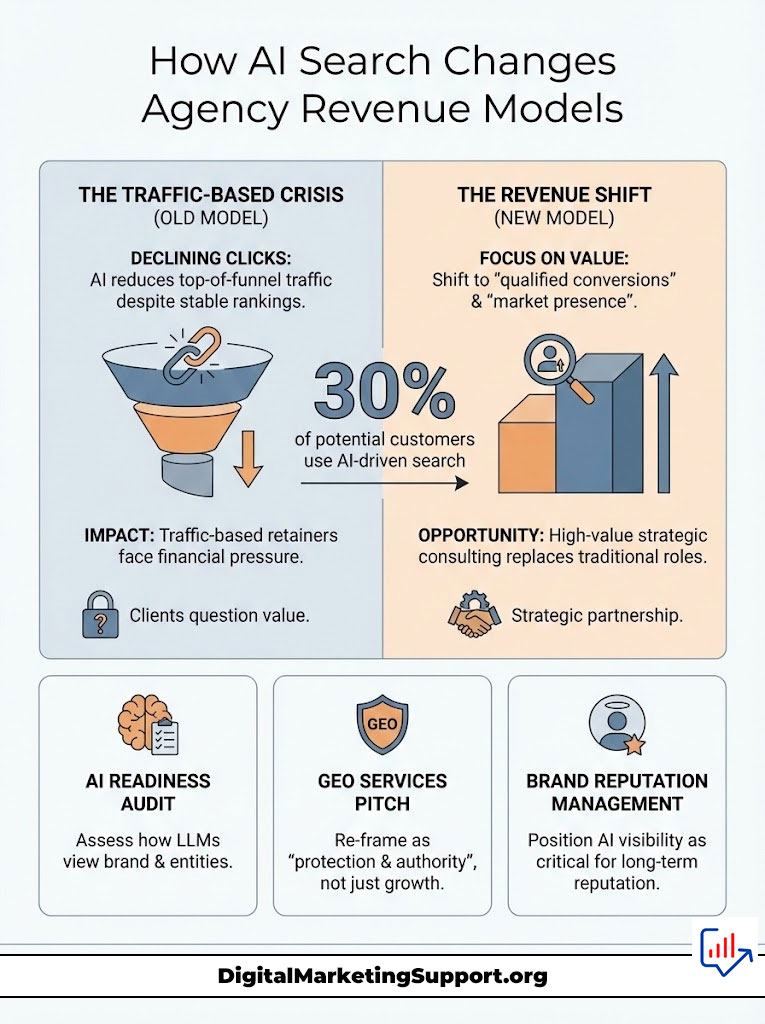
The technical shift creates a financial crisis for agencies stuck in 2020. Clients will inevitably ask why their organic traffic is dipping even though their rankings seem stable. The answer lies in the screen real estate lost to AI answers.
The Decline of Traffic-Based Retainers
For years agencies charged retainers based on traffic growth targets. That model is breaking. As AI search visibility increases “top of funnel” informational queries will stay inside the search engine.
If a user asks “how to tie a tie” or “what is the capital of Ohio” the AI gives the answer. No click happens. If your Agency AI strategy relies on measuring success solely by session increases you will face high churn.
You must pivot the conversation. The value metric is no longer raw traffic. It is “qualified conversions” and “market presence.” A user who clicks a citation in an AI answer is far more likely to convert than a random searcher. They have already been educated by the AI.
The Rise of High-Value Advisory Services
Smart agencies are moving upstream. They are becoming strategic consultants rather than just implementation arms. There is a massive opportunity in auditing a brand’s AI search visibility.
You can charge a premium for an “AI Readiness Audit.” This involves analyzing how Large Language Models (LLMs) currently view the client’s brand. Are they associated with the right entities? is the brand sentiment positive in the datasets that train these models?
This type of strategic work commands higher fees than writing four blog posts a month. It positions the agency as a partner in navigating a complex future.
Selling GEO Services to Clients
The hardest part of this transition is selling GEO services to clients who are used to traditional SEO. The pitch needs to change from “growth” to “protection and authority.”
Here is the angle: “Mr. Client, currently 30% of your potential customers are using AI-driven search to find answers. Right now your competitor is being recommended by these tools and you are invisible. We need to implement a Generative Engine Optimization (GEO) plan to fix this.”
When selling GEO services to clients focus on the concept of being a “verified source.” Explain that AI search visibility is about teaching the AI that they are the authority. If you frame it as brand reputation management rather than just SEO it becomes a boardroom-level priority.
Pillars of AI Search Visibility and Agency AI Strategy
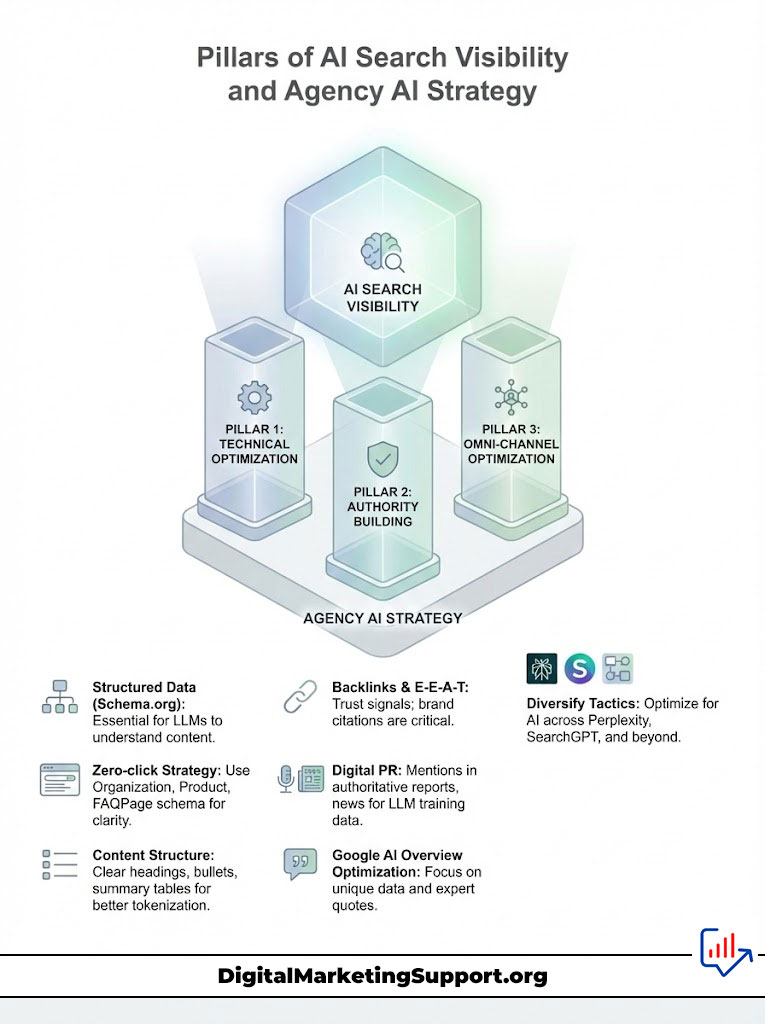
To execute this you need a tactical framework. A robust Agency AI strategy rests on three pillars: Technical, Authority, and Omni-channel Optimization.
Technical Optimization for LLMs and Structured Data
Technical SEO is not dead. It is more critical than ever but for a different reason. You are no longer just helping a crawler index a page. You are helping an LLM parse data.
Structured data (Schema.org) is the language of Large Language Models (LLMs). If you want an AI to know your client’s pricing, location, and founder, you must wrap that data in schema.
A zero-click search strategy requires robust use of Organization, Product, and FAQPage schema. This unambiguous code gives the AI confidence. When an AI is confident it is more likely to cite the information as a fact rather than a hallucination.
Furthermore, content structure matters. AI search visibility improves when content uses clear headings, bullet points, and summary tables. These formats are easier for tokenization processes to digest and retrieve.
Authority Building and Brand Citations
In the world of Generative Engine Optimization (GEO) backlinks are still important but they function differently. They are now primarily trust signals for E-E-A-T signals.
Brand citations are the new gold standard. An unlinked mention of your client’s brand in a high-authority industry report or a reputable news site is valuable. Large Language Models (LLMs) ingest this data and associate the brand with specific topics.
Your Agency AI strategy must include Digital PR. The goal is to get the client mentioned in the “training data” of the future. If The New York Times or a major industry journal mentions your client as an expert in “sustainable logistics” the AI learns that connection.
Optimizing for Google AI Overviews and Perplexity
Different platforms require different tactics.
AI Overview optimization for Google requires a focus on “informational gain.” Google wants to see unique data, expert quotes, and fresh perspectives. It rewards content that adds something new to the conversation.
Perplexity and SearchGPT are different. They often function as citation engines. To rank here you need to be cited by the sources they trust. This often means getting your client featured in niche industry publications or highly credible newsletters.
A comprehensive Agency AI strategy diversifies. You cannot rely solely on Google. You must track AI search visibility across all major answer engines.
Real-World Examples of AI Search Impact
Let’s look at how this plays out in the wild. The data shows a clear divergence between winners and losers in the Search Generative Experience (SGE) era.
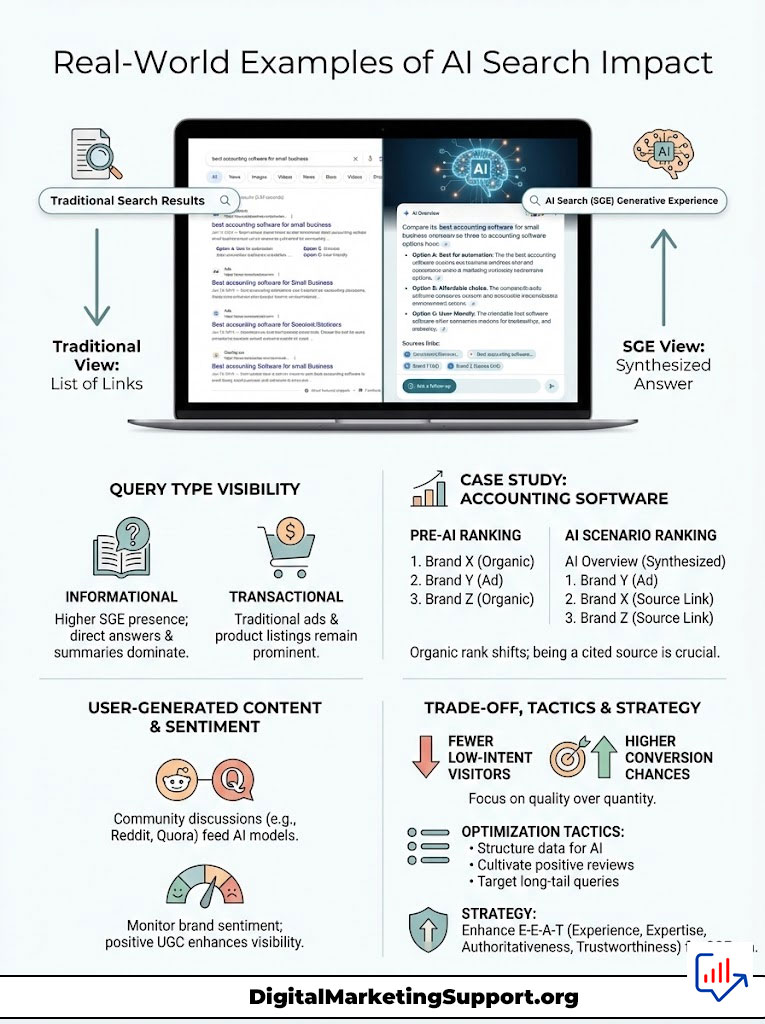
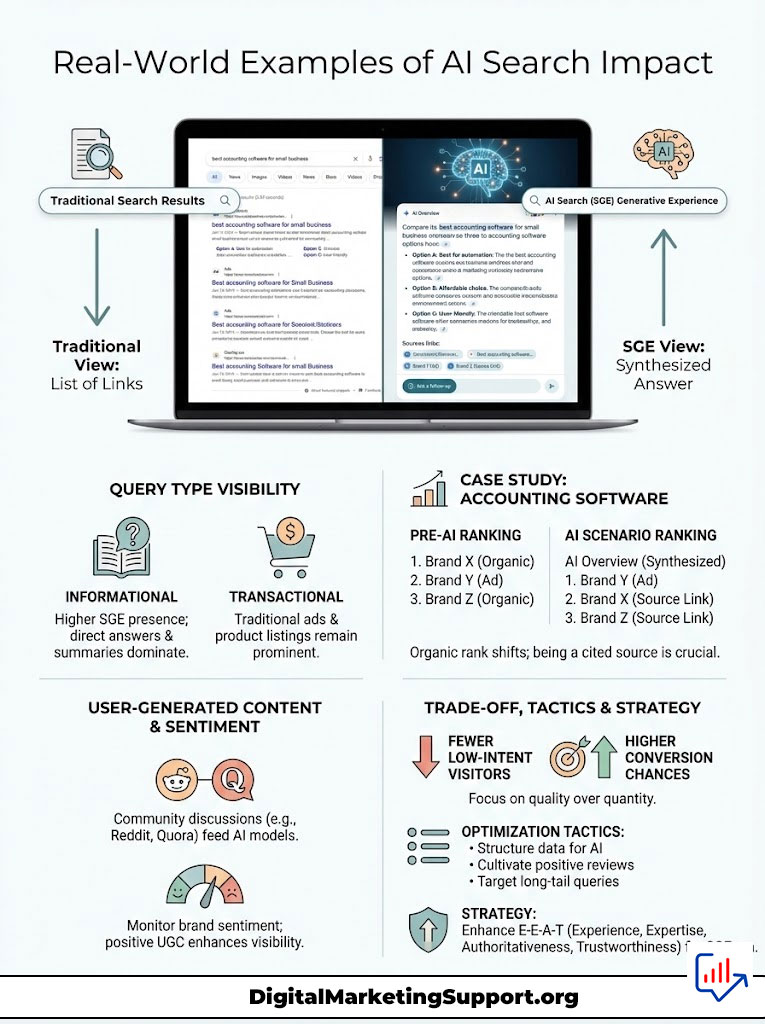
Informational vs. Transactional Queries in SGE
Consider a client selling “accounting software.”
In a traditional SERP they might rank #1 for “best accounting software.” In an AI Overview optimization scenario Google generates a list. If the client’s site has a paywall or aggressive pop-ups the AI might skip it in favor of a clean, informative review site like G2 or Capterra.
We have seen instances where informational traffic drops by 40% for basic “what is” queries. However, the traffic that remains is transactional. A user searching for “accounting software integration with Shopify price” is high-intent.
Selling GEO services to clients involves explaining this trade-off. “You will get fewer tire-kickers but more buyers.”
The Reddit Effect and Brand Sentiment
One of the most surprising elements of AI search visibility is the dominance of user-generated content. Google and other LLMs are heavily prioritizing Reddit, Quora, and forums.
Why? Because these platforms demonstrate “Experience” (the first E in E-E-A-T).
Real human discussion is valuable data for Large Language Models (LLMs). If a user asks “is Brand X reliable?” the AI often scrapes Reddit threads for the answer.
If your Agency AI strategy ignores reputation management on forums you are leaving a massive gap. We have seen brand citations on Reddit drive more AI visibility than a press release. Agencies must monitor brand sentiment in these communities to ensure the AI “reads” the brand positively.
Platform Optimization Tactics
| Platform | Primary Data Source | Optimization Tactic |
| Google AI Overviews | Top 10 Rankings + Knowledge Graph | Schema Markup + High E-E-A-T Content |
| Perplexity AI | Academic Papers + Trusted News | Citation in High-Authority News Sites |
| SearchGPT | Bing Index + Partner Publishers | Real-time Data + Clear Structure |
| Bing Copilot | Bing Index + LinkedIn | B2B Content + LinkedIn Articles |
Future Outlook: Preparing for the Next 5 Years
The pace of change is accelerating. An Agency AI strategy created today will need to evolve in six months. However, the trajectory is clear.
From SEO Agency to Answer Engine Agency
The agency of the future is an “Answer Engine Agency.” Your job is to ensure your client is the answer wherever the question is asked.
This means Generative Engine Optimization (GEO) will become the standard. Agencies will likely employ “Prompt Engineers” whose sole job is to test how different AI models perceive client brands.
We will also see a rise in “Zero-Party Data” strategies. As AI search visibility becomes more competitive owning the customer relationship directly becomes vital. Agencies must help clients build their own data moats so they are not entirely dependent on Google or OpenAI.
Selling GEO services to clients will eventually just be called “digital marketing.” The distinction will vanish. Every agency will be an AI agency or they will be out of business.
The Role of Proprietary Data
To truly win in AI Overview optimization you need proprietary data. Large Language Models (LLMs) crave unique statistics and insights.
If your client publishes an annual “State of the Industry” report with original data they become a primary source. Other sites cite them. The AI cites them.
This is the ultimate zero-click search strategy. Be the source of the truth. Agencies should push clients to conduct surveys, release white papers, and generate data that no one else has. This is the fuel for AI search visibility.
Conclusion
The impact of AI search on digital agencies is not a temporary trend. It is a fundamental restructuring of the web. The days of easy traffic are gone.
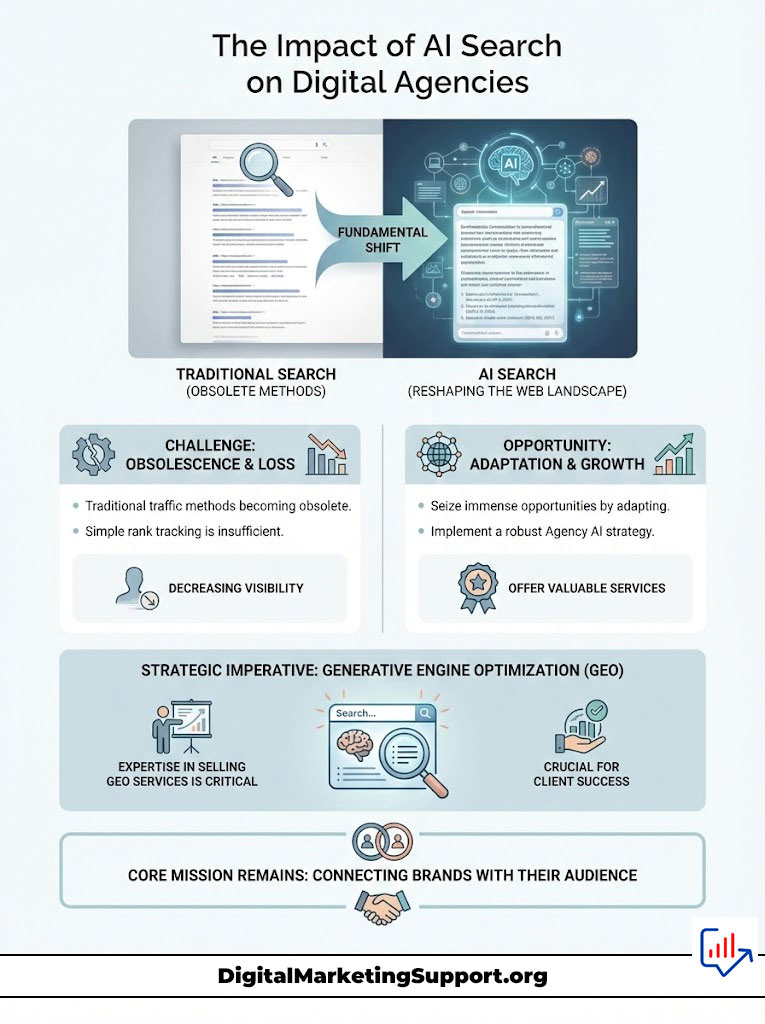
However, for agencies willing to adapt the opportunity is immense. By implementing a robust Agency AI strategy you can offer services that are far more valuable than simple rank tracking. You can become the guardian of your client’s reputation in the age of artificial intelligence.
Focus on Generative Engine Optimization (GEO). Master AI search visibility. Become an expert in selling GEO services to clients. The tools have changed but the core mission remains the same: connecting brands with the people who need them.
Key Takeaways
- Pivot to GEO: Shift from keyword rankings to Generative Engine Optimization (GEO) and brand citations.
- Value Over Volume: accept lower traffic volumes but focus on higher conversion rates from AI Overview optimization.
- Technical Excellence: Use schema and structured data to make client content readable for Large Language Models (LLMs).
- Reputation Management: Monitor and influence brand sentiment on forums and review sites to ensure positive AI summaries.
- Consultative Selling: When selling GEO services to clients focus on the risk of invisibility and the authority of being a cited source.
Frequently Asked Questions
How does AI search impact digital marketing agencies?
AI search forces agencies to move beyond traditional SEO tactics like keyword stuffing and link building. It requires a shift toward Generative Engine Optimization (GEO) focusing on brand authority structured data and becoming a cited source in AI-generated answers.
What is the best Agency AI Strategy for retaining clients?
The best strategy involves educating clients on the shift to “zero-click” search. Agencies should offer services that track and improve AI search visibility such as optimizing for Perplexity managing brand sentiment on forums and building high-quality digital PR citations.
How can I start selling GEO services to clients?
Start by auditing their current visibility in tools like ChatGPT or Google Gemini. Show them where their competitors are being cited and they are not. Position GEO as a “future-proofing” service that ensures their brand remains visible as search behaviors change.
Will SEO become obsolete due to AI search?
No SEO will not become obsolete but it will evolve. Traditional technical SEO remains the foundation but the focus will shift from ranking for keywords to optimizing for entities and intent which is the core of AI search visibility.
What metrics should agencies use to track AI search success?
Since traditional click-through rates may decline agencies should track “Share of Model” or how often a brand is cited. Also monitor brand sentiment analysis direct traffic and conversions from high-intent referral sources.
How do I optimize content for Google’s AI Overviews?
Focus on “Answer Engine Optimization.” Structure content with clear questions and concise factual answers. Use schema markup to help Google understand your data and ensure your content demonstrates high E-E-A-T signals.
Why is E-E-A-T crucial for AI search visibility?
Large Language Models (LLMs) refer to trusted sources to avoid “hallucinations.” Google’s algorithms prioritize content with strong Experience Expertise Authoritativeness and Trustworthiness when generating AI summaries.
What is the difference between SGE and traditional search?
Search Generative Experience (SGE) now often called AI Overviews uses AI to synthesize a direct answer from multiple sources at the top of the results page. Traditional search provides a list of blue links for the user to explore.
Can small agencies compete in the AI search era?
Yes. Small agencies can pivot faster than large firms. By specializing in specific niches and mastering Agency AI Strategy for local or vertical-specific markets small agencies can offer high-value specialized Generative Engine Optimization (GEO) services.
What tools help with AI search optimization?
Tools like Semrush Ahrefs and specialized platforms like Authoritas are developing features to track AI rankings. Additionally using the Large Language Models (LLMs) themselves to audit content for clarity and sentiment is a powerful tactic.
How does user intent change with AI search?
Users are becoming more conversational and specific. Instead of searching “best shoes” they search “best running shoes for flat feet under $100.” Agencies must target these detailed long-tail queries with specific high-value content to capture AI search visibility.
Is social media content important for AI search?
Extremely. AI models ingest data from social platforms particularly video transcripts from YouTube and TikTok as well as discussions on Reddit. A holistic Agency AI strategy must include optimizing a brand for discovery across these platforms.