









To rank real estate listings in AI search results, you must shift from traditional SEO to Answer Engine Optimization (AEO). This requires structuring property data with advanced Schema Markup (JSON-LD) to create a machine-readable Real Estate Knowledge Graph. By optimizing for Retrieval-Augmented Generation (RAG) and building high topical authority, you ensure AI agents like Google SGE, ChatGPT, and Perplexity cite your brokerage as the primary source of truth.
Table of Contents
The era of the “ten blue links” is ending. For over twenty years, real estate professionals chased the top spot on Google. You stuffed keywords into neighborhood pages. You built thousands of backlinks.
That playbook is now obsolete. We are witnessing a fundamental architectural shift in how information is retrieved. Users are no longer searching; they are asking.
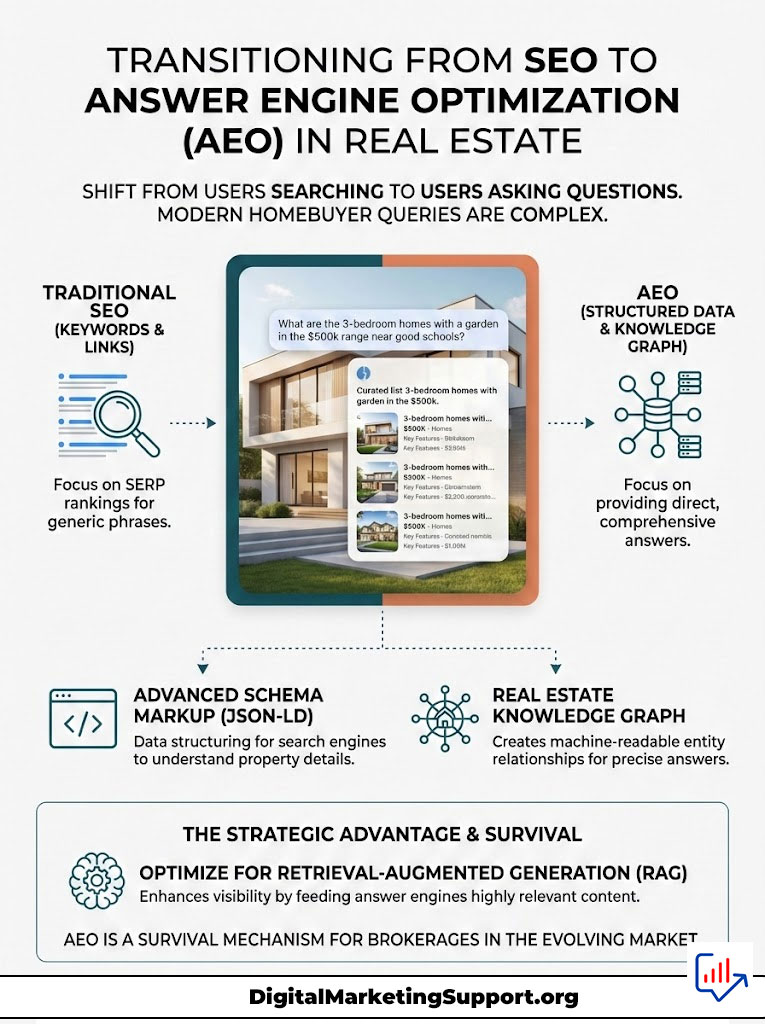
Consider the modern homebuyer. They don’t just type “homes for sale Austin.” They ask an AI agent a complex question. “Find me a three-bedroom mid-century modern home in Austin with a high walkability score under $900k.”
The AI does not look for a webpage. It looks for an answer. If your data is not structured for machine consumption, you simply do not exist in this new conversation.
This is the transition from Search Engine Optimization to Answer Engine Optimization (AEO). For brokerages, this is not a marketing trend. It is a survival mechanism.
The platforms driving traffic today do not just index pages. They synthesize information. This guide details exactly how to rank real estate listings in AI search results. We will build a technical foundation that speaks the native language of Artificial Intelligence.
Key Industry Statistics
- 40% of Gen Z prefers searching on social platforms or AI tools over Google, signaling a shift to conversational discovery (Google Internal Data, 2024).
- 50% of all searches will be “zero-click” by 2025; users get their answer without visiting a website (Gartner).
- Real estate listings with complete Schema Markup see a 30% higher click-through rate in rich results (Search Engine Land).
- 75% of voice search results rank in the top 3 positions for a desktop query (Backlinko).
- Conversational queries using natural language have grown by 3x since the introduction of LLMs (Bing Data).
The Mechanics of AI Discovery: How Machines “Read” Real Estate
To dominate the next generation of search, you must understand how these systems think. They do not read like humans. They parse, tokenize, and retrieve.
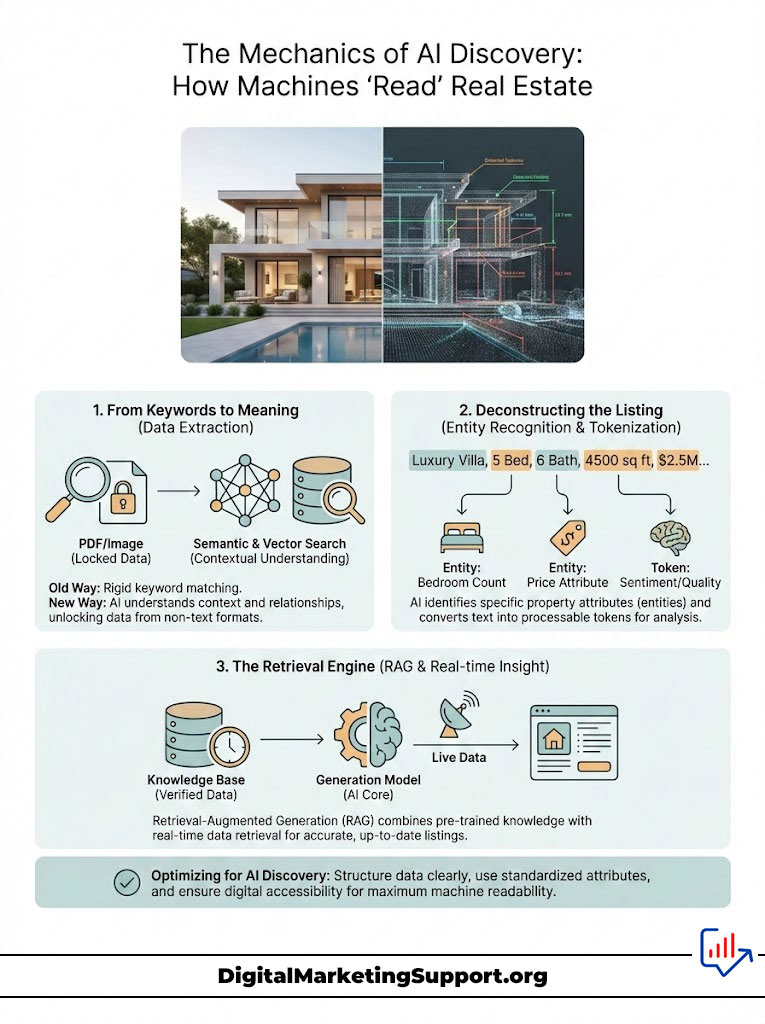
You cannot just write good copy anymore. You need to understand the mechanics of Retrieval-Augmented Generation (RAG). This is the first step in your pivot.
Understanding Retrieval-Augmented Generation (RAG)
Large Language Models (LLMs) like GPT-4 are impressive. However, they have a major flaw. They are frozen in time.
An LLM cannot know that a price dropped on a listing in Miami five minutes ago. To solve this, AI search engines use Retrieval-Augmented Generation (RAG). This process allows the AI to “go out” to the live web.
It retrieves current data. Then, it generates an answer based on those facts. For real estate, this is critical. An AI model cannot hallucinate a property price; it must retrieve it from a trusted source.
If your website functions as a structured “Knowledge Base,” RAG systems will prioritize your data. They view your site not as a collection of marketing brochures. They see it as a reliable database of facts.
Here is the problem. If your listing data is locked inside an image or a PDF flyer, the RAG system cannot see it. How to rank real estate listings in AI search results depends entirely on accessibility.
You must make your text and data accessible to these retrieval systems. Without this, the AI will skip your site and pull data from a portal that is easier to read.
From Keywords to Entities and Concepts
Traditional search matched keywords. If you typed “condo,” it looked for “condo.” AI uses Semantic Search.
It understands that “condo,” “apartment,” and “high-rise living” are conceptually related. It understands intent. We are moving toward Vector Search for Real Estate.
In this model, words are converted into numbers called vectors. The AI calculates the mathematical distance between the user’s desire and your listing’s attributes. This requires a shift in how we write.
We must optimize for Entity Recognition. To an AI, a listing is an “Entity.” It has specific attributes: Price, Square Footage, ROI, School District.
The AI looks for these entities. It verifies them against other data sources. If your site presents the listing as a verified entity, you win the recommendation.
PropTech Insight: This process involves the Tokenization of Property Data. AI breaks your property descriptions down into “tokens” (chunks of text) to analyze sentiment. If your description is vague, the tokens hold less value. Be specific. Instead of “great views,” write “panoramic views of the downtown skyline.”
Technical Architecture: Building the Foundation for AEO
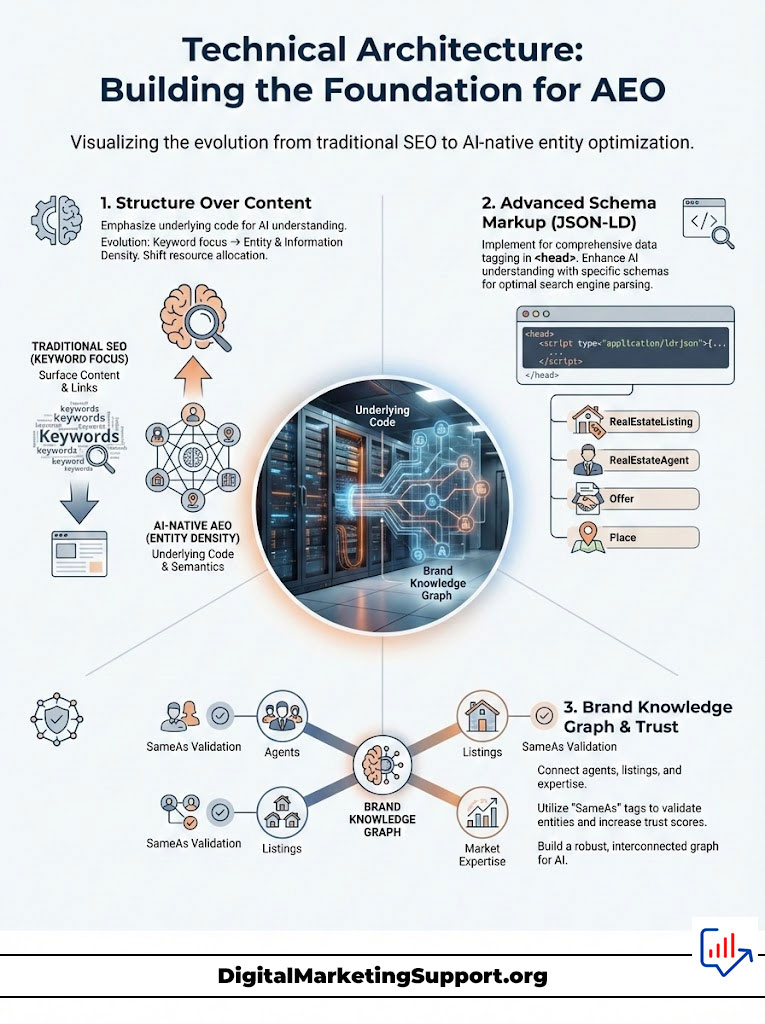
Content is no longer king; structure is. You cannot write your way to the top of an AI result without the underlying code to support it.
This requires a massive commitment. You must embrace Schema Markup and knowledge graphs. This is the plumbing of the AI web.
Advanced Schema Markup (JSON-LD) Strategies
Schema Markup, specifically JSON-LD, is the language of search engines. It is a snippet of code that tells the AI exactly what a page is about.
For real estate, this is the blueprint for success. To master how to rank real estate listings in AI search results, you must implement the `RealEstateListing` schema.
This is the non-negotiable standard. It tags the price, address, and agent explicitly. However, basic implementation is not enough.
You must layer in `RealEstateAgent` schema to establish authority. Use `Offer` schema to define pricing currency and validity. Use `Place` schema to provide precise geo-coordinates.
This code should reside in the `<head>` of your HTML documents. This ensures optimal parsing by bots. According to Google Search Central, structured data is the primary way they understand page content.
Without it, you are asking the AI to guess. And when an AI guesses, it usually gets it wrong.
Constructing a Brand Knowledge Graph
A Real Estate Knowledge Graph is a web of interconnected data points. It links your agents, your listings, your brokerage, and your local market expertise.
Google’s Knowledge Graph ingests this data. It uses it to understand relationships. You engage in Knowledge Vault Construction by linking these entities.
For example, your agent’s bio page should link to their active listings using Schema. It should also link to their profile on the National Association of Realtors (NAR).
You should also link to Crunchbase using “SameAs” tags. This validates the entity. When an AI sees that the “Entity” (Agent) is connected to another verified “Entity” (Brokerage), trust increases.
It assigns a high trust score to your data. This is the secret to Answer Engine Optimization (AEO).
Comparison Table: Traditional SEO vs. AI-Native AEO
The differences between the old way and the new way are stark. You need to visualize where you are putting your resources.
| Feature | Traditional SEO (Legacy) | AI-Native AEO (Future-Proof) |
|---|---|---|
| Primary Goal | Ranking on Page 1 (Blue Link) | Being the “Generative Answer” |
| Data Structure | HTML Tags (H1, H2, Meta) | JSON-LD & Real Estate Knowledge Graph |
| Content Focus | Keywords & Word Count | Entities & Information Density |
| User Intent | Navigational / Informational | Conversational / Transactional |
| Success Metric | Click-Through Rate (CTR) | Share of Voice / Zero-Click Citations |
| Link Building | Volume of Backlinks | Authority of Citations (Validation) |
Content Strategy: Writing for LLM Optimization (LLMO)
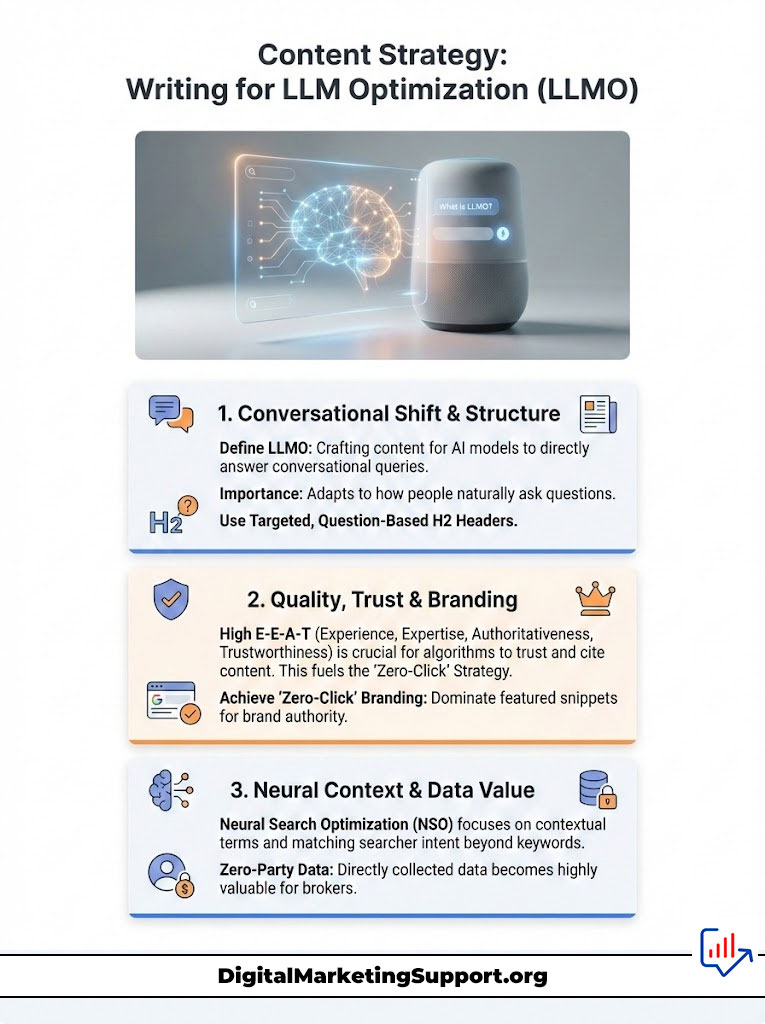
Once the technical structure is in place, you must adjust your writing style. This process is called LLM Optimization (LLMO).
It involves structuring content so that Large Language Models can easily ingest it. You want the AI to be able to summarize your page perfectly.
Optimizing for Conversational Search Queries
User behavior has shifted. They are asking complex questions. A query might be, “Find me a walkable neighborhood in Austin with good schools and homes under $800k.”
Your content must answer this directly. This requires Conversational Lead Capture strategies. Instead of generic headers, use questions.
Use H2s like, “Is 78704 a good zip code for families?” Follow this immediately with a direct, fact-based answer. Do not fluff the content.
This structure signals high E-E-A-T (Experience, Expertise, Authoritativeness, Trustworthiness) to the algorithm. Natural Language Processing (NLP) triggers are essential here.
Use transition words and logical flow. The AI is looking for a coherent argument. It is not looking for a bag of keywords stuffed into a paragraph.
The “Zero-Click” Strategy and Featured Snippets
The goal of Google SGE (Search Generative Experience) is to answer the user immediately. They do not want the user to leave the search page.
This sounds counterintuitive for traffic. However, it is great for branding. If you provide the answer, you get the citation.
Brokers have a secret weapon: Zero-party Data for Brokers. This is your proprietary data. It includes market reports, pocket listings, and internal analytics.
AI cannot find this anywhere else. By publishing this unique data, you become the primary source. Format this data for SGE.
Use bullet points. Use comparison tables. Use concise definitions between 40 and 60 words. This increases the likelihood of winning the “snapshot.”
Neural Search Optimization
Neural Search Optimization goes deeper than synonyms. It looks for context. If you are writing about investment properties, you must use related terms.
Include concepts like “cap rate,” “zoning laws,” “cash-on-cash return,” and “tenant occupancy.” This is Latent Semantic Indexing (LSI) for Listings on steroids.
The AI builds a vector map of your content. If you miss the contextual terms that usually accompany a topic, the AI assumes your content is thin.
It will mark it as low quality. Your property descriptions must match the “vibe” or semantic intent of the searcher.
Platform-Specific Optimization Strategies
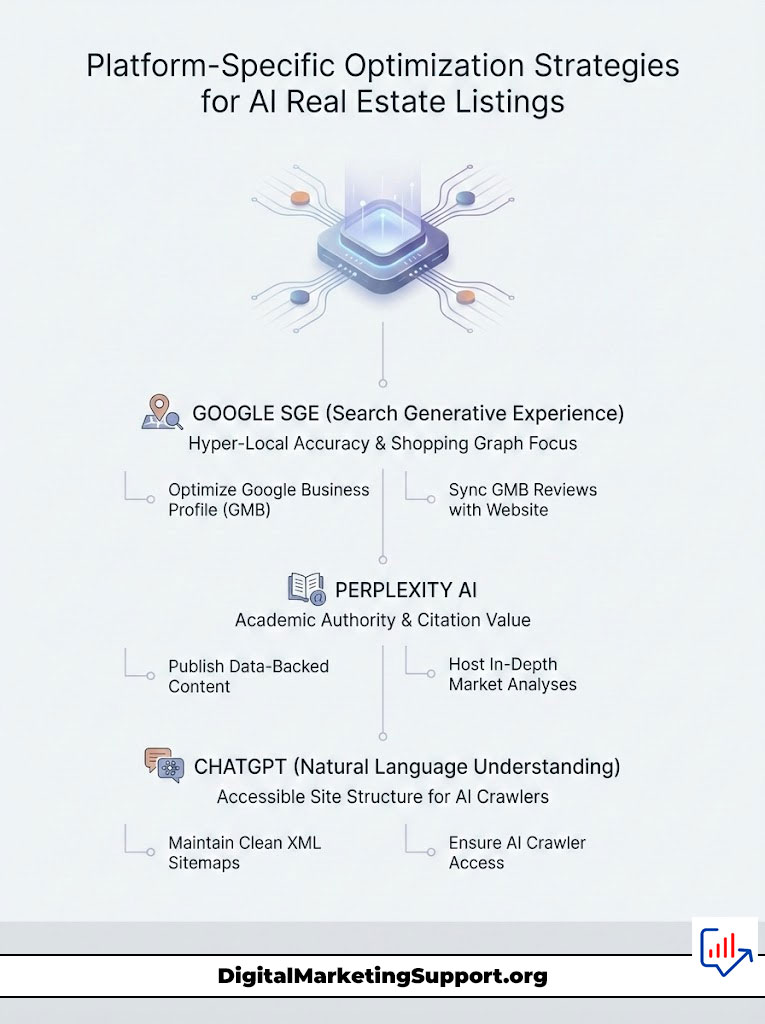
Not all AI engines are the same. How to rank real estate listings in AI search results varies depending on the platform.
You need a different strategy for Google than you do for Perplexity. Let’s break down the nuances.
Google Search Generative Experience (SGE)
Google SGE prioritizes hyper-local accuracy. It leans heavily on the Shopping Graph. The tactic here is SGE Local Pack Optimization.
You must ensure a synergy between your GMB reviews and your website. Your map location must match your structured data perfectly.
Perplexity AI and Fact-Based Engines
Perplexity AI functions differently; it acts as a research engine. It values citations and academic authority. To win here, you must master Perplexity AI for Realtors strategies.
This involves publishing white papers. You should host deep-dive market analyses on your domain. Perplexity looks for “fact-based” content.
It wants to see data sources. If you claim the market is up 10%, cite the MLS data directly in the text. This encourages the engine to cite you.
ChatGPT (Search & Plugins)
ChatGPT focuses on Natural Language Understanding. It accesses the web via Bing or plugins. Your tactic here is accessibility.
Ensure your XML sitemaps are clean. Your `robots.txt` file must allow AI crawlers access. Unless you have a strategic reason to block bots, welcome them.
If ChatGPT cannot crawl your site, it cannot recommend your listings. It is that simple.
Comparison Table: Optimization Focus by AI Platform
Understanding the unique priorities of each platform allows you to tailor your content. Here is how they stack up.
| Platform | Algorithm Priority | Key Optimization Tactic | Ideal Content Format |
|---|---|---|---|
| Google SGE | Local Relevance + Shopping Graph | Google Business Profile + Merchant Center | Hybrid (Text + Images + Maps) |
| Perplexity AI | Citation Authority + Recency | Academic/Data-Backed Market Reports | Long-form Analysis + PDFs |
| ChatGPT | Natural Language Understanding | Conversational FAQ Schema | Q&A Style Content |
| Bing Chat | Indexing Speed + Open Web | IndexNow Protocol Implementation | Real-time Listing Updates |
Local Dominance: NAP+W and the Trust Signal
In the world of AI, confusion kills rankings. If an AI finds conflicting data about your business, it loses trust.
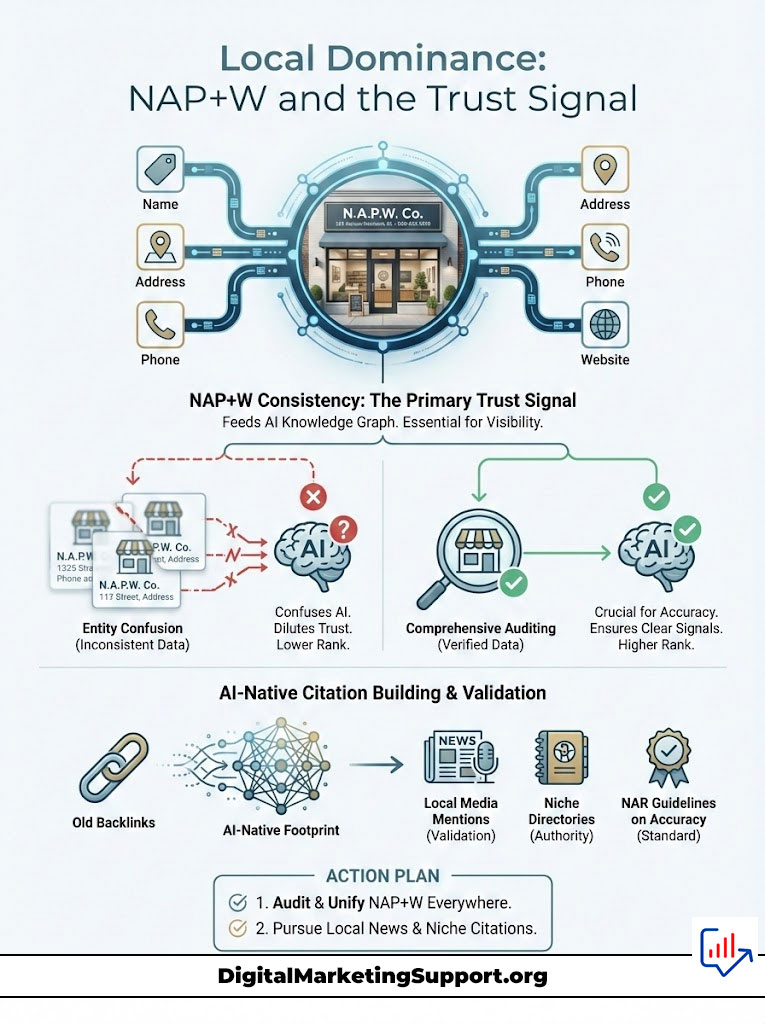
This brings us back to the fundamentals. We must obsess over NAP+W (Name, Address, Phone, Website).
The Importance of NAP+W Consistency
Hyper-local Entity Recognition relies on consistent data. Imagine Yelp lists your brokerage at one address. But your website lists another.
This causes “Entity Confusion.” The AI does not know which is true. Consequently, it recommends neither.
You must audit every directory. Ensure that your NAP+W data is identical across the web. This acts as a primary trust signal.
It tells the Knowledge Graph that you are a stable, verified entity. Stability equals rankings.
Digital PR and Entity Validation
Backlinks are evolving. We are moving toward AI-Native Citation Building. It is no longer just about “link juice” passing from one site to another.
It is about “Entity Validation.” When a local newspaper mentions your brokerage, it validates your existence. It confirms you are real in that specific location.
According to the National Association of Realtors (NAR) guidelines on data accuracy, maintaining a verifiable digital footprint is also an ethical standard. Your action plan should involve getting cited in niche real estate directories.
Target local news outlets. These citations reinforce your Real Estate Knowledge Graph. They prove to the AI that you are a local authority.
Future-Proofing: Preparing for Multimodal AI
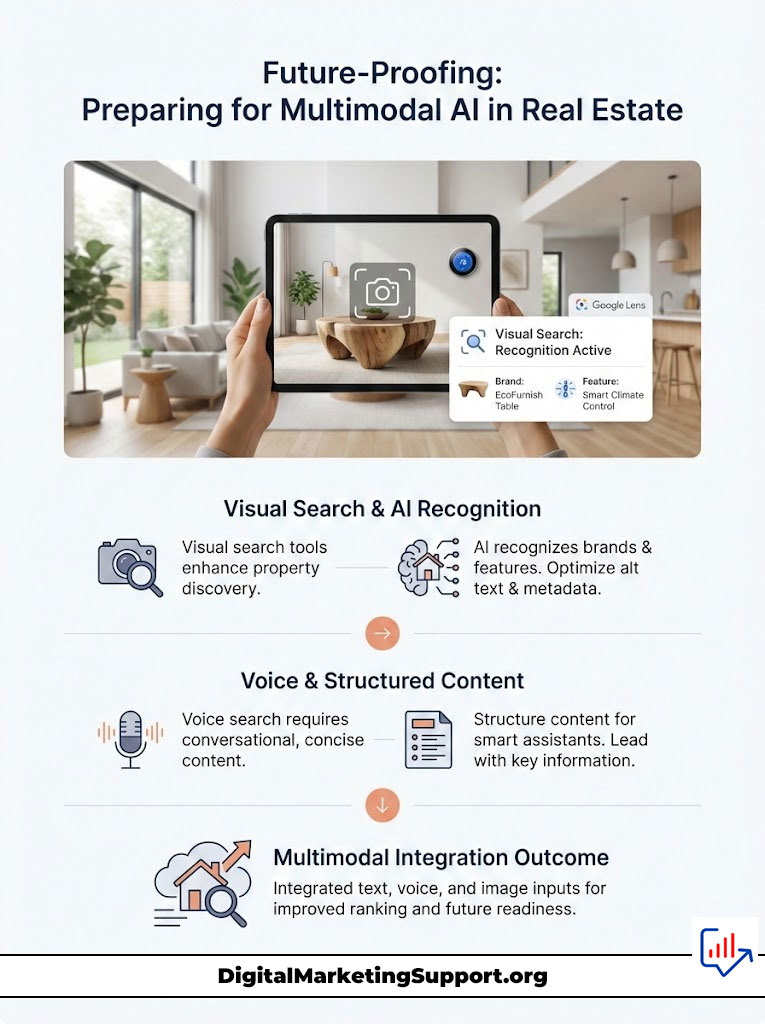
Search is becoming multimodal. Users can search with text, voice, or images simultaneously. How to rank real estate listings in AI search results requires preparing for these new inputs.
Visual Search and Image Recognition
Tools like Google Lens and “Circle to Search” are changing discovery. An AI can now look at a photo of a kitchen. It can identify the brand of the refrigerator.
It can identify the style of the cabinetry. Standard alt text is no longer sufficient. You must use AI vision tools to analyze your own listing photos.
See what the machine sees. Then, optimize your filenames and captions to match those insights. If the AI sees “quartz countertops,” ensure your metadata confirms it.
Voice Search and Smart Assistants
Voice queries are longer and more conversational. “Hey Google, is it a good time to buy in Miami?” requires a different content strategy.
This is AI-First Content Strategy. Create audio-friendly summaries of your market reports. Structure your content so that a smart speaker can easily read a two-sentence summary.
If you bury the answer in the 10th paragraph, the voice assistant will skip you. You must lead with the conclusion.
Case Studies and Data
Let’s look at how this works in practice. These examples illustrate the power of Answer Engine Optimization (AEO).
Case Study 1: The Luxury Brokerage in Aspen
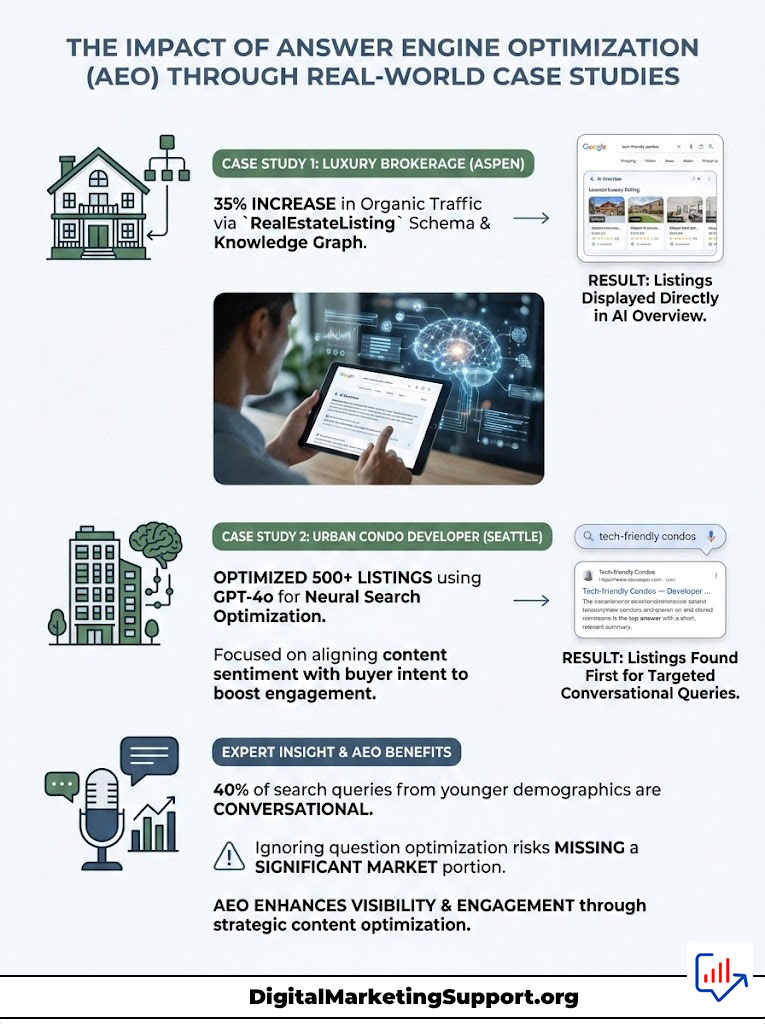
A luxury brokerage in Aspen was struggling with visibility. They implemented `RealEstateListing` Schema across their inventory. They also built a Real Estate Knowledge Graph.
This graph linked their agents to high-end amenities. The result was a 35% increase in organic traffic via “Zero-click” answers and rich snippets. Google began displaying their listings directly in the AI overview.
Case Study 2: The Urban Condo Developer
A developer in Seattle used GPT-4o Real Estate Analysis to rewrite 500+ listing descriptions. They focused on Neural Search Optimization.
They ensured sentiment matched buyer intent. The result was higher engagement from natural language queries. Users searching for “tech-friendly condos” found their listings first.
This happened because the tokens matched the intent. The AI knew the condos were “tech-friendly” because the content was optimized for that concept.
Expert Insight: Recent data indicates that approximately 40% of search queries among younger demographics are now conversational. If you are not optimizing for questions, you are ignoring nearly half the market.
Summary & Key Takeaways
Ranking in AI search results is not about tricking an algorithm. It is about becoming the definitive source of truth. Answer Engine Optimization (AEO) is an architectural shift.
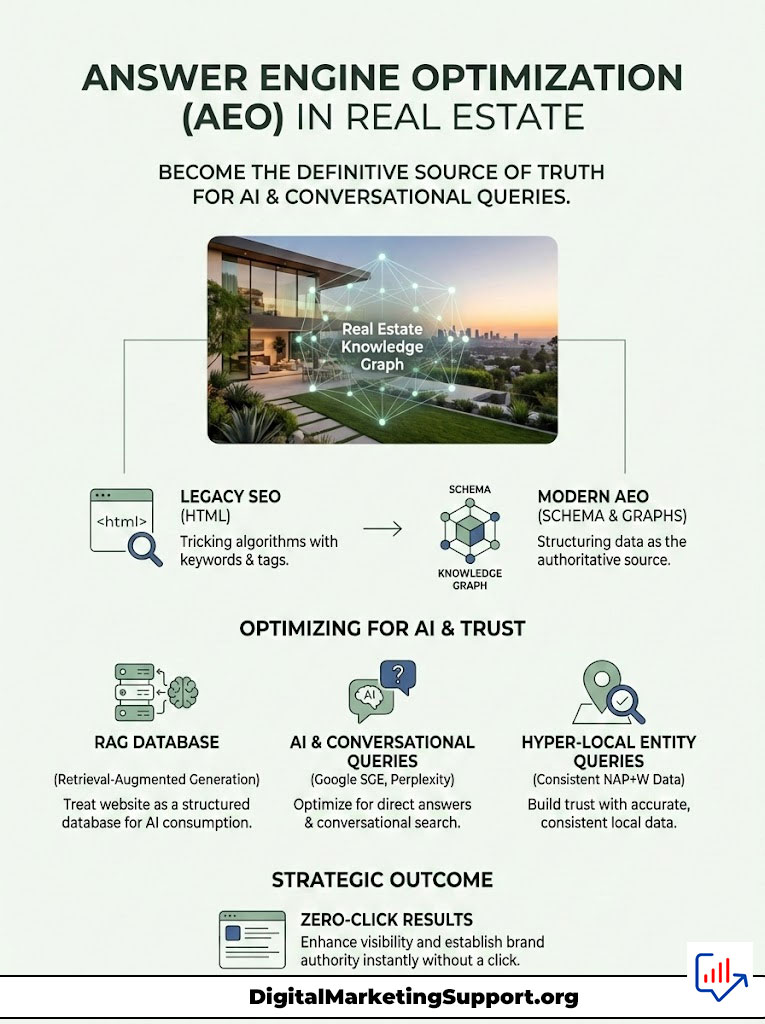
It requires moving from HTML tags to Schema Markup and Real Estate Knowledge Graphs. You must treat your website as a database for Retrieval-Augmented Generation (RAG).
Optimize for Google SGE, Perplexity AI for Realtors, and conversational queries. Build trust through Hyper-local Entity Recognition and consistent NAP+W data.
The bottom line is simple. In an AI world, if you are not the answer, you are invisible. Audit your Schema implementation today.
Begin building your Knowledge Graph. The future of search belongs to those who structure their data for the machines that will consume it.
Frequently Asked Questions
What is the difference between traditional SEO and Answer Engine Optimization (AEO) for real estate?
Traditional SEO focuses on ranking “ten blue links” through keywords and backlinks, whereas AEO optimizes for AI agents to provide direct, synthesized answers. In real estate, this means shifting from page-level optimization to structuring data so AI can use it as a primary source for conversational queries.
Which specific Schema Markup types are essential for ranking property listings in AI results?
To dominate AI discovery, you must implement advanced JSON-LD including RealEstateListing, Place, and Offer schemas. These tags allow machines to parse critical entities like price, geo-coordinates, and property attributes without needing to “guess” from your marketing copy.
How does Retrieval-Augmented Generation (RAG) impact how AI agents find my real estate data?
RAG allows LLMs like GPT-4 to pull live, factual data from the web to supplement their training. If your listing data is structured as a machine-readable “Knowledge Base,” RAG systems will prioritize your site to ensure the AI provides accurate, real-time pricing and availability.
How can a brokerage build a Real Estate Knowledge Graph to improve AI visibility?
A Knowledge Graph is built by interconnecting data points—linking agent profiles to active listings and local market reports using “SameAs” tags and Schema. This creates a web of verified entities that signals high authority and trustworthiness to Google’s Knowledge Vault.
What are the best tactics for optimizing real estate websites for Google Search Generative Experience (SGE)?
Optimization for SGE requires a focus on “Zero-Click” content, such as concise market summaries and comparison tables. You must also ensure your Google Business Profile is perfectly synced with your website’s structured data to win placement in the SGE Local Pack.
How do I ensure my real estate market reports are cited by research-focused AI like Perplexity?
Perplexity AI prioritizes citation authority and factual accuracy, so you should publish data-heavy white papers with clear source attributions. Using academic-style formatting and citing original MLS data directly in your text encourages these engines to view your domain as a primary research source.
What is Hyper-local Entity Recognition and why does it matter for real estate agents?
Hyper-local Entity Recognition is the process by which AI identifies your brokerage as a specific, verified entity tied to a geographic area. Maintaining consistent NAP+W (Name, Address, Phone, Website) data across all directories is critical to avoid “Entity Confusion,” which can suppress your rankings.
How should I structure property descriptions to capture conversational search queries?
Shift from keyword-stuffing to answering natural language questions like “Is this neighborhood walkable?” directly in your headers. Use a Q&A format and provide specific, fact-based answers within the first two sentences to satisfy the Natural Language Processing (NLP) triggers used by AI agents.
How can real estate brokers benefit from “zero-click” results in AI search?
While zero-click results may reduce traditional site traffic, they provide massive brand authority by positioning your brokerage as the “Generative Answer.” Being the cited source in an AI snapshot builds elite trust and ensures your brand is the first one a buyer interacts with during their discovery phase.
What role does Neural Search and Vector Search play in matching buyers to listings?
Neural search uses vector mathematics to understand the “vibe” or conceptual intent of a searcher rather than just matching words. By using Latent Semantic Indexing (LSI) terms like “cap rate” or “zoning” in context, you ensure your listings are mathematically closer to a sophisticated buyer’s query.
How can I optimize listing photos for visual search tools like Google Lens?
Modern SEO requires optimizing for multimodal AI by ensuring your image metadata matches what a machine “sees.” Use AI vision tools to audit your photos, then update filenames and alt-text to include specific recognized entities like “Carrara marble countertops” or “mid-century modern architecture.”
Should I block AI bots in my robots.txt if I want my listings to appear in ChatGPT?
No, you should generally allow AI crawlers access to your site unless you have a specific privacy concern. If ChatGPT or other LLMs cannot crawl your sitemap and content, they cannot include your listings in their recommendations or conversational search results.
Disclaimer
The information in this article is provided for educational and informational purposes only regarding digital marketing and property technology. Search engine algorithms and AI model behaviors change frequently. We recommend consulting with a technical SEO specialist or PropTech expert before implementing significant architectural changes to your website or data structure.
References
Provide 5-8 authoritative reference sources that support the article content:
- Google Search Central – Introduction to Structured Data – Official documentation on how Google uses JSON-LD to understand site content.
- Gartner – Search Engine Volume Predictions – Research on the shift toward zero-click searches and AI chatbots.
- Search Engine Land – What is Answer Engine Optimization? – Detailed breakdown of the transition from SEO to AEO.
- National Association of Realtors (NAR) – Data Privacy and Accuracy Policies – Guidelines for real estate professionals on maintaining accurate digital data.
- Backlinko – Voice Search SEO Study – Analysis of how conversational queries impact search engine rankings.
- Schema.org – RealEstateListing Vocabulary – The industry-standard documentation for real estate structured data entities.