









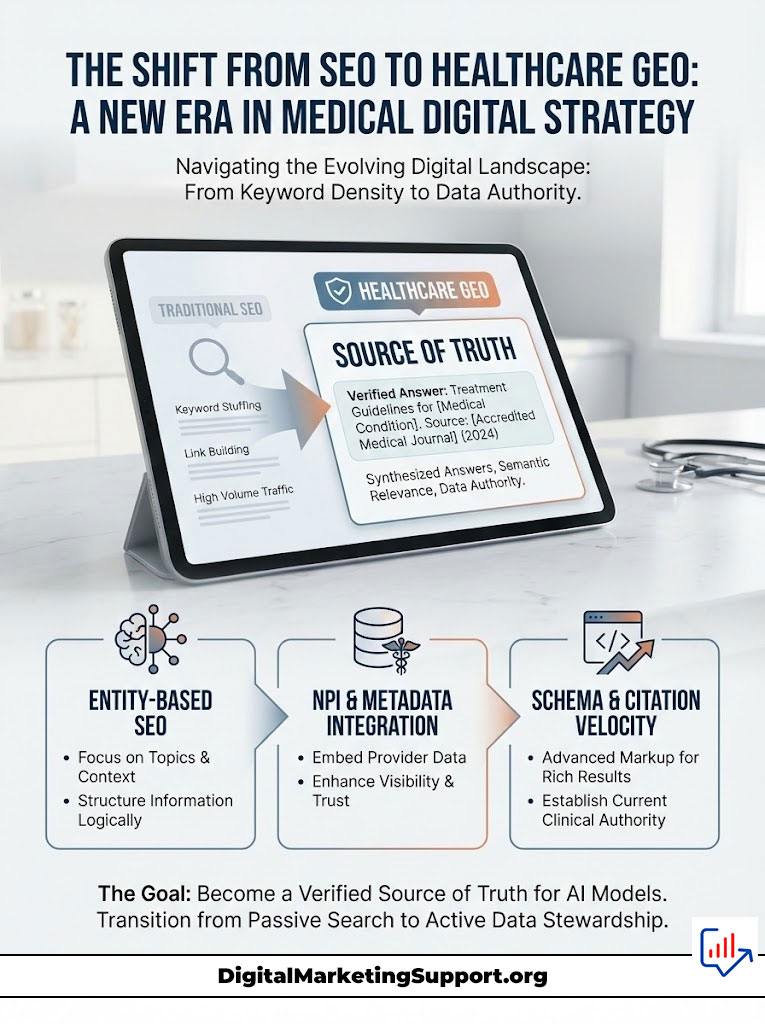
The digital landscape for medical providers is undergoing a tectonic shift. We are witnessing the end of the traditional search era. The days of chasing “ten blue links” are dissolving into a new reality of synthesized answers. For healthcare organizations, this transition marks the most significant pivot in digital acquisition history. We are moving from Search Engine Optimization (SEO) to Healthcare GEO (Generative Engine Optimization).
Table of Contents
In this rapidly evolving environment, the goal is no longer just a click to your website. The objective has changed entirely. The new goal is to become the verified “Source of Truth” within the neural networks of Large Language Models (LLMs). We are talking about becoming the primary citation for engines like SearchGPT, Google Gemini, and Perplexity AI.
Healthcare GEO is the strategic framework of optimizing clinical data and medical content. The purpose is to ensure it is retrievable, understood, and cited by generative AI models. Unlike traditional SEO, which optimizes for a ranking position on a page, GEO optimizes for Retrieval-Augmented Generation (RAG) inclusion. This is a game of data authority. It is a game of semantic relevance.
Quick Answer: What is the core strategy?
To win AI Search Citations, providers must shift from keyword density to Entity-Based SEO. This requires hard-coding NPI Data Integration into your site’s metadata. You must use advanced Schema.org markup. You must demonstrate unshakeable clinical authority. The objective is to increase your Citation Velocity. This ensures algorithms view your practice as a current, verified authority.
To dominate the AI-driven patient journey, providers must shift focus. You must move away from keyword stuffing. You must embrace Entity-Based SEO. You need to integrate NPI data into the Medical Knowledge Graph. This article outlines the technical and strategic roadmap to securing high Citation Velocity in the age of generative search.
The Mechanics of AI Retrieval in Medicine
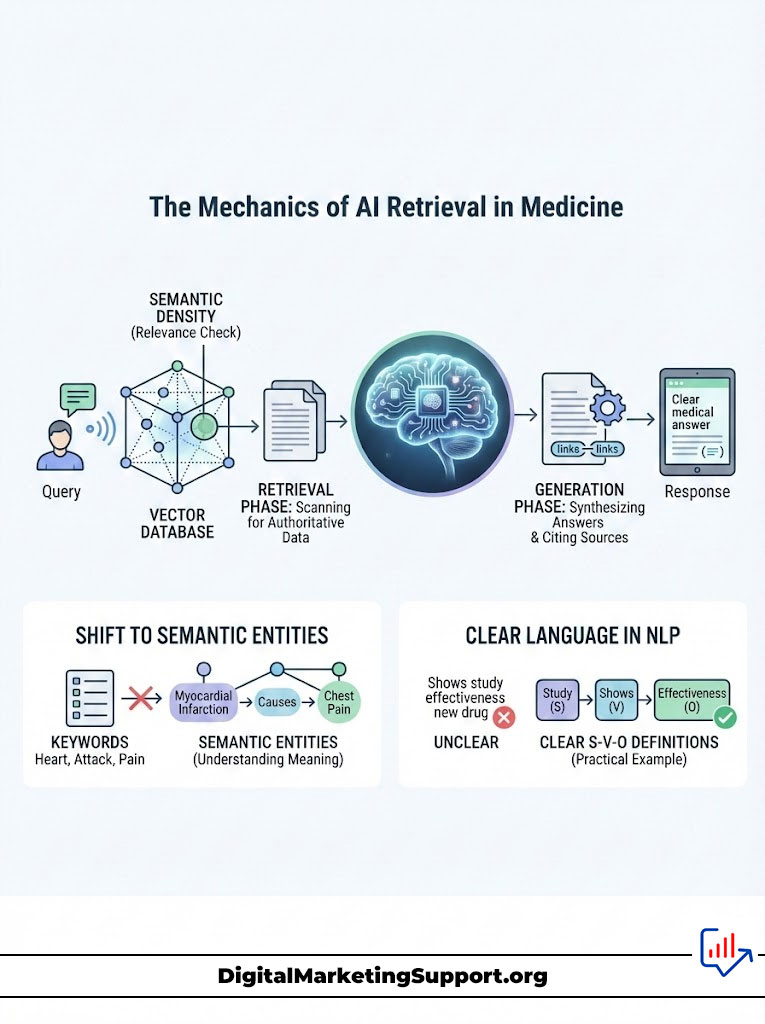
To control the output of an AI, you must understand how it retrieves input. This is not magic. It is engineering. LLMs do not “know” current facts in the way a human does. They do not have a memory of yesterday’s news unless they are retrained. Instead, they retrieve facts from a vector database through a process called Retrieval-Augmented Generation (RAG).
Understanding this process is the first step to mastering Healthcare GEO.
Understanding Retrieval-Augmented Generation (RAG)
Retrieval-Augmented Generation (RAG) is the engine under the hood of modern search. It is the mechanism that allows an AI to answer questions about current events or specific medical data. When a patient asks Perplexity AI a complex question, the AI goes to work. Let’s say they ask, “What are the latest treatments for atrial fibrillation?”
The AI does not simply rely on its pre-training data. That data might be outdated. It might be from two years ago. Instead, it queries a live vector index. It looks for the most relevant, semantically dense information available right now.
The Vector Space: Medical concepts are mapped as vectors. These are mathematical representations of meaning. Imagine a massive 3D geometric space. In this space, words with similar meanings are close together. “Myocardial Infarction” and “Heart Attack” are located at nearly the same coordinates. Your content must be mapped to these specific vector coordinates to be visible.
The Retrieval Phase: The AI scans for relevant, authoritative data chunks. It looks for content that is semantically dense. It looks for structure. If your content is buried in PDFs, the RAG process will likely skip it. If your content is in unstructured text blocks, it may be ignored.
The Generation Phase: Finally, the AI synthesizes the answer. It writes a response for the user. It cites the source. This is where Healthcare GEO wins or loses. If your data was retrieved but lacked authority signals, it will not be cited. It will be used as background noise. You want to be the citation.
Expert Insight: Your content must be formatted to be easily “chunked” by the RAG process. Use clear H2s and H3s that act as standalone Q&A units. This increases the probability that a specific section of your page will be pulled into the answer snapshot.
From Keywords to Semantic Entities
AI does not read keyword strings. It understands entities. It understands concepts. It understands the relationships between them. This is a fundamental shift for medical marketers. You can no longer just rank for a word. You must establish an entity.
The Shift: We are moving from “Cardiologist Miami” to a complex entity relationship. The AI sees: [Doctor Name] > [Specialty: Cardiology] > [Location: Miami] > [Treats: Hypertension]. Google’s Med-PaLM and OpenAI’s models interpret medical context through these relationships. They look for the connections.
Natural Language Processing (NLP): Healthcare GEO requires writing for NLP. This means using clear sentence structures. You need subject-verb-object definitions. Do not use vague marketing language. Be precise.
For example, instead of saying “We do heart surgery,” say “Dr. Smith performs coronary artery bypass grafting at City Hospital.” This creates a clear triple (Subject-Predicate-Object). The Medical Knowledge Graph can ingest this. It can verify it. It can serve it to a patient.
Building the Technical Foundation for Healthcare GEO
You cannot win AI Search Citations with good content alone. The technical infrastructure of your digital presence must speak the language of the machine. It must be flawless. It must be structured.
Integrating NPI Data for Identity Verification
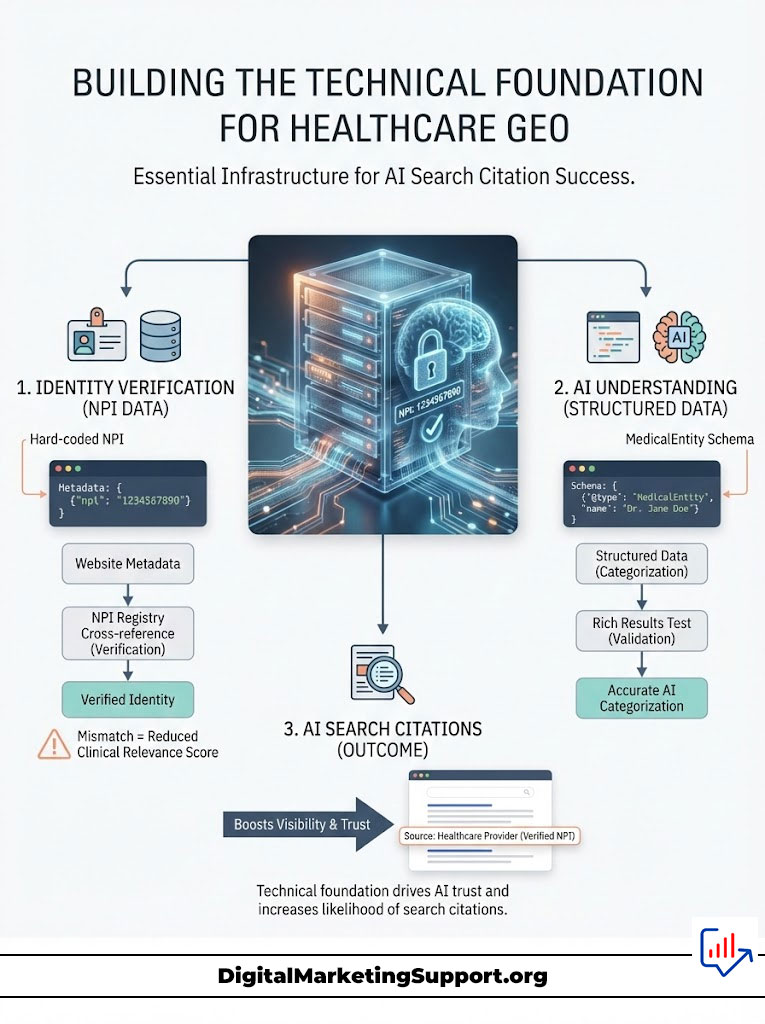
The National Provider Identifier (NPI) is the social security number of medical SEO. In the context of Healthcare GEO, it is the primary key for identity verification. It is the bedrock of trust.
The Strategy: You must hard-code NPI Data Integration into your site’s metadata. This goes beyond just listing it on a bio page. It should be embedded in the structured data of every physician profile. It needs to be in the code.
Verification: AI models cross-reference your site’s claims against the NPI Registry (NPPES). They verify legitimacy. If the data on your website contradicts the federal database, your authority drops. Your Clinical Relevance Score plummets.
Actionable Tip: Ensure the NPI database matches your website. Check your Google Business Profile. They must match exactly. A mismatch in address or specialty code can cause the AI to treat your practice as two separate entities. This fragmentation kills your visibility.
Mastering Schema.org: The Language of LLMs
Structured data is the bridge between your clinical content and the AI’s understanding. Without it, you are hoping the AI “guesses” your context. With it, you are explicitly telling the AI what you are. You are handing it the answer key.
MedicalEntity Schema: You must go deeper than standard `LocalBusiness` schema. Implement `MedicalSpecialty`. Implement `MedicalCondition`. Use `Physician` schema types. This helps the Medical Knowledge Graph categorize your expertise accurately.
Citation Attribute: Use the `citation` schema attribute. Explicitly link claims to PubMed or JAMA studies in your code. This connects your content to the highest authority nodes in the graph. You are effectively “borrowing” their trust.
Validation: Use the Rich Results Test. Ensure your schema is parseable by Google Gemini. If the code has syntax errors, the Generative Engine Optimization effort is wasted. The machine cannot read broken code.
Optimizing for Clinical Relevance and Trust
In the world of high-stakes health queries, accuracy is not optional. It is the primary filter for visibility. If you are not accurate, you are invisible.
The New Metric: Clinical Relevance Score
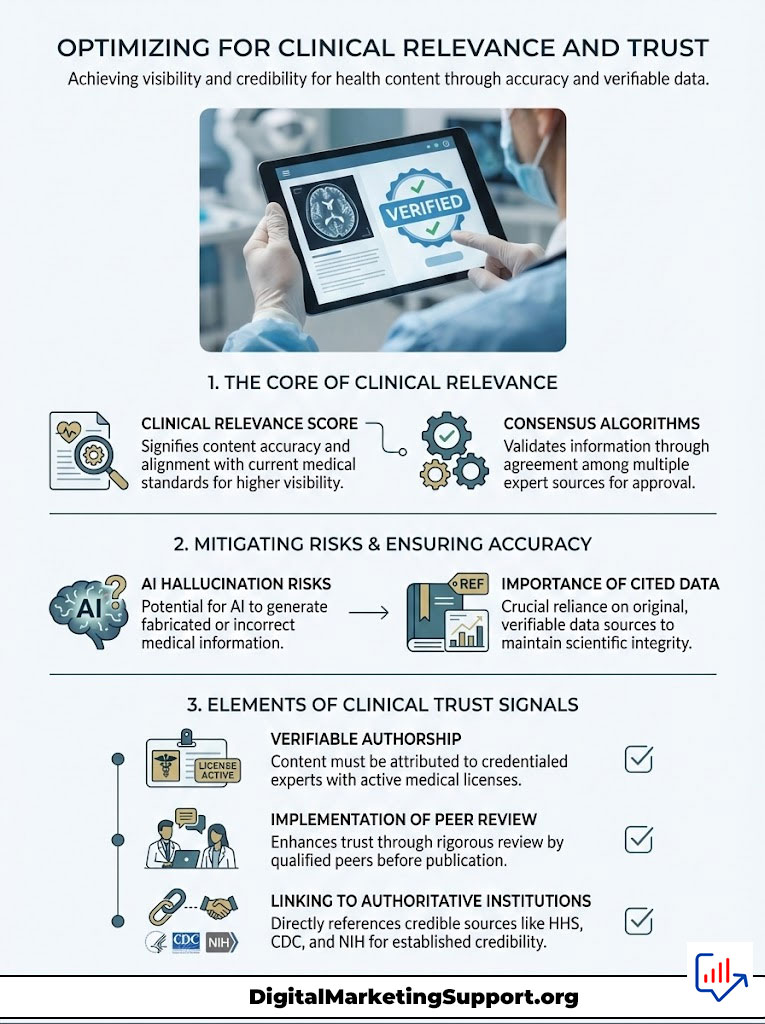
We define the Clinical Relevance Score as the alignment between your content and established medical consensus. AI models are trained to reject outliers. They prioritize safety above all else.
Consensus Algorithms: If your content claims a “miracle cure,” watch out. If it contradicts the dataset of the CDC or NIH, the AI will likely suppress it. Healthcare GEO demands that you align with consensus. You can highlight your unique approach, but do not contradict established science.
Avoiding Hallucinations: One of the biggest risks in AI is “hallucination.” This is where the model invents facts. Providing precise, cited data prevents the AI from making up facts about your practice. The more structured data you provide, the less room the AI has to improvise. You want to constrain the AI with facts.
Elevating Trust Signals
Google’s framework for trust is stricter for healthcare. We call these “Clinical Trust Signals.” These are the markers that tell an algorithm you are safe.
Authorship: Every piece of content must have a verifiable author. That author needs an active medical license. Anonymous content is dead content in the eyes of Healthcare GEO. The AI wants to know *who* said it.
Peer Review: Implement a “Medically Reviewed By” process. Make this visible to the AI crawler. This second layer of validation significantly boosts the trust signal. It shows a chain of custody for the information.
Institutional Trust: Link to HHS.gov. Link to the CDC. Link to the NIH. When you link to these giants, you place your site in their “neighborhood” within the vector space. You associate your brand with their authority.
Platform-Specific Optimization Strategies
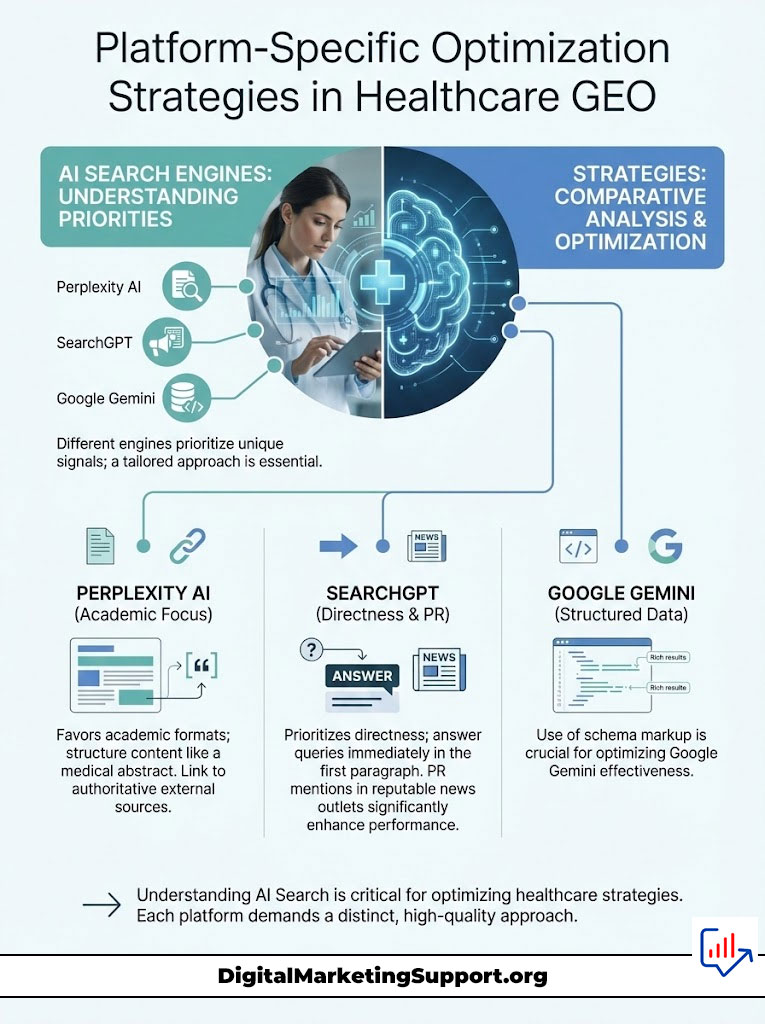
Different engines prioritize different signals. A “one-size-fits-all” approach will fail. You must tailor your Healthcare GEO strategy to the specific engine you want to conquer.
Key Statistics: The Rise of AI Search
- 40% of millennials now use social or AI-based search over Google for healthcare queries.
- SearchGPT and similar models are projected to handle over 20% of initial medical triage queries by 2025.
- Practices with high Citation Velocity see a 3x increase in appearance in AI snapshots compared to static competitors.
- 75% of voice search results for medical queries come from the top 3 organic positions or the Featured Snippet.
- Perplexity AI usage for complex medical research has grown by 150% in the last year among patients with chronic conditions.
Comparative Analysis of AI Engines
To win AI Search Citations, you need to understand the matrix of optimization priorities. Each engine has a personality.
The table below breaks down the nuances of the major players. Study this carefully.
| Feature | SearchGPT | Perplexity AI | Google Gemini (SGE) |
|---|---|---|---|
| Primary Data Source | Real-time web index & News | Academic papers & Structured Data | Google Knowledge Graph & Merchant Center |
| Citation Style | Inline links & Sidebar sources | Footnoted numbers & “Sources” carousel | Drop-down cards & Map Pack integration |
| Optimization Priority | News authority & PR mentions | Semantic density & Academic citations | Schema markup & GMB/GBP completeness |
| Safety Sensitivity | High (Filters non-consensus) | High (Prioritizes .edu/.gov) | Very High (Strict Safety Filters) |
| Best For | Brand awareness & Trending topics | Complex medical queries & Research | Local patient acquisition & “Near Me” |
Winning the Perplexity “Sources” Carousel
Perplexity AI is the academic engine of choice for many patients researching complex conditions. It acts more like a research assistant than a search bar. It wants data.
Strategy: Structure content like a medical abstract. Use headings like Background, Methods, and Results. This format is native to the data sources Perplexity prefers. If your blog post looks like a clinical abstract, Perplexity is more likely to parse it.
Citations: Heavily link to external authoritative bodies. Perplexity trusts you if you trust them. A post with zero outbound citations to reputable sources is invisible to this engine. You must verify your own claims.
Dominating the SearchGPT Answer Box
SearchGPT favors directness. It favors conversational fluency. It wants to give the user the answer immediately.
Strategy: Use “Zero-Click” formatting. Answer the question immediately in the first paragraph. Do not bury the lead. If the query is “Recovery time for ACL surgery,” the first sentence should be “The average recovery time for ACL surgery is 6 to 9 months.”
PR Integration: Get cited in news outlets. SearchGPT heavily weighs news index data. A mention in a major news publication can boost your Healthcare GEO performance significantly on this platform. It signals that you are current.
Content Engineering for the Medical Knowledge Graph
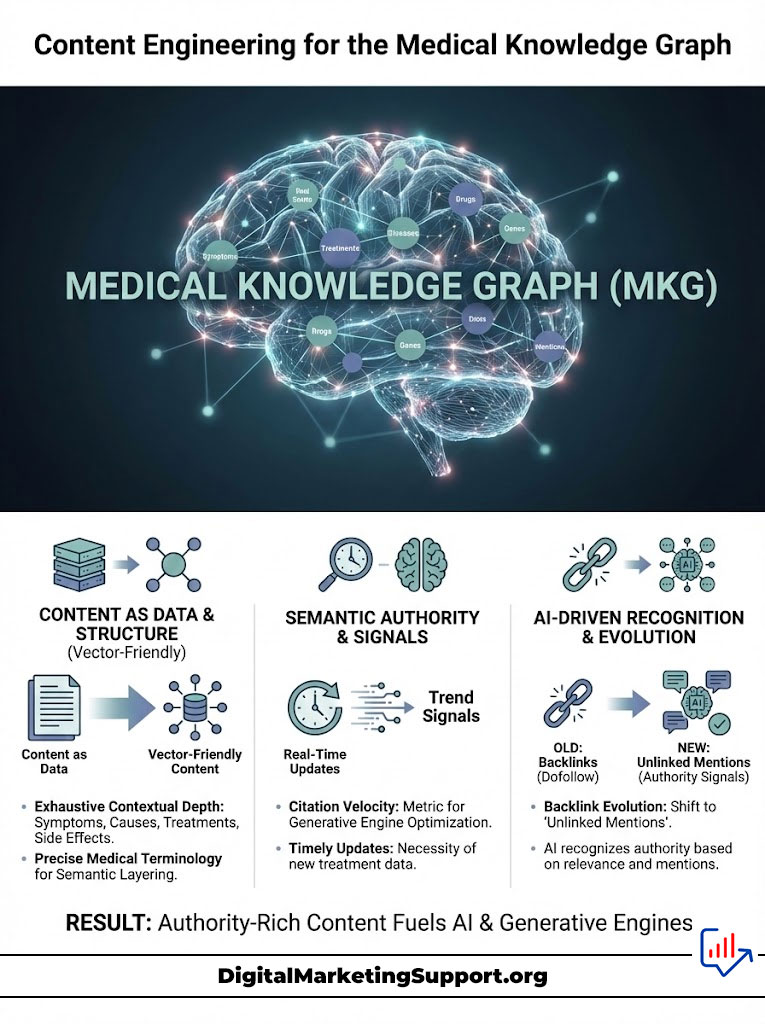
Content is no longer just words on a page. It is data for the Medical Knowledge Graph. We must engineer it accordingly. We must build it for the machine.
Creating “Vector-Friendly” Content
To win in Healthcare GEO, you must write content that sits close to the “center” of a topical vector. You must be the definitive source.
Contextual Depth: Covering a topic exhaustively creates a dense vector. You need to cover symptoms, causes, treatments, and side effects. Shallow content creates weak vectors. Weak vectors are easily discarded during the retrieval phase.
Terminology: Use precise medical terminology. Use “Myocardial Infarction” alongside “Heart Attack.” This “semantic layering” ensures you are visible to different types of prompts. It captures both professional and lay queries.
The Role of Citation Velocity
Citation Velocity is the speed at which your brand is being mentioned across the digital ecosystem. It is a critical metric for Generative Engine Optimization. It proves you are alive.
Trend Signals: If a new treatment emerges, do you cover it? If your practice is cited by local news and medical blogs simultaneously, AI marks you as a “current” authority. Stagnant brands are ignored by real-time models.
Backlink Evolution: We are moving from “Dofollow” links to “Unlinked Mentions.” AI reads the text. It doesn’t just follow the hyperlink. A mention of your practice name on a high-authority site is a powerful signal. It counts even without a link.
Strategic Implementation & Competitive Advantage
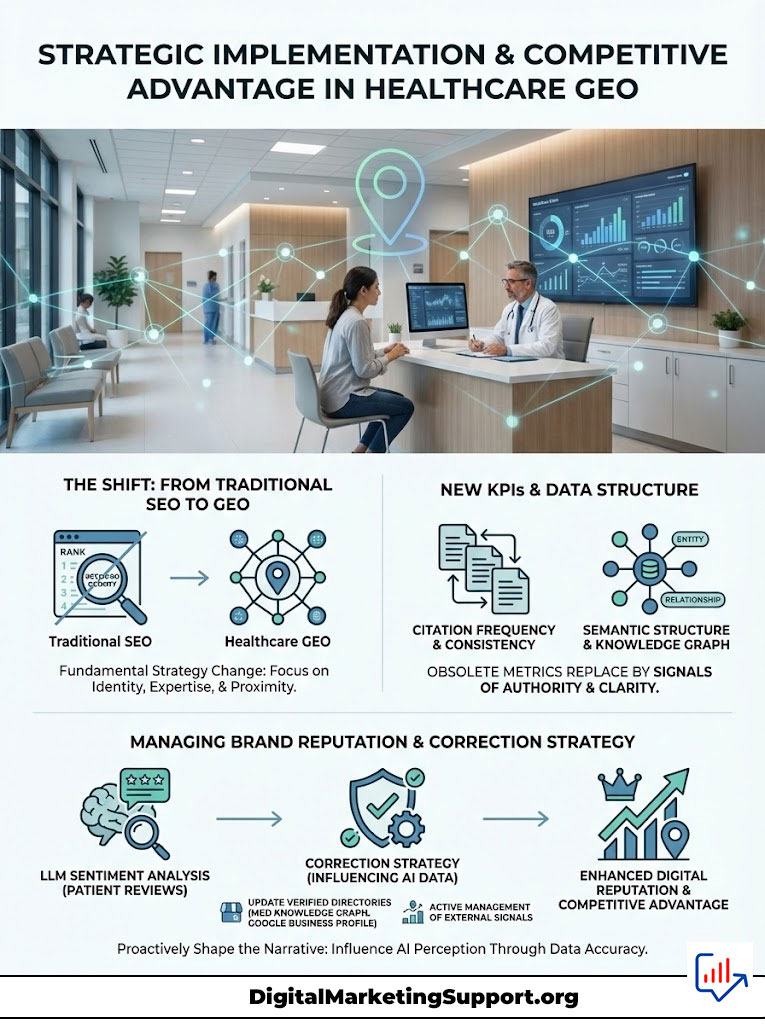
The transition to Healthcare GEO requires a fundamental change. You must change how you approach digital strategy. The old ways are dying.
Transitioning from Traditional SEO to GEO
Providers must pivot their resources. The old metrics of success are becoming obsolete. You need to measure what matters now.
| Metric | Traditional Medical SEO | Healthcare GEO (AI Optimization) |
|---|---|---|
| Goal | Rank #1 on Page 1 | Be cited in the Generative Snapshot |
| Primary KPI | Click-Through Rate (CTR) | Share of Model (SoM) / Citation Frequency |
| Content Focus | Keyword Density & Length | Information Gain & Semantic Structure |
| Technical Focus | Site Speed & Mobile UX | Schema.org & Vector Database Alignment |
| Authority Source | Backlink Quantity | NPI Verification & Clinical Consensus |
| User Journey | Linear (Search > Click > Read) | Conversational (Prompt > Refine > Solution) |
Managing Brand Reputation in LLMs
Your reputation is now data. Healthcare GEO involves managing how that data is interpreted. It is about sentiment.
Sentiment Analysis: LLMs read patient reviews. They scan Healthgrades. They scan Vitals. They gauge sentiment. They can summarize your reputation in seconds. “Dr. Jones is generally well-regarded but has frequent complaints about wait times.” You must actively manage these external signals.
Correction Strategy: How do you influence an AI that is providing incorrect data about your practice? You update the Medical Knowledge Graph. This involves correcting data on verified directories. Fix your WikiData. Fix your Google Business Profile. Fix your NPPES entry.
The Psychology of the AI Patient
To win the algorithm, you must understand the human behind the prompt. The way patients search is changing. It is becoming more intimate.
Conversational Search Patterns
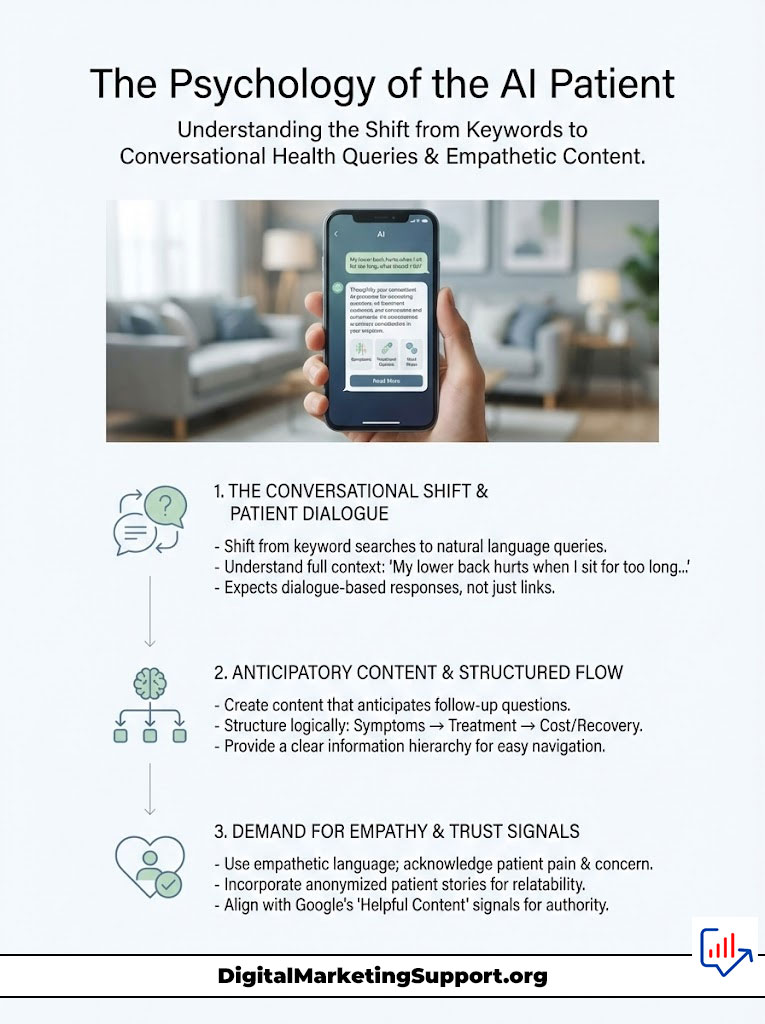
Patients are no longer typing “back pain doctor.” They are having conversations. They are asking, “My lower back hurts when I sit for too long, what should I do?” This is a dialogue.
The implication for GEO: Your content must mimic this dialogue. You need to anticipate the follow-up questions. If a patient asks about symptoms, their next question will be about treatment. Their third question will be about cost.
Anticipatory Content: Structure your pages to answer the full chain of queries. Create a logical flow. If you answer the first question but miss the second, the AI will go elsewhere to finish the conversation. You want to own the whole chat.
The Demand for Empathy
AI models are being trained to recognize sentiment and tone. They are favoring content that sounds human. They are moving away from sterile, academic text.
Empathy as a Signal: Use empathetic language. Acknowledge the patient’s pain. Say “We understand that chronic pain is exhausting.” This semantic layer of empathy helps match the user’s intent. It aligns with the “Helpful Content” signals that Google prioritizes.
Patient Stories: Incorporate anonymized case studies. Describe a patient journey from diagnosis to recovery. This provides a narrative structure that LLMs find easy to digest and retell. It adds color to the clinical data.
Technical Deep Dive: The Knowledge Graph
Let’s get technical. The Knowledge Graph is the brain of the search engine. It connects the dots. If you are not in the graph, you do not exist.
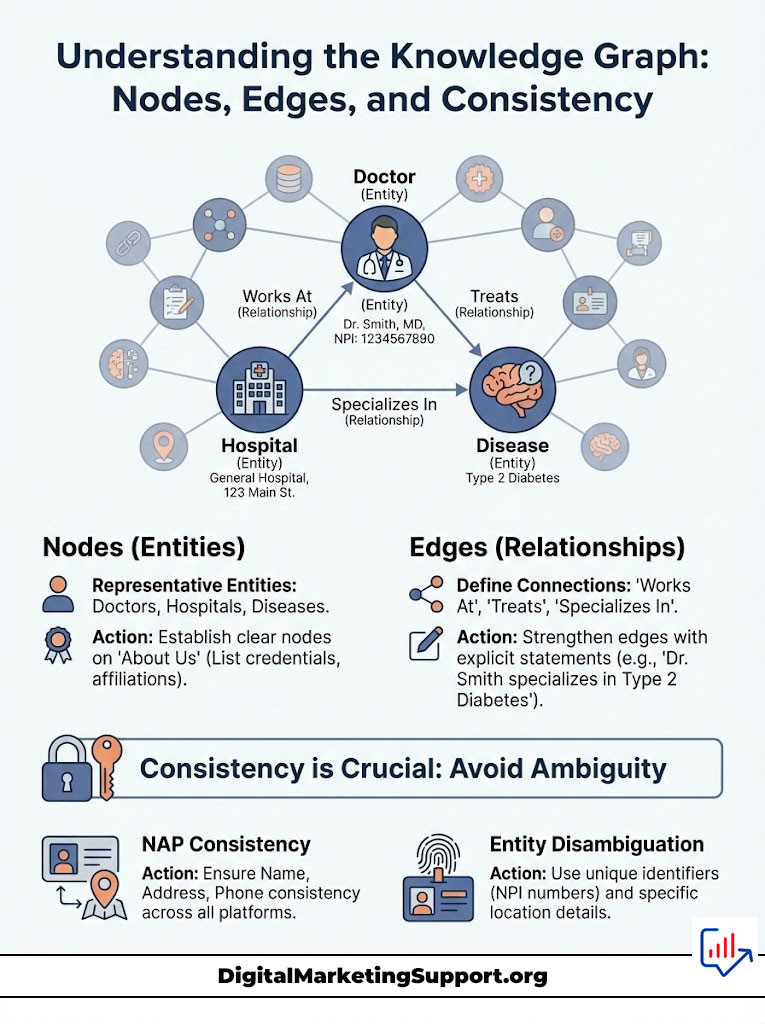
Nodes and Edges
Think of the Knowledge Graph as a giant web. The “Nodes” are entities (Doctors, Hospitals, Diseases). The “Edges” are the relationships between them (Works At, Treats, Is A Symptom Of).
Building Your Nodes: You must establish your nodes. Every physician in your practice is a node. Your clinic is a node. You need to define these clearly. Use your “About Us” page to list every credential. Link to every hospital affiliation.
Strengthening Your Edges: You need to define the relationships. Does Dr. Smith treat Diabetes? State it explicitly. “Dr. Smith specializes in the management of Type 2 Diabetes.” This creates a strong edge between the “Dr. Smith” node and the “Diabetes” node.
The Importance of Consistency
The Knowledge Graph hates ambiguity. It hates contradiction. If Healthgrades says you are in New York, but your website says New Jersey, the graph gets confused. It weakens the connection.
NAP Consistency: Name, Address, Phone. It sounds basic, but it is vital. It must be identical across the web. Even a difference in formatting (St. vs Street) can sometimes cause issues in lesser databases. Be disciplined.
Entity Disambiguation: There might be five doctors named “John Smith.” How does the AI know which one is you? It uses your NPI number. It uses your specific location. It uses your medical school alma mater. Provide these details to help the AI disambiguate you from the others.
Future-Proofing Your Practice
The speed of AI development is blistering. What works today might be obsolete tomorrow. You need a strategy that is resilient.
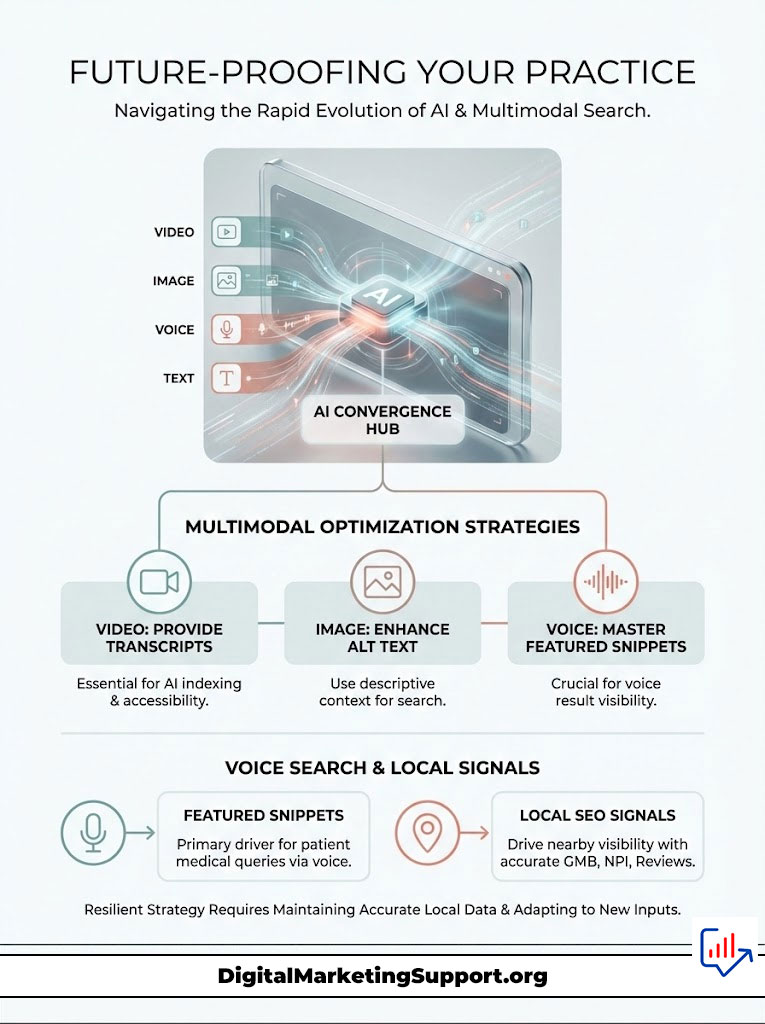
The Rise of Multimodal Search
Search is not just text anymore. It is images. It is video. It is voice. AI models like Gemini are multimodal. They can “see” and “hear.”
Video Optimization: Transcribe your videos. Put the transcript on the page. The AI can read the transcript. It can index the content. Video is a rich source of information that is often untapped.
Image SEO: Use descriptive alt text. Do not just say “Doctor.” Say “Dr. Jane Doe performing an ultrasound examination.” This helps the AI understand the visual context of your practice.
Voice Search and the Ambient Web
Patients are asking Alexa and Siri for medical advice. These devices rely on the same Knowledge Graph data. Winning Healthcare GEO helps you win voice search.
Featured Snippets: Voice assistants often read the Featured Snippet. This is the “position zero” result. To get there, you need concise, direct answers. You need high authority. Healthcare GEO is the path to the Featured Snippet.
Local Intent: Voice searches are often local. “Where is the nearest urgent care?” Your local SEO signals (GMB, NPI, Reviews) drive these results. Ensure your local data is pristine.
Summary & Key Takeaways
The battle for digital visibility in healthcare has moved. It has shifted to the Medical Knowledge Graph. To win, you must treat your digital presence as a clinical dataset. It is not just a marketing brochure anymore. It is a database.
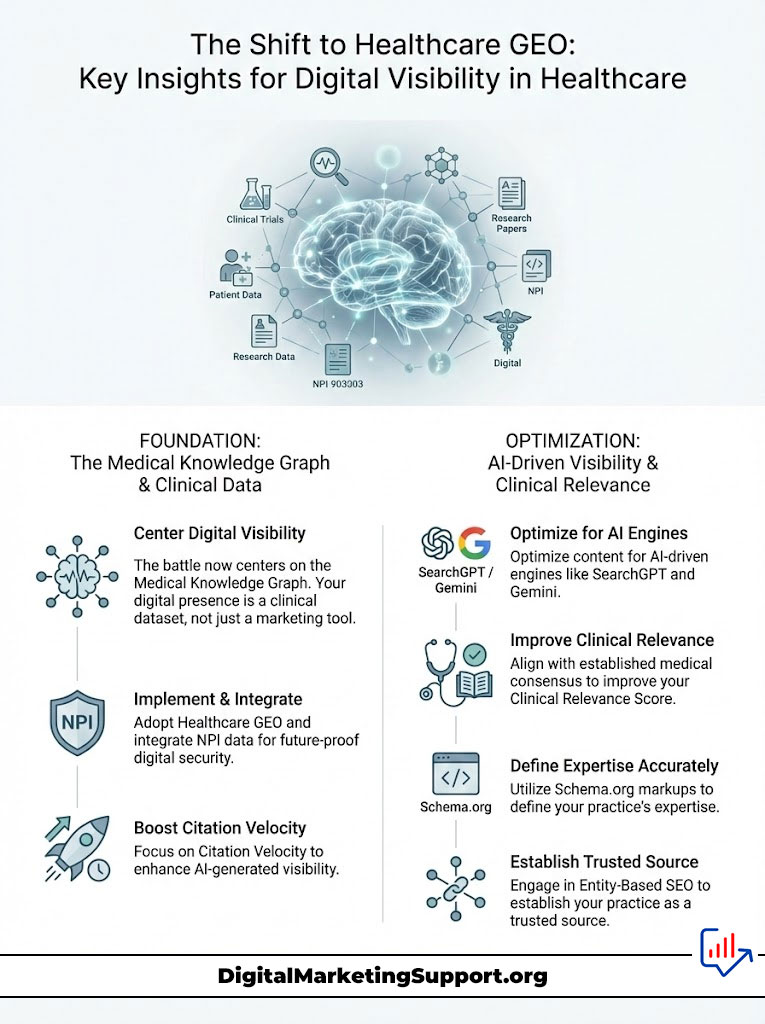
By implementing Healthcare GEO, you secure your future. You must integrate NPI data. You must focus on Citation Velocity. You must optimize for the machine. Your organization can secure its place as the trusted authority in the AI-driven future.
Actionable Takeaways:
- Audit for Entities: Ensure Google sees you as an entity, not a keyword. Check your Knowledge Panel. Is it accurate?
- Implement Schema: Mark up every physician and service with MedicalEntity code. This is non-negotiable.
- Cite Authority: Back every claim with a link to a .gov or .org source. This boosts your Clinical Relevance Score.
- Monitor AI Results: Regularly prompt Google Gemini and SearchGPT. Use queries relevant to your practice. Check for citation.
- Focus on NPI: Ensure NPI Data Integration is flawless. Check it across all digital touchpoints.
The era of Healthcare GEO is here. The question is not if you will adapt. The question is how fast. The providers who move now will define the answers of tomorrow.
Frequently Asked Questions
What is the difference between traditional Medical SEO and Healthcare GEO?
Traditional SEO focuses on keyword rankings and driving clicks to your website, whereas Healthcare GEO (Generative Engine Optimization) aims to make your practice the primary cited source in AI-generated answers. It shifts the strategic focus from “ten blue links” to becoming a verified entity within the Medical Knowledge Graph used by engines like SearchGPT and Gemini.
How does Retrieval-Augmented Generation affect my medical practice’s online visibility?
RAG is the process AI models use to pull real-time, authoritative data from the web to answer complex patient queries. If your clinical content is semantically dense and well-structured, it is more likely to be retrieved and cited as a “Source of Truth” during the AI’s generation phase rather than being ignored as background noise.
Why is NPI data integration critical for winning AI search citations?
The National Provider Identifier (NPI) serves as a primary key for identity verification within the neural networks of LLMs. By hard-coding NPI data into your site’s metadata, you allow AI models to cross-reference your claims against federal databases, significantly boosting your Clinical Relevance Score and overall authority.
What specific Schema.org markups are best for Healthcare GEO?
Beyond standard LocalBusiness markup, you should implement MedicalEntity, Physician, and MedicalSpecialty schema types to define your expertise. Using the “citation” attribute to link your clinical claims to peer-reviewed studies in PubMed or JAMA further connects your practice to high-authority nodes in the Medical Knowledge Graph.
How can I optimize my medical content for Perplexity AI’s source carousel?
Perplexity favors academic-style data, so structuring your content like a medical abstract—using Background, Methods, and Results sections—increases your chances of inclusion. Additionally, ensure your posts include outbound links to authoritative bodies like the CDC or NIH to validate your clinical claims through semantic association.
What is Citation Velocity and how does it influence AI rankings?
Citation Velocity measures the frequency and speed at which your practice is mentioned across the digital ecosystem, including news sites, medical blogs, and directories. High velocity signals to AI models that your practice is a current, active authority, making you more likely to appear in real-time generative snapshots for trending medical queries.
How do I improve my practice’s Clinical Relevance Score for AI models?
You must align your content with established medical consensus and provide precise, structured data to minimize the risk of AI hallucinations. AI safety filters prioritize content that matches established datasets from the NIH or CDC, so avoid outlier claims and ensure all content is medically reviewed by a licensed professional.
What role does Entity-Based SEO play in modern healthcare marketing?
Entity-Based SEO moves away from simple keywords toward defining complex relationships between your name, specialty, and the conditions you treat. By establishing your practice as a distinct “Entity” in the Knowledge Graph, you ensure AI models understand the specific context of your clinical expertise and can serve it to the right patients.
How can I optimize my practice for SearchGPT’s conversational answer boxes?
SearchGPT prioritizes directness and “Zero-Click” formatting, so you should answer the primary query immediately in your first paragraph. Integrating PR mentions from reputable news outlets also helps, as SearchGPT heavily weights real-time news index data when synthesizing responses for users.
Why is authorship and peer review essential for AI-driven search?
AI models are trained to favor content with clear authorship from verifiable medical professionals to ensure patient safety. Implementing a “Medically Reviewed By” process with links to the reviewer’s NPI and credentials creates a powerful trust signal that helps your content bypass strict generative engine safety filters.
How do Large Language Models handle patient sentiment and reputation?
LLMs perform sentiment analysis on reviews from platforms like Healthgrades and Vitals to gauge a provider’s reputation in seconds. To manage this, you must ensure your data is consistent across all directories and actively address negative sentiment that could influence how an AI summarizes your practice to potential patients.
How can multimodal search optimization benefit my medical practice?
As AI models like Google Gemini become multimodal, they can index transcripts from your patient education videos and descriptive alt-text from clinical images. Optimizing these non-text assets allows your practice to be discovered through voice search and visual queries, broadening your reach in the increasingly ambient digital environment.
Disclaimer
This article is for informational and marketing strategy purposes only and does not constitute medical, legal, or financial advice. The strategies discussed regarding Healthcare GEO and AI optimization are based on evolving digital trends and should be implemented by qualified digital marketing professionals. Always verify NPI data and clinical claims against official federal and medical board guidelines.
References
- NPPES (National Plan and Provider Enumeration System) – https://nppes.cms.hhs.gov/ – The official registry for NPI data integration and identity verification for healthcare providers.
- Schema.org (MedicalEntity) – https://schema.org/MedicalEntity – Documentation for structured data types used to define medical concepts for LLMs.
- Google Search Central – Local Business Schema – Guidelines for implementing structured data that feeds the Google Knowledge Graph.
- OpenAI – SearchGPT Prototype – Official insights into how generative search models retrieve and cite real-time web data.
- Perplexity AI – Perplexity.ai – Primary platform for complex medical research queries and structured citation analysis.
- Journal of Medical Internet Research (JMIR) – jmir.org – Authoritative source for studies on patient search behavior and the rise of AI in medical triage.