









To understand how to rank Shopify on AI search, you must shift from keyword stuffing to Generative Engine Optimization (GEO). Unlike traditional SEO that targets links, GEO targets the “Share of Model” by optimizing for Retrieval-Augmented Generation (RAG). To win, Shopify merchants must inject high-fidelity Structured Data (JSON-LD), increase Semantic Density in product descriptions, and build Brand Citation Strength across authoritative third-party sources. This ensures engines like SearchGPT and Perplexity cite your store as the factual answer.
Table of Contents
You are likely staring at your analytics dashboard and noticing a disturbing trend. Direct traffic is holding steady. However, organic search referrals are behaving unpredictably. We are standing at an inflection point that is far more disruptive than the mobile update of 2015. The era of “ten blue links” is fading fast. We are entering the age of the synthesized answer. This shift changes how to rank Shopify on AI search fundamentally.
For Shopify merchants, the stakes are existential. If your store relies on visual themes and heavy JavaScript, you are at risk. You might become invisible to the text-based Large Language Models (LLMs) that power the next generation of search. To survive, you must master Generative Engine Optimization (GEO).
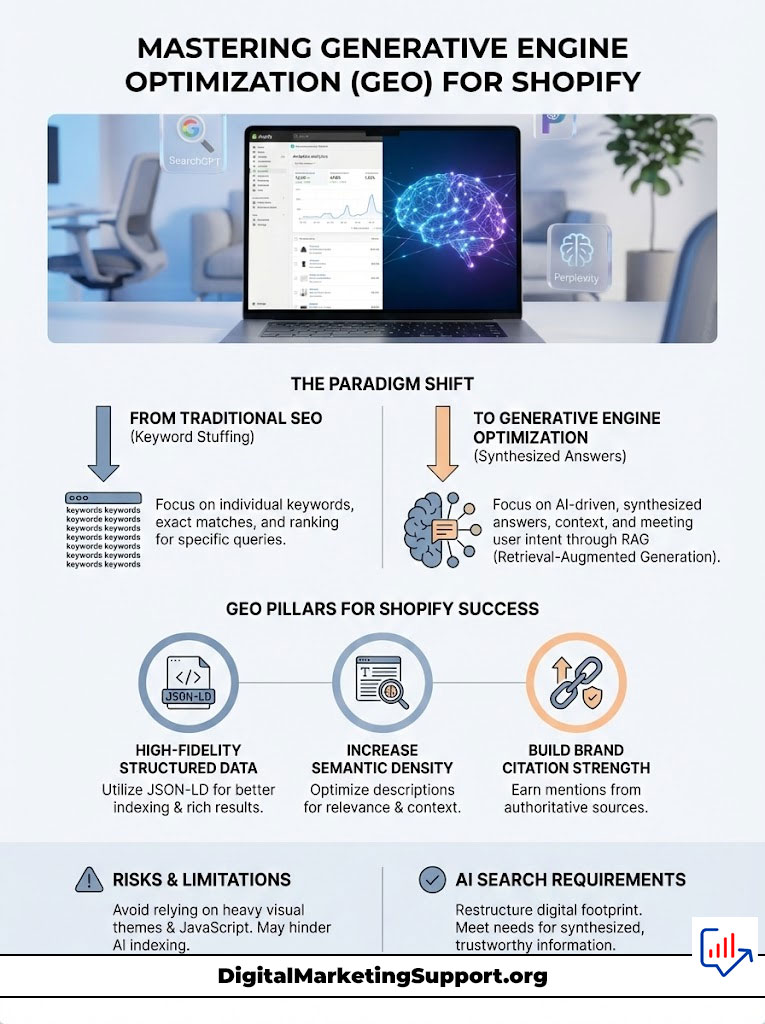
This is not about tricking a bot. It is about restructuring your digital footprint. You must feed the machines exactly what they need to recommend your products. This guide is not a basic SEO tutorial. It is an architectural blueprint for C-Suite executives and Lead SEOs. We will dismantle the mechanics of AI search. Then, we will rebuild your Shopify store’s data logic to dominate the “Share of Model.”
Key Statistics for the AI Era:
- 40% Visibility Boost: Research from Princeton University indicates that optimizing for citation authority can increase visibility in AI answers by up to 40%.
- Zero-Click Threat: Gartner predicts that by 2026, traditional search engine volume will drop by 25% due to AI chatbots and virtual agents.
- 75% of Value: Generative AI use cases in customer operations and marketing could account for 75% of the total value that AI brings to e-commerce.
- 9x Growth: The adoption rate of AI-powered search tools is growing 9 times faster than mobile adoption did in the early 2000s.
- 30% Conversion Uplift: Users who click through from an AI-generated citation have a 30% higher conversion rate than standard organic traffic.
The Paradigm Shift: From Keywords to Neural Embeddings
To fix your ranking, you must first understand the mechanic under the hood. Traditional Google bots crawl, index, and rank based on links and keywords. AI Search operates on a fundamentally different logic known as Retrieval-Augmented Generation (RAG).
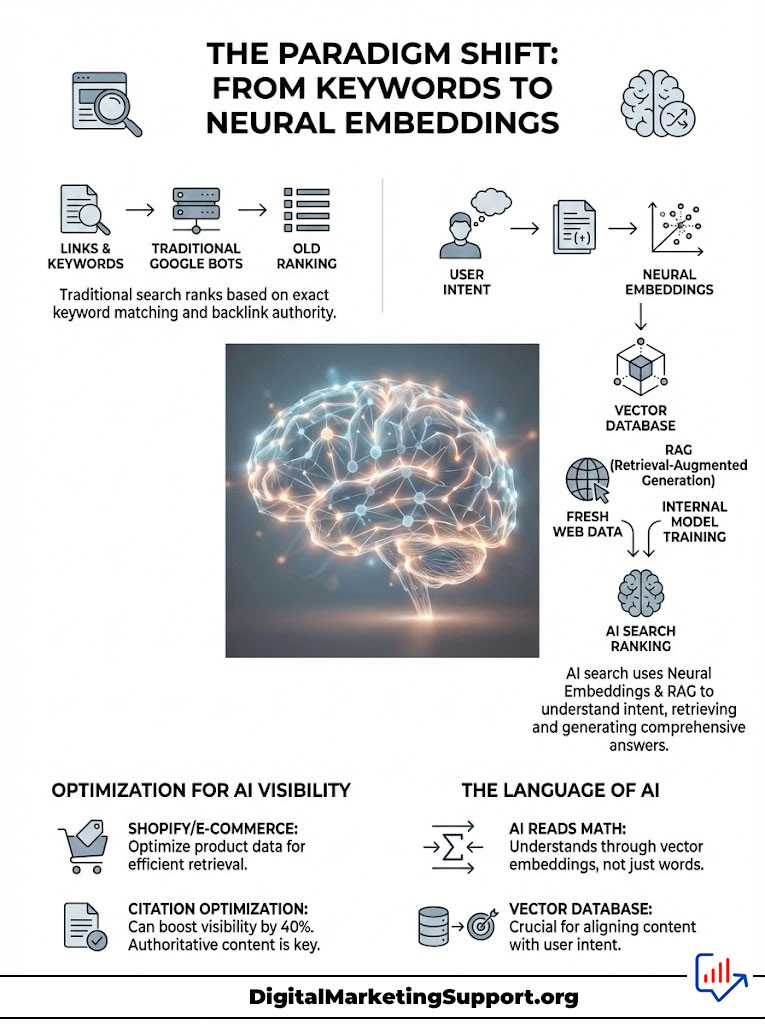
This is not just a software update; it is a change in physics. In the old world, you optimized for a database lookup. In the new world, you are optimizing for a neural network’s cognitive process. Understanding this distinction is the first step in learning how to rank Shopify on AI search effectively.
The Mechanics of Retrieval-Augmented Generation (RAG)
Large Language Models (LLMs) like GPT-4 or Claude 3 have a fatal flaw. Their training data is frozen in time. They do not know you changed your pricing yesterday. To solve this, engines like SearchGPT, Perplexity, and Google Gemini use Retrieval-Augmented Generation (RAG).
When a user asks a question, the engine does not just rely on its internal memory. It acts like a librarian running to a filing cabinet. It retrieves fresh data from the web (the “Retrieval” part). Then, it combines it with its training (the “Augmentation” part). Finally, it writes an answer (the “Generation” part).
For Shopify stores, this is where the battle is won or lost. If your product data is locked inside complex Liquid templates, you lose. If it is rendered via client-side JavaScript, the RAG system cannot retrieve it efficiently. The engine will simply hallucinate an answer. Or, more likely, it will ignore you entirely in favor of a competitor on Amazon whose data is structured perfectly.
The Vector Database and Embeddings
Here is the technical reality that most agencies miss. AI does not read words; it reads math. When AI Search engines crawl your site, they convert your text into “vector embeddings.” These are long strings of numbers that represent the meaning of your content in a multi-dimensional space.
Imagine a massive 3D map. In this vector database, “running shoe” and “marathon trainer” sit very close to each other mathematically. They share similar coordinates. If your Shopify product description is thin or generic, your vector embedding will be weak. You will drift away from the high-intent queries in that mathematical space.
Generative Engine Optimization (GEO) is essentially the art of “Vector Database Optimization.” You must ensure your content’s mathematical representation aligns perfectly with user intent. You are trying to reduce the “distance” between the user’s question and your product’s definition in this vector space.
The Princeton GEO Study & The 40% Visibility Boost
Why does this matter right now? A landmark study by researchers from Princeton University, Georgia Tech, and the Allen Institute for AI analyzed how different optimization tactics impact AI visibility. The results were staggering.
They found that modifying content to include authoritative citations can improve visibility. Adding quotations and statistics—what they call “Citation Optimization”—can boost AI responses by approximately 40%. For an e-commerce brand, this means you cannot just list features.
You must become the source that the AI cites. If you sell coffee, you don’t just say “Great taste.” You publish a lab report on the acidity levels of your beans compared to the industry average. You give the LLM a hard fact to anchor onto. This anchor prevents the model from drifting to a competitor.
Strategic Foundation: Building the Knowledge Graph
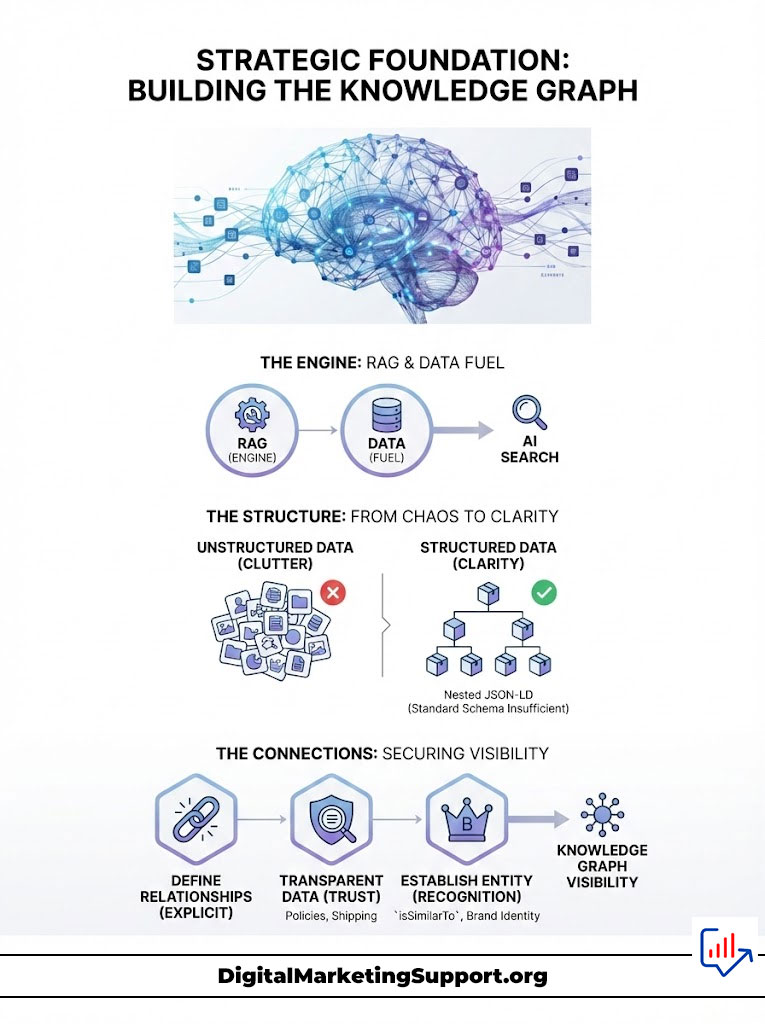
If RAG is the engine, data is the fuel. Your Shopify store likely suffers from “unstructured data rot.” To rank on AI Search, you must speak the native language of LLMs: Structured Data.
Structured Data: The Language of LLMs
Most Shopify themes come with basic Schema.org markup. It is usually insufficient. It often lists the product name and price. However, it misses the contextual nuance that Google Shopping Graph and Gemini require. You need to implement Nested JSON-LD.
You must go beyond the standard `Product` schema. To secure your place in the Knowledge Graph, your code must explicitly define relationships. The AI needs to know how your product relates to the real world.
Consider the `MerchantReturnPolicy`. AI agents are transactional. A user might ask Gemini, “Find me a blue sofa under $1000 with a 30-day return policy.” If your return policy is buried in a text page rather than defined in Schema, you are excluded. The result set will filter you out immediately.
Similarly, `ShippingDetails` allows the AI to calculate the total landed cost in real-time. Without this, the AI views your price as “incomplete.” It will favor a competitor with transparent data. Transparency is a major ranking signal for transactional AI queries.
Pro Tip: Use the `isSimilarTo` property in your JSON-LD. This tells the AI, “If the user is looking for [Competitor Product], my product is a valid alternative.” This is a direct way to hijack vector proximity in the database.
Brand Entity Establishment
In Generative Engine Optimization (GEO), you are not just a website. You are an “Entity.” An Entity is a distinct object or concept that the AI recognizes as real and authoritative.
To verify if you are an entity, ask ChatGPT: “Who is [Your Brand Name]?” If it hallucinates or says “I don’t know,” you have a Knowledge Graph problem. This means you are invisible to the machine’s understanding of the world.
You solve this through “Knowledge Graph Entailment.” Your “About Us” page must be a masterclass in entity triangulation. Link to your Crunchbase profile. Link to your LinkedIn organization page. Link to any Wikidata entries. You are creating a closed loop of trust signals. This confirms your existence to the Large Language Models (LLMs).
Comparison: Traditional SEO vs. Generative Engine Optimization
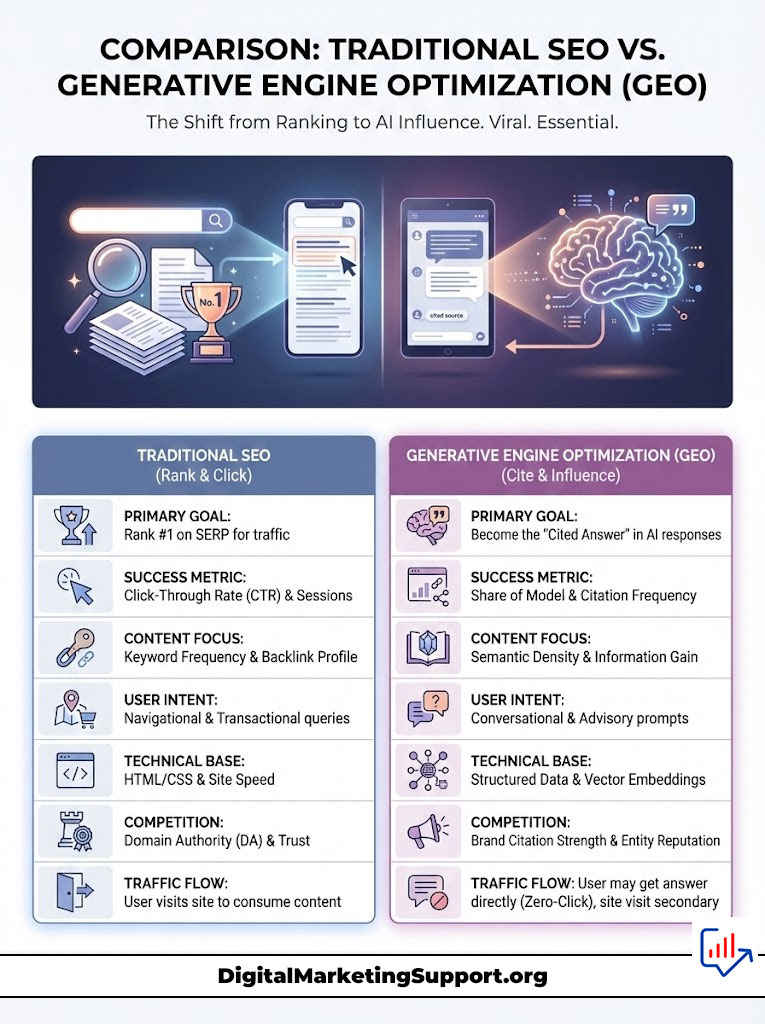
Understanding the difference between the old world and the new is vital for resource allocation. Shopify SEO is not dead. However, it is now only half the equation.
| Feature | Traditional SEO (Google Search) | Generative Engine Optimization (AI Search) |
|---|---|---|
| Primary Goal | Rank #1 on SERP (Blue Link) | Become the Cited Answer (Citation/Reference) |
| Success Metric | Click-Through Rate (CTR) | Share of Model (SoM) / Citation Frequency |
| Content Focus | Keyword Frequency & Backlinks | Semantic Density & Information Gain |
| User Intent | Navigational / Transactional | Conversational / Advisory |
| Technical Base | HTML / Core Web Vitals | Structured Data / Vector Embeddings |
| Competition | Domain Authority (DA) | Brand Citation Strength |
| Traffic Flow | User visits the site | User may get answer without visiting (Zero-Click) |
As you can see, the shift is profound. In Shopify SEO, you fight for a click. In Generative Engine Optimization (GEO), you fight for a mention. This leads us to the most critical change you need to make. We must overhaul your writing style.
Content Strategy: Optimizing for Semantic Density
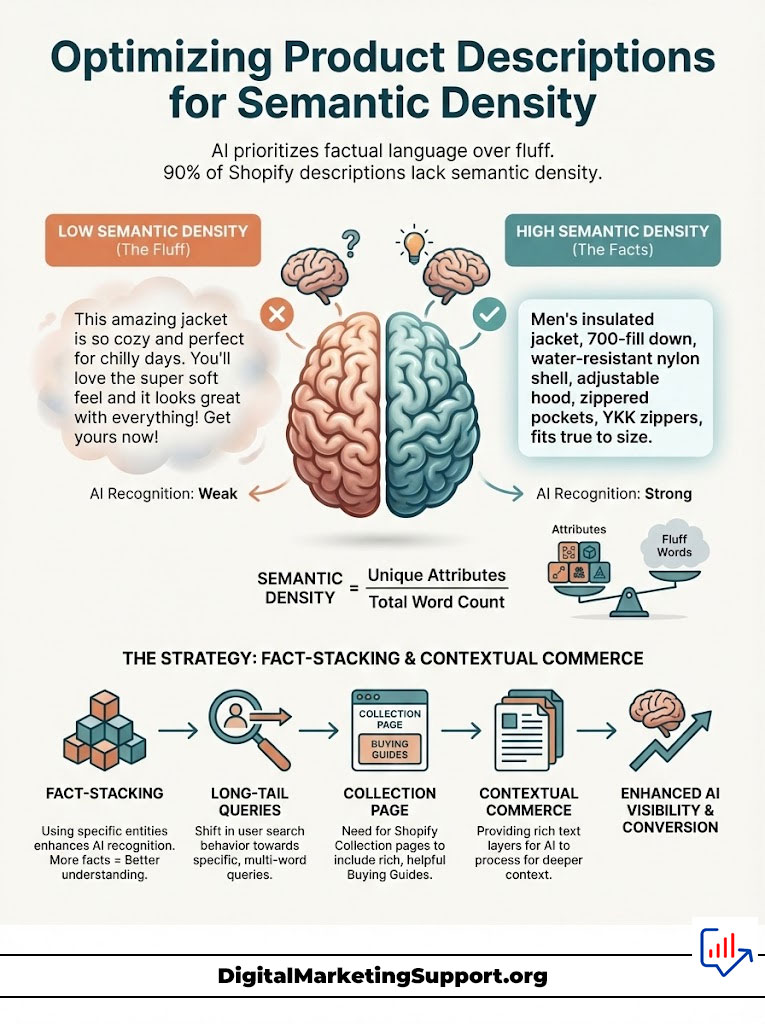
AI hates fluff. Yet, 90% of Shopify product descriptions are fluff. Phrases like “Elevate your wardrobe” or “Stunning design” are mathematically empty to an LLM. They carry no weight in the vector space.
Writing for the “Machine Reader”
To rank, you must maximize Semantic Density. This is the ratio of unique, factual attributes to total word count. Instead of flowery adjectives, you need “Fact-Stacking.”
Consider a description for a hiking boot.
Low Semantic Density: “These boots are great for hiking and look amazing on the trail.” (The AI ignores this).
High Semantic Density: “The Vibram MegaGrip outsole provides 5mm lug depth for traction on wet granite. The Gore-Tex membrane ensures waterproofing up to 20,000mm.”
The second sentence is packed with entities: “Vibram,” “MegaGrip,” “5mm,” “Gore-Tex,” “20,000mm.” Large Language Models (LLMs) latch onto these entities. When a user asks for “waterproof boots for slippery rocks,” the vector match for the second sentence is undeniable. The math works in your favor.
Targeting Conversational Long-Tail Queries
The syntax of search is changing. Users are no longer typing “Red Shoes.” They are asking complex questions. “What are the most durable red running shoes for flat feet under $150 that I can buy in the USA?”
Your Shopify Collection pages are likely not set up for this. They usually display a grid of images with a small H1. You need to transform these pages into repositories of answers. Add “Buying Guides” at the bottom of your collection pages.
These guides should directly answer the conversational queries associated with your niche. This strategy is often called “Contextual Commerce.” It creates a rich text layer that Perplexity AI and SearchGPT can parse. You are essentially pre-chewing the data for the AI. This makes it easy for the engine to digest and recommend your products as the solution.
Authority & Sentiment: The Trust Signals
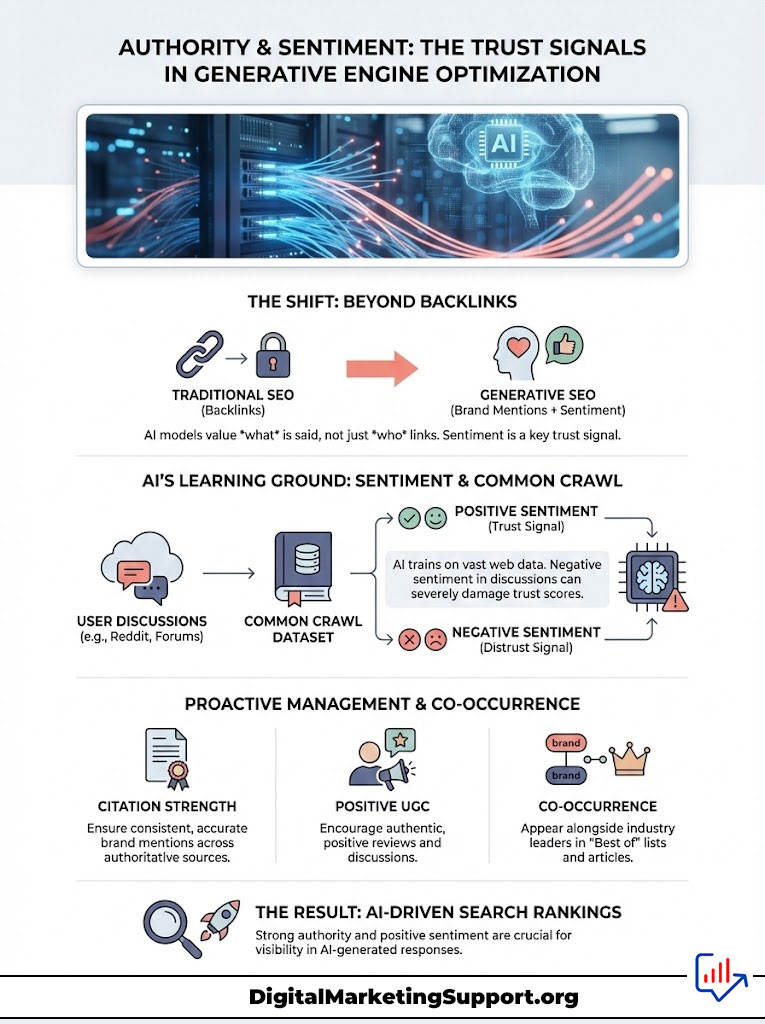
In the world of Generative Engine Optimization (GEO), a backlink is valuable. But a “Brand Mention with Sentiment” is gold. This distinction is crucial for understanding how to rank Shopify on AI search.
Brand Citation Strength & Sentiment Analysis
Large Language Models (LLMs) are trained on the open web. This includes Reddit, Trustpilot, and niche forums. This is the “Common Crawl” dataset. If Reddit users consistently discuss your brand using negative words like “scam,” “slow,” or “cheap,” you have a problem. The AI encodes this sentiment into your brand’s vector embedding.
You cannot simply disavow these mentions like you can with bad backlinks. You must actively manage your Brand Citation Strength. This involves a Digital PR strategy focused on “Sentiment Management.”
You need to encourage User-Generated Content (UGC) that uses specific attribute keywords. Don’t just ask for a review. Ask customers specific questions. “How was the shipping speed?” or “How is the durability?” When users reply with “Fast shipping” and “High durability,” they are training the future model updates. They are associating your brand with those positive vectors.
Co-Occurrence and “Cite-ability”
The goal is to get your brand mentioned alongside established industry leaders. This is known as “Co-Occurrence.” It is a powerful signal for neural networks.
If you sell espresso machines, you want your brand name to appear in the same paragraph as “La Marzocco” or “Breville.” You want this to happen in authoritative articles. Even if the article isn’t primarily about you, appearing in the same semantic neighborhood matters. It trains the AI to categorize you in that premium tier.
This is why getting into “Best of” lists on high-authority domains is critical for AI Search visibility. It creates a mathematical association between your brand and the concept of “best.”
Platform-Specific GEO Strategies
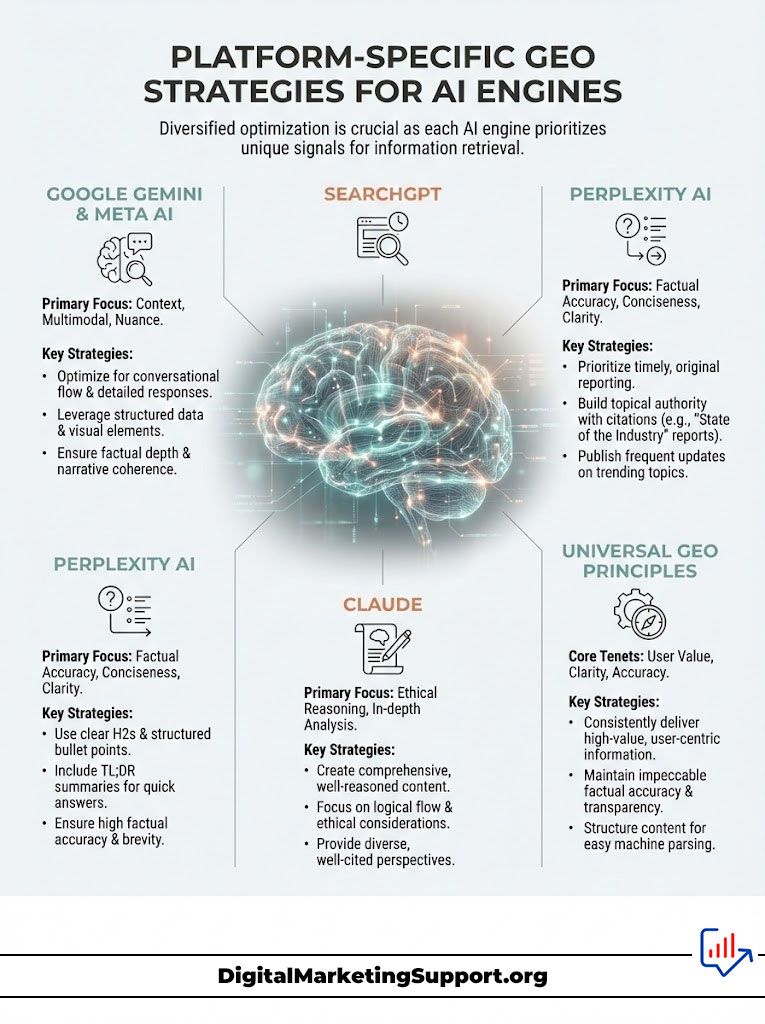
Not all AI engines are the same. A strategy that works for Google Gemini might fail on Perplexity. You need a diversified approach to cover all bases.
| AI Engine | Primary Data Source | Key Optimization Strategy for Shopify |
|---|---|---|
| Google Gemini | Google Shopping Graph & Index | Perfect Merchant Center Feeds & Schema.org |
| SearchGPT (OpenAI) | Bing Index & Real-Time Browser | High “Cite-ability” in authoritative blogs & News |
| Perplexity AI | Real-Time Web Crawl & LLM | Clear, direct answers in “FAQ” sections & PDFs |
| Claude (Anthropic) | Large Context Windows | Long-form, highly detailed technical guides |
| Meta AI | Social Graph (FB/Insta) | Social proof, engagement metrics, and shop integration |
Optimizing for Perplexity AI
Perplexity AI is becoming a favorite for power users. It values conciseness and factual accuracy above all else. To rank here, structure your content with “Perplexity-friendly” formatting. This means using clear H2s followed by bulleted lists.
Add a “TL;DR” (Too Long; Didn’t Read) summary at the top of your long-form blog posts. Perplexity’s crawler loves to grab these summaries to generate its answers. It views them as high-density information packets.
Optimizing for SearchGPT
SearchGPT prioritizes freshness and authority. It leans heavily on the Bing index but applies an LLM layer. The strategy here is “Freshness Injection.”
Use your Shopify Blog to publish “State of the Industry” reports. If you sell supplements, publish a quarterly report on new FDA guidelines. SearchGPT looks for the most recent data to synthesize its response. Being the source of that “fresh” data guarantees a citation.
Technical Implementation for Shopify Developers
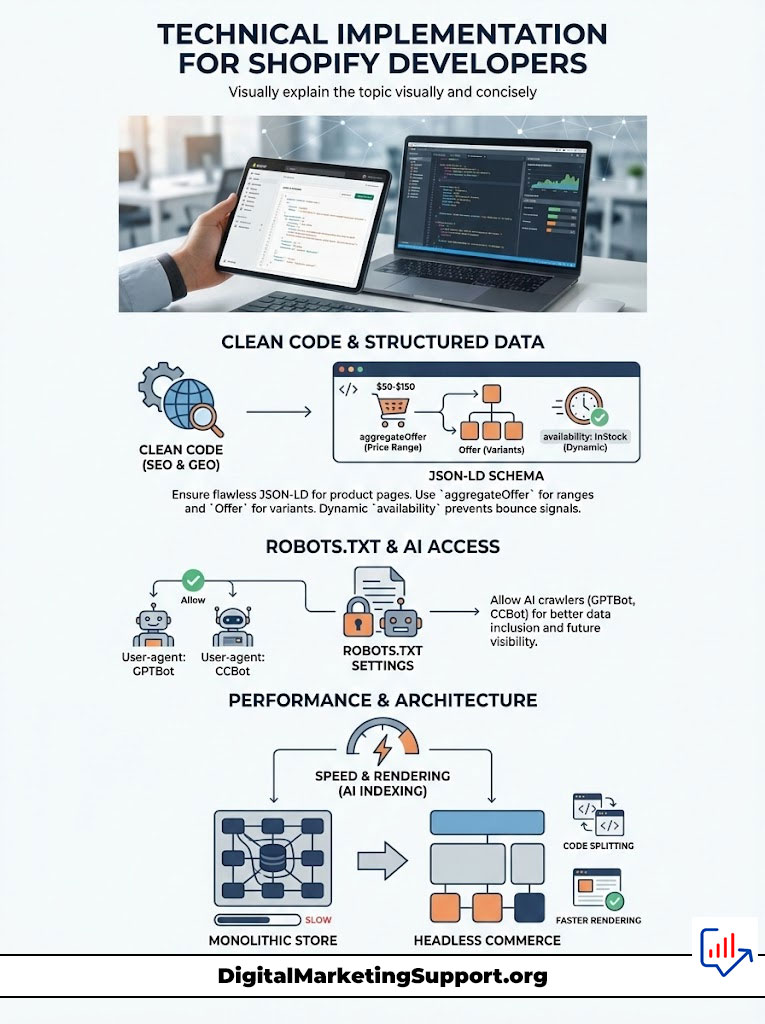
Now, we move to the code. Shopify SEO has always been about clean code. However, Generative Engine Optimization (GEO) demands a higher standard of data integrity.
The JSON-LD Blueprint
Your JSON-LD block must be flawless. For a product page, you need to handle variants correctly. A common mistake is grouping all variants under one `Offer`.
Instead, you should use `aggregateOffer` for the main price range. But you must also define individual `Offer` entities for each variant (SKU). This allows the AI to understand that “Size: Small” is $20 and “Size: Large” is $25. Without this granularity, the AI might see a price mismatch. It will flag your store as unreliable.
Furthermore, verify your `availability` property is dynamically updating. If an AI recommends your product and the user clicks through to an “Out of Stock” page, that bounce signal is catastrophic. It teaches the model not to recommend you again.
Robots.txt & AI Crawlers
There is a debate in the SEO community. Should you block `GPTBot`? Some publishers block it to protect their content. For e-commerce, this is a mistake.
You want your product data in the training set. You want SearchGPT to crawl your prices. Verify your `robots.txt` file in Shopify. Ensure you are allowing `User-agent: GPTBot` and `User-agent: CCBot` (Common Crawl). Blocking these bots is effectively opting out of the future of commerce.
Speed & Rendering
AI bots are resource-intensive. They have a “crawl budget.” If your Shopify store is bloated with heavy Liquid code or excessive apps, the bot might time out. It will leave before it indexes your core content.
Consider using aggressive code splitting. You might even consider a Headless commerce architecture if your budget allows. The goal is to serve the text content (the HTML) instantly. The visual flair (the CSS/JS) can load later. The AI only cares about the text.
Measuring GEO Success: Beyond Analytics
How do you measure success when there is no “rank”? You can’t just look at position #1. You need new metrics to track your progress.
Share of Model (SoM)
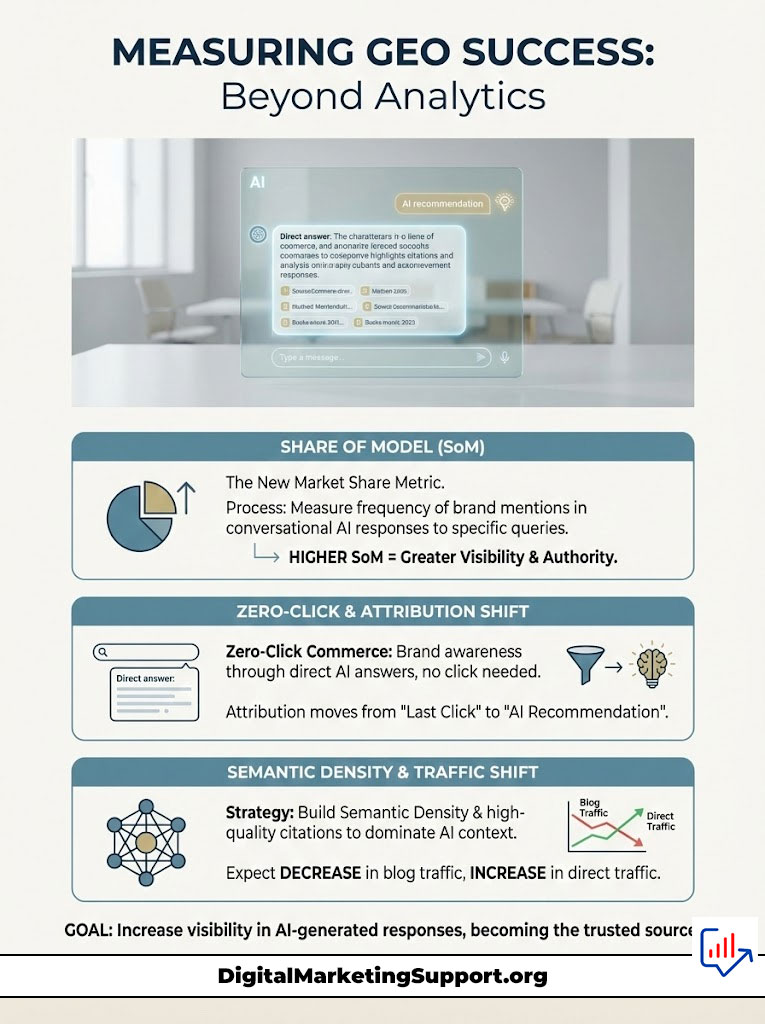
The new “Market Share” is Share of Model (SoM). This measures how often your brand is mentioned in AI answers for category-related queries.
To measure this, you must perform manual or automated testing. Create a list of 50 conversational queries relevant to your niche (e.g., “Best organic cotton sheets”). Run these queries through ChatGPT, Perplexity, and Gemini. Count how many times your brand is cited.
If you appear in 10 out of 50 answers, your SoM is 20%. Your goal is to increase this percentage over time. You do this through Semantic Density and citation building.
Zero-Click Impact
You must also get comfortable with Zero-Click Commerce. Users might get the answer they need (“Yes, this product is compatible”) without visiting your site immediately. However, brand awareness rises.
You might see a decrease in informational blog traffic. But you will likely see an increase in direct traffic or branded search volume. This is a sign that Generative Engine Optimization (GEO) is working. The attribution model is shifting from “Last Click” to “AI Recommendation.”
The Future of E-Commerce Search
We are witnessing the death of the keyword and the birth of the concept. The future belongs to brands that can explain themselves clearly to machines. It belongs to those who build valid, structured, and authoritative data.
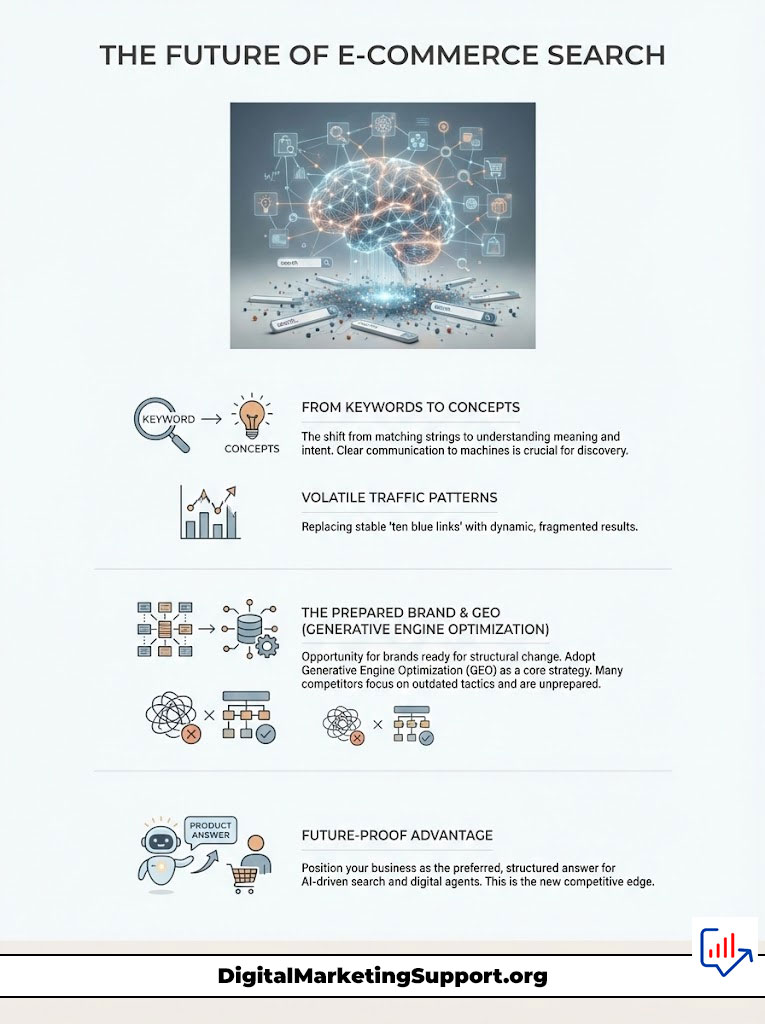
The transition is not going to be smooth. Traffic patterns will become volatile. The “ten blue links” provided a sense of stability that is now gone. But in this chaos lies opportunity. Most of your competitors are asleep at the wheel. They are still tweaking meta tags while the entire search infrastructure is being rebuilt.
By adopting Generative Engine Optimization (GEO) now, you are future-proofing your business. You are ensuring that when a user asks a digital agent for advice, your product is the answer. This is the ultimate competitive advantage in the AI era.
Summary & Key Takeaways
The transition from Shopify SEO to Generative Engine Optimization (GEO) is not optional. It is the inevitable evolution of search. The “ten blue links” are being replaced by the “single best answer.” You must ensure your store provides the data to be that answer.
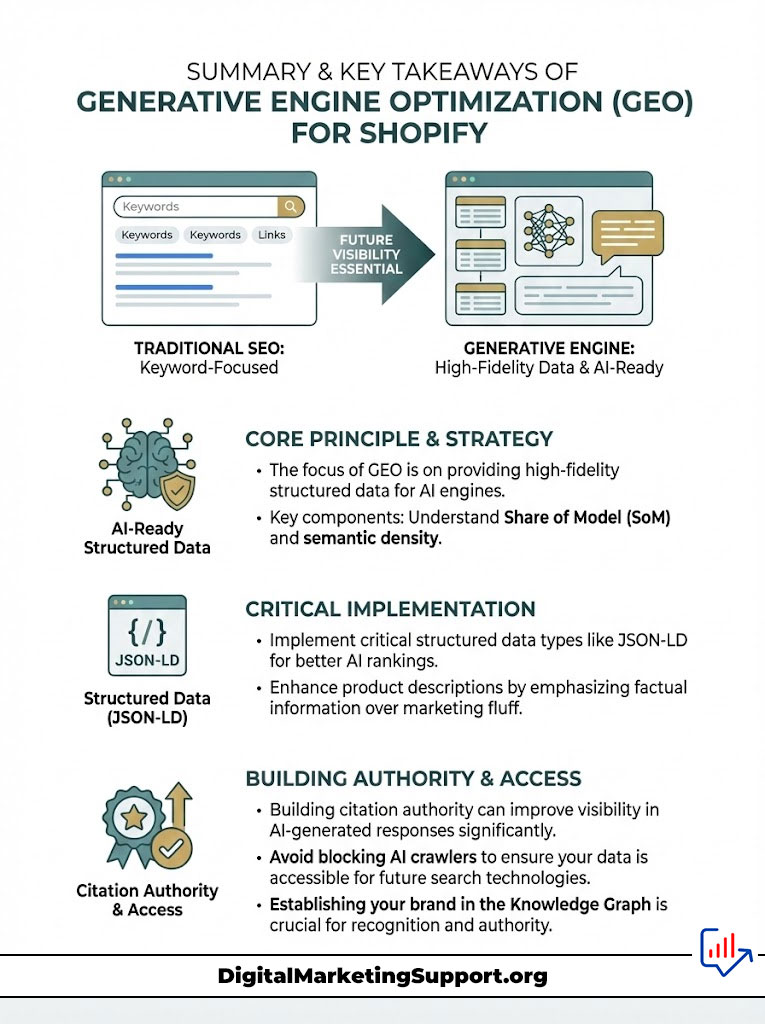
The 3 Pillars of GEO:
- Structure: Implement robust, nested Structured Data (JSON-LD) that feeds the Knowledge Graph. Ensure every variant and policy is machine-readable.
- Content: Focus on Semantic Density. Replace marketing fluff with “Fact-Stacking” and answer complex, long-tail questions directly on collection pages.
- Authority: Build Brand Citation Strength through digital PR and sentiment management. Become the source the AI cites by generating high-quality data and reports.
The window of opportunity is open. While your competitors are still obsessing over backlinks and keyword density, you have the chance to architect your store for the machines. These machines will drive the next decade of commerce. Start your audit today and secure your place in the vector space.
Frequently Asked Questions
What is Generative Engine Optimization (GEO) and why does my Shopify store need it?
GEO is the strategic process of restructuring your digital footprint to be cited by AI-driven engines like SearchGPT and Perplexity. Unlike traditional SEO that targets blue links, GEO focuses on “Share of Model” by ensuring your data is digestible for Large Language Models (LLMs) through high-fidelity structured data and semantic density.
How does Retrieval-Augmented Generation (RAG) affect Shopify search rankings?
RAG allows AI engines to pull real-time data from the web to supplement their static training sets. If your Shopify store provides clear, machine-readable information, RAG systems can accurately retrieve and cite your products as the factual answer to user queries rather than hallucinating or choosing a competitor.
Which structured data types are most critical for ranking on AI search?
Beyond basic product schema, you must implement nested JSON-LD including MerchantReturnPolicy, ShippingDetails, and aggregateOffer properties. These specific data points allow AI agents to perform real-time transactional comparisons, ensuring your brand is included in filtered search results for specific user constraints.
What is semantic density and how can I improve it in product descriptions?
Semantic density is the ratio of factual, entity-based information to total word count. To improve it, you should replace vague marketing fluff with “fact-stacking,” utilizing technical specifications, material certifications, and industry-standard terminology that LLMs can easily map to specific vector coordinates in their database.
How does citation authority impact visibility in AI-generated answers?
Research indicates that including authoritative citations, statistics, and verifiable data points can boost your visibility in AI responses by up to 40%. By providing anchors like lab reports or industry benchmarks within your content, you give the generative engine a “hard fact” to cite, which increases your brand’s credibility in the synthesized answer.
Why should Shopify merchants avoid blocking AI crawlers like GPTBot?
Blocking AI bots effectively opts your business out of the future of search. Allowing these crawlers ensures your product data, pricing, and brand sentiment are correctly encoded into the training sets and real-time retrieval systems used by millions of users who are shifting away from traditional search engines.
How can I establish my Shopify brand as a recognized entity in the Knowledge Graph?
You must practice “Knowledge Graph Entailment” by linking your About Us page to authoritative third-party profiles like LinkedIn, Crunchbase, and Wikidata. This creates a closed loop of trust signals that confirms your brand’s existence and authority as a distinct entity to neural networks and Large Language Models.
What is the difference between Share of Model (SoM) and traditional search rankings?
Traditional rankings measure your position in a list of links, while Share of Model measures the frequency with which an AI engine cites your brand for category-specific queries. SoM reflects your dominance within the AI’s cognitive framework and its likelihood to recommend you as the definitive solution.
How do I optimize my Shopify collection pages for conversational AI queries?
Transform collection pages into “Contextual Commerce” hubs by adding detailed buying guides and FAQ sections that answer long-tail, advisory questions. This provides a rich text layer that engines like Perplexity and SearchGPT can parse to recommend your store when users ask complex, multi-intent questions.
What role does sentiment management play in Generative Engine Optimization?
LLMs are trained on massive datasets like Common Crawl, which includes social discussions on Reddit and niche forums. Positive brand mentions and specific attribute endorsements influence the “sentiment vector” the AI associates with your brand, directly impacting whether the model views you as a high-quality or low-quality recommendation.
How do I rank specifically on Perplexity AI?
Perplexity prioritizes conciseness, factual accuracy, and clear formatting. Use “TL;DR” summaries at the beginning of long-form content and structure your pages with descriptive H2 headings followed by bulleted lists to make your data easily extractable for the engine’s real-time web crawler.
Will AI search lead to a total loss of organic traffic for e-commerce stores?
While informational traffic may decrease due to “zero-click” answers, users who click through from AI citations typically show a 30% higher conversion rate. The shift moves your traffic from high-volume, low-intent clicks to high-intent recommendations where the AI has already pre-qualified your product as the best match.
Disclaimer
The information in this article regarding Generative Engine Optimization (GEO) is based on emerging research and current trends in artificial intelligence and search engine technology. AI algorithms and ranking factors are subject to rapid change. We recommend verifying technical implementations with a qualified SEO professional and monitoring official updates from AI engine providers like OpenAI, Google, and Perplexity.
References
Provide 5-8 authoritative reference sources that support the article content:
- Princeton University, Georgia Tech, & Allen Institute for AI – “GEO: Generative Engine Optimization” Research Paper – Primary study on citation optimization and its 40% impact on visibility.
- Gartner – “Gartner Predicts Search Engine Volume Will Drop 25% by 2026” – Statistical source for the zero-click threat and search volume decline.
- McKinsey & Company – “The economic potential of generative AI: The next productivity frontier” – Source for the 75% value uplift in marketing and customer operations.
- Schema.org – “Product and MerchantReturnPolicy Documentation” – Technical reference for structured data implementation and Knowledge Graph signals.
- OpenAI – “GPTBot Documentation” – Official guidelines on allowing AI crawlers to access site data for model training and retrieval.
- Search Engine Journal – “The Shift from Keywords to Entities” – Industry authority insight on the evolution of neural embeddings and semantic search.
