






The landscape of digital marketing is undergoing a seismic shift that many professionals are only beginning to understand. For decades the formula was simple and linear. You optimized a page. You ranked for a keyword. The user clicked the blue link. They landed on your site. This paved the road for conversions and revenue. That era is fading. We have entered the age of Zero-Click SEO where the search engine is no longer just a gateway but the destination itself.
Table of Contents
Data analysis reveals a stark reality for modern publishers. A significant majority of Google searches now end without a referral to an external website. This is not a glitch in the system. It is the intended design of the modern Search Generative Experience. Users demand instant gratification. They want the weather forecast, the definition of a complex financial term, or the score of the game immediately. Google has evolved to meet this demand by becoming an answer engine rather than a search engine.
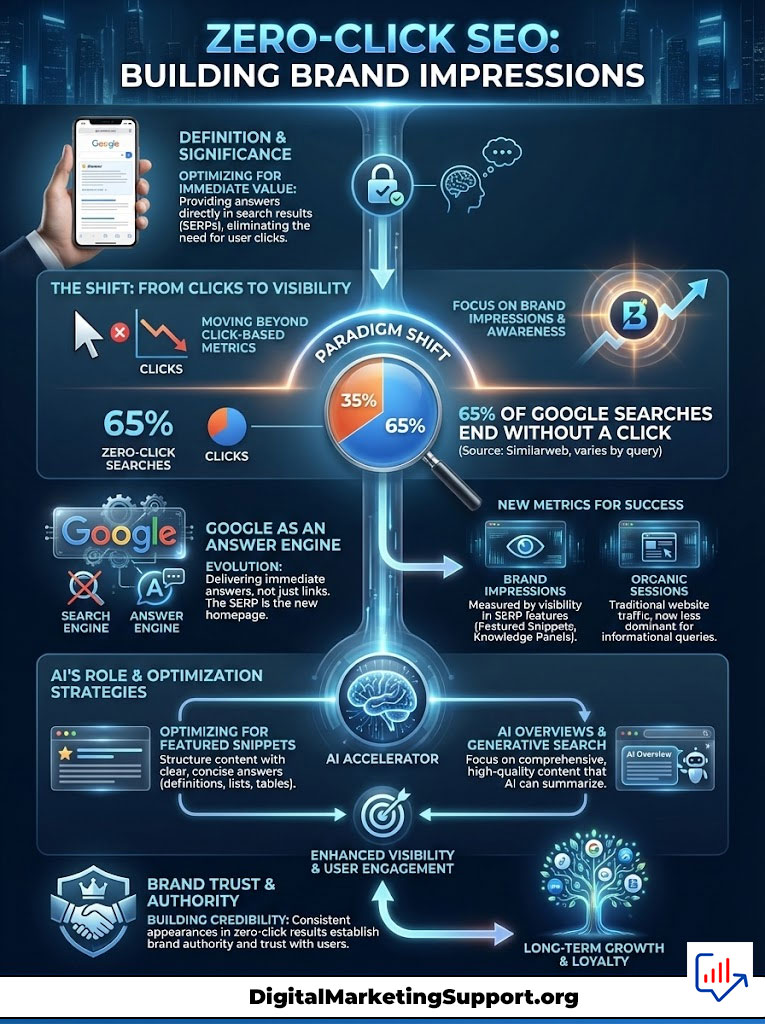
This transition requires a fundamental restructuring of how we value search visibility. If you judge success solely by organic sessions in Google Analytics, you are looking at a broken compass. The new gold standard is Brand Impressions. When a user sees your company name cited as the source of truth in a Google AI Overview or a Featured Snippet, you have achieved a powerful touchpoint. You have built trust and authority without a single click. This guide explores the deep mechanics of AI Search Visibility and provides a roadmap for dominating the SERP in a world where clicks are scarce but attention is more valuable than ever.
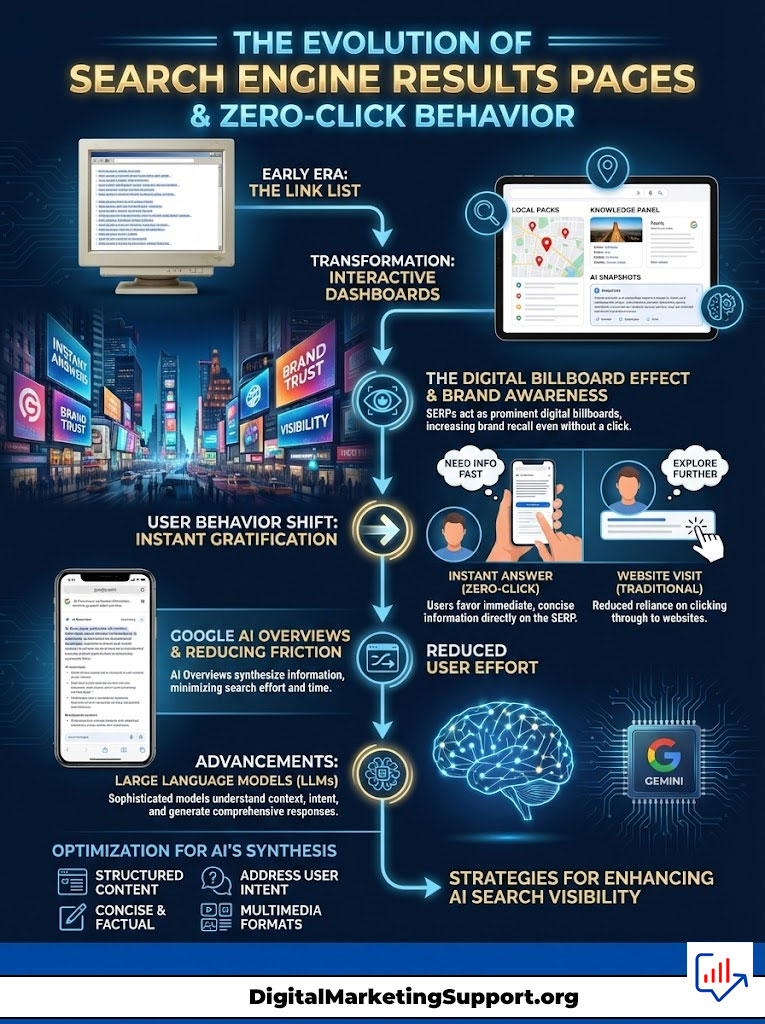
The Evolution of Search Engine Results Pages and Zero-Click Behavior
To survive this transition, we must first understand the mechanism driving the change. The search results page has transformed from a list of links into a complex dashboard of interactive features. Local packs, knowledge panels, shopping carousels, and AI-generated snapshots now occupy the prime real estate above the fold. This is the ecosystem of Zero-Click SEO.
Understanding the Digital Billboard Effect on Brand Awareness
The concept of the Digital Billboard Effect is critical for modern SEO strategy. Consider the physical billboards you pass on a highway. You do not stop your car to interact with them. You do not click them. Yet, when you see a specific brand of coffee or insurance repeatedly, it registers in your subconscious. You build a mental association between that brand and the solution it offers.
The Google SERP now functions as the world’s most expensive digital billboard. When a user searches for “best enterprise CRM” and sees your brand listed in the Featured Snippet or cited in an AI summary, a similar psychological process occurs. You are validating your market position. Even if the user does not click through immediately, the impression has value. Later, when that user is in a buying cycle, they are statistically more likely to perform a navigational search for your brand name because they have already recognized you as an authority. Building Brand Impressions on the SERP is about playing the long game of mental availability.
Why US Searchers Prefer Instant Answers Over Website Visits
The United States market is characterized by high mobile adoption and a culture of speed. American users are often searching on the go. They might be in a store comparing prices, commuting, or multitasking. In these scenarios, the friction of loading a slow mobile website, closing cookie consent pop-ups, and scrolling past interstitial ads is too high.
Google AI Overviews and rich snippets solve this friction problem. They provide the “Too Long; Didn’t Read” version of the answer instantly. For brands targeting the US audience, adapting to this behavior is not optional. You must structure your content to feed these instant answer engines. If your content is locked behind deep paragraphs and fluff, the search engine will bypass you for a competitor who provides the answer upfront.
How Google Gemini and AI Models Synthesize Information
The technology powering this shift is advanced Large Language Models (LLMs) like Google Gemini. Unlike traditional algorithms that matched keywords to strings of text, these models “read” and “understand” content. They ingest millions of documents to form a consensus on a topic. When a user asks a question, the AI generates a synthesis of that information.
This is a critical distinction for Zero-Click SEO. You are no longer just optimizing for a keyword match. You are optimizing for inclusion in the AI’s synthesis. The model looks for authoritative sources to cite. It creates a composite answer and links to the entities that provided the most accurate data. To achieve AI Search Visibility, your content must be structured in a way that makes it easy for the LLM to extract facts, figures, and definitions. We will explore the specific tactics for this later in the guide.
Comparing Traditional Organic Strategies vs Zero-Click SEO Tactics
It is important to clarify that Zero-Click SEO does not replace traditional SEO. It complements it. However, the tactics and goals are distinct. Traditional SEO is a traffic-acquisition channel. Zero-Click is a brand-building channel. Understanding the nuance between these two approaches allows marketers to allocate resources effectively and set realistic expectations for stakeholders.
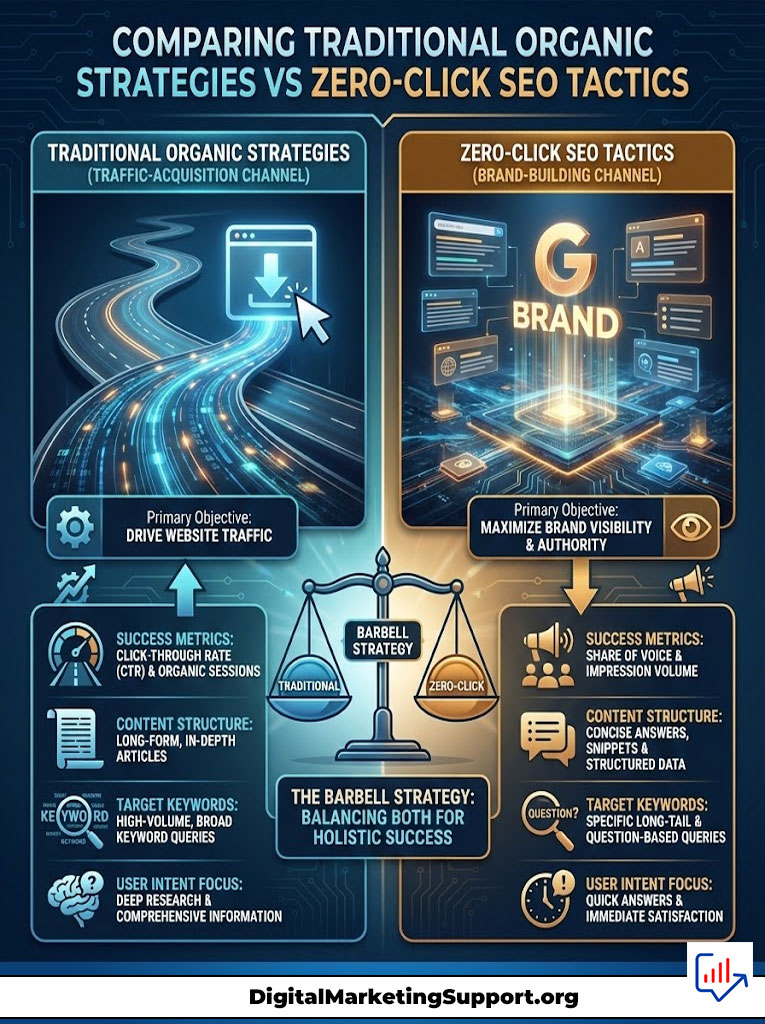
The following comparison highlights the operational differences between optimizing for clicks and optimizing for impressions.
| Strategic Component | Traditional SEO Approach | Zero-Click SEO Approach |
| Primary Objective | Drive organic traffic to the website | maximize on-SERP brand visibility |
| Success Metric | Click-Through Rate (CTR) & Sessions | Share of Voice & Impression Volume |
| Content Structure | Long-form, comprehensive storytelling | Concise answers, tables, & lists |
| Target Keywords | High-volume head terms | Specific, long-tail question queries |
| User Intent | Deep research & discovery | Quick answers & fact-checking |
| Optimization Focus | Meta tags & internal linking | Schema markup & snippet formatting |
| Value Proposition | In-depth analysis on-site | Immediate value on Google |
The Decline of Organic Click-Through Rates for Informational Queries
The data is clear regarding the impact of AI and snippets on click-through rates. Informational queries are the hardest hit. These are searches starting with “what is,” “who is,” “when is,” or “how to.” For example, a search for “when is the Super Bowl” yields a massive bold date at the top of the screen. The CTR for the number one organic result below that snippet is negligible.
However, this does not mean you should abandon informational content. It means you must change your KPI for it. You optimize these pages for Zero-Click SEO to keep your brand top-of-mind. Meanwhile, you reserve your traffic-driving expectations for complex, transactional queries where the user still needs to visit a website to complete an action. This “barbell strategy” balances high-volume, low-CTR brand plays with lower-volume, high-CTR conversion plays.
Mastering AI Search Visibility Through Information Gain
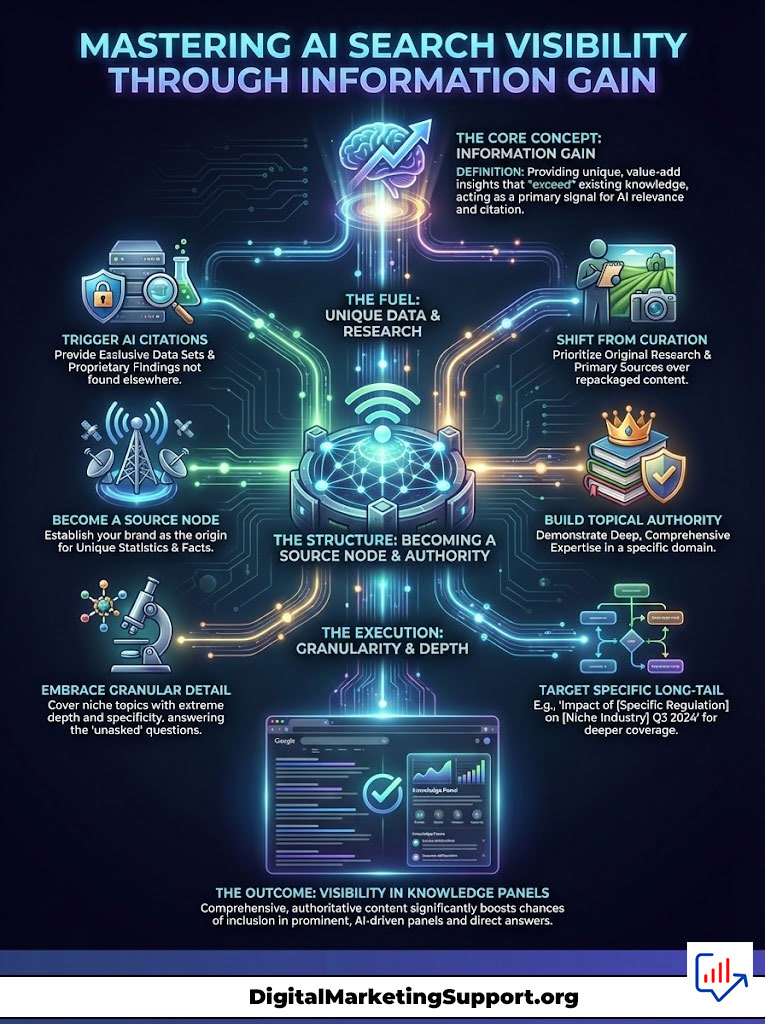
One of the most significant concepts in modern search optimization is “Information Gain.” Google has filed patents describing a scoring system that rewards content for providing new, unique information that is not found elsewhere in the search results. In an age of AI-generated content where every article sounds the same, Information Gain is your competitive advantage.
Creating Unique Data Sets to Trigger AI Citations
If you write an article that repeats the same tips found in the top ten results, an AI model has no reason to cite you. It can get that information from more established sources like Wikipedia or major news outlets. To win at Zero-Click SEO, you must be the primary source of new data.
This requires a shift from curation to creation. Brands should focus on publishing original research. This could involve surveying your customer base to find trends, analyzing your own internal data to produce industry benchmarks, or running experiments and publishing the results. When you publish a statistic that no one else has, you become the “source node” for that fact. When other sites reference your data, and when AI models look for answers, they point back to you. This is the most reliable way to secure citations in Google AI Overviews.
Moving Beyond Generic Content to Establish Topical Authority
Topical authority is the depth of expertise your site demonstrates on a specific subject. AI models heavily weight authority when deciding which sources to trust. You cannot be a generalist. You must cover your niche with granular detail.
To build Brand Impressions effectively, you need to map out the entire knowledge graph of your topic. If you are in the project management software space, you should not just write about “best project management tools.” You must write about “how to implement agile workflows for remote marketing teams” or “comparing waterfall vs kanban for construction projects.” These specific, long-tail topics are less likely to be fully answered by a generic AI summary. They provide opportunities for your brand to appear as the specialist expert. By covering every angle of a topic, you signal to the search engine that you are a comprehensive resource, increasing the likelihood that your content is pulled into Knowledge Panels and snippets.
Technical Optimization for Entities and Knowledge Graphs
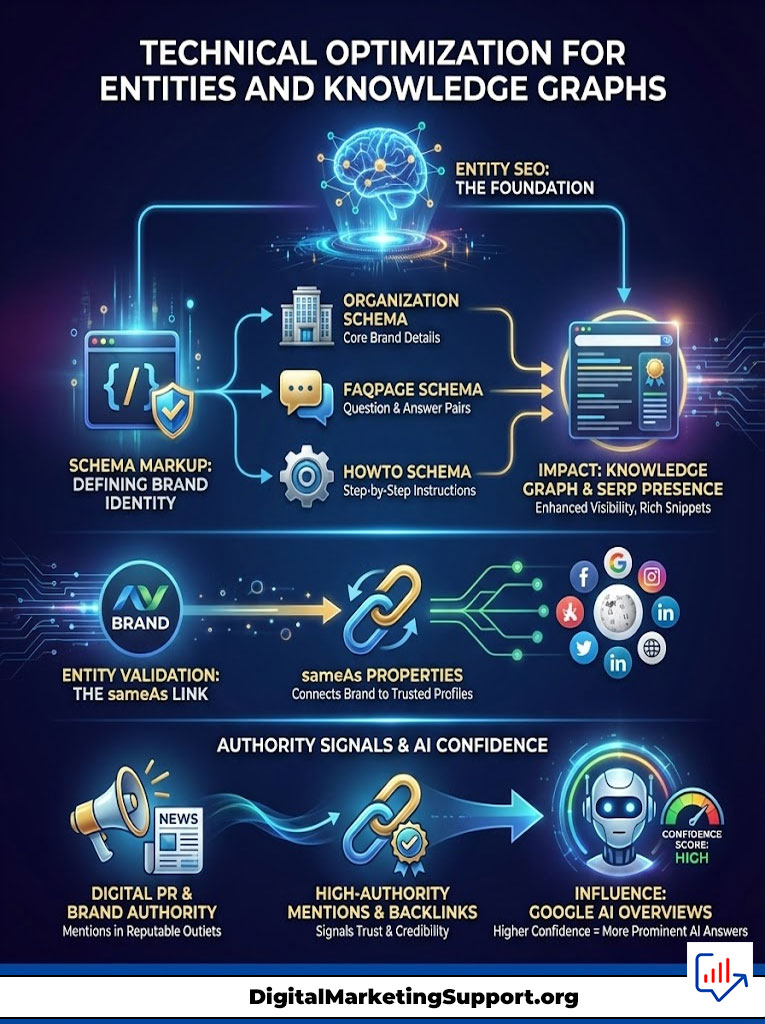
While content is king, code is the crown. Search engines are machines. They need structure to understand the context of your content. This is where Entity SEO and Schema Markup become the foundational pillars of Zero-Click SEO. Google is moving away from keyword matching and toward entity recognition. It wants to know who you are, what you offer, and how you are connected to other authoritative entities in your industry.
Leveraging Schema Markup to Define Brand Identity
Schema markup is the language of the search engine. It is a code that you place on your website to explicitly tell Google what your content means. For Zero-Click SEO, specific types of schema are non-negotiable.
You must implement Organization schema on your homepage. This should include your logo, your official social media profiles, and your contact information. This data feeds directly into the Knowledge Graph panel that appears on the right side of desktop search results. Furthermore, you should utilize FAQPage schema and HowTo schema on relevant articles. These script types allow Google to pull your questions and answers directly into the SERP, expanding your visual footprint. The more screen real estate you occupy, the higher your Brand Impressions.
Connecting the Dots with SameAs Properties and Digital PR
A critical but often overlooked aspect of schema is the sameAs property. This field in your Organization schema tells Google, “We are the same entity that is listed on this Wikipedia page, this Crunchbase profile, and this LinkedIn company page.”
This helps Google “reconcile” your entity. It confirms that the brand mentioned in a New York Times article is the same brand that owns your website. Digital PR plays a massive role here. Getting mentioned in high-authority publications does more than just build backlinks. It validates your entity. When an AI model scans the web and sees your brand associated with other trusted entities, its confidence score in your brand increases. High confidence leads to more citations in Google AI Overviews and a more robust Knowledge Panel presence.
Dominating Featured Snippets and Position Zero Opportunities
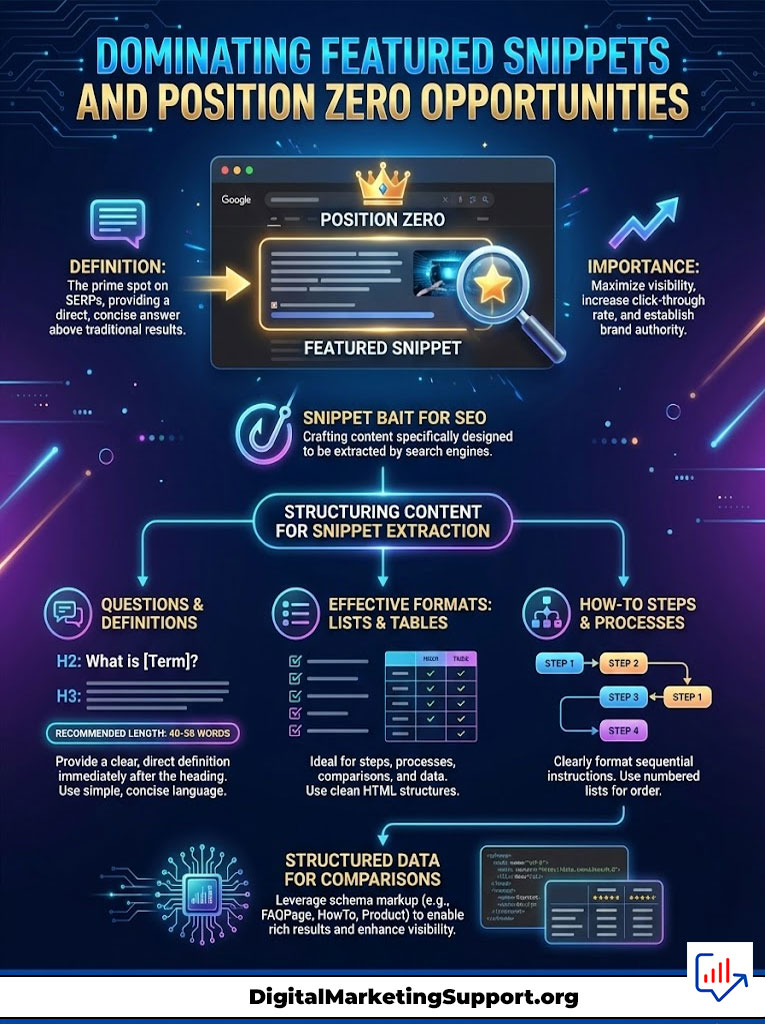
The Featured Snippet, often called Position Zero, remains the holy grail of Zero-Click SEO. It sits above the first organic result and arguably captures the most attention on the page. While AI overviews are growing, standard featured snippets are still the default for millions of queries, especially on voice search devices.
Structuring Content for Snippet Extraction and Voice Search
To capture a featured snippet, you must write for extraction. You need to identify the “trigger” question your audience is asking and provide a direct, concise answer. This is often referred to as “Snippet Bait.”
For a definition query, place the question in an H2 or H3 tag. Immediately following the header, provide a clear, factual definition between 40 and 58 words. This specific length has been shown to be the sweet spot for Google’s algorithms. Do not fluff this paragraph. Do not start with “In this section, we will discuss…” Start directly with the answer. For example, “Zero-Click SEO is the strategy of…” This declarative writing style makes it easy for the algorithm to lift your text and display it in the box.
Utilizing Tables and Lists for Maximum SERP Real Estate
Google loves structure. For queries that imply a process or a comparison, lists and tables are the most effective format. If you are targeting a “how-to” keyword, format your steps with clear H3 headers or a numbered list. Ensure the steps are concise.
For comparison queries, such as pricing or feature breakdowns, use an HTML table. Tables are frequently pulled directly into the Featured Snippet because they provide high information density in a small space. By formatting your data in a clean table, you not only improve the user experience on your site but also dramatically increase your chances of winning the zero-click result. This is a tactical way to push competitors down the page and assert your authority.
Measuring Success Beyond the Click: New SEO Metrics
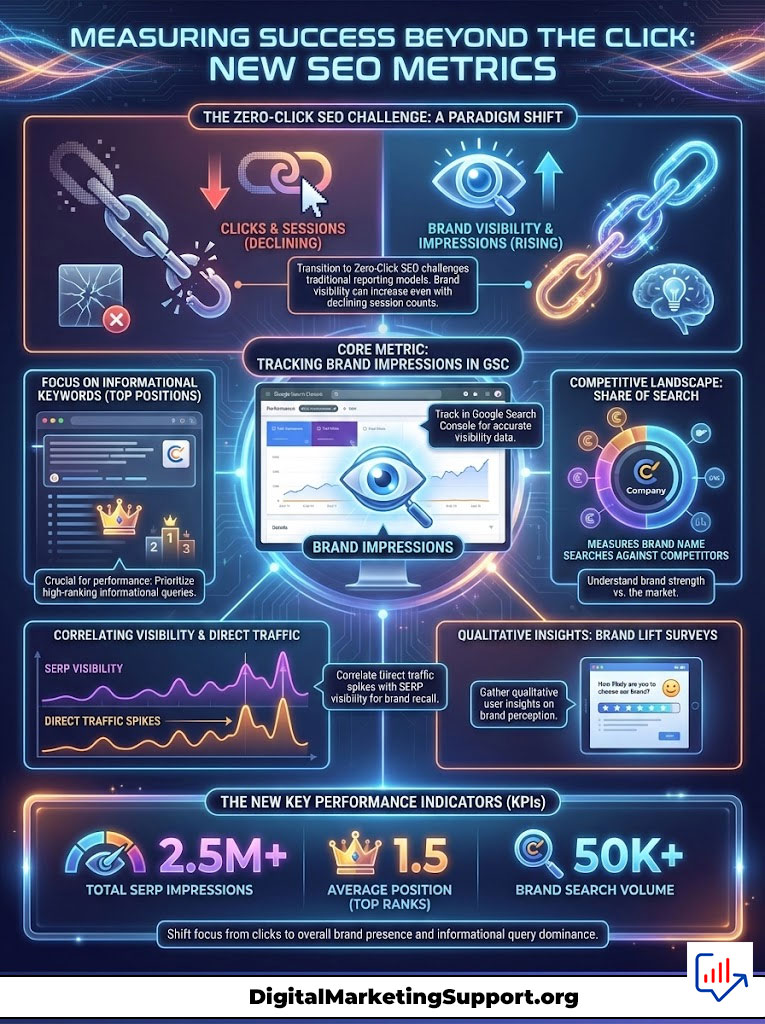
The transition to Zero-Click SEO creates a reporting challenge. Traditional attribution models break down when the interaction happens off-site. Marketing executives accustomed to seeing traffic growth charts may misinterpret a decline in sessions as a failure, even if brand visibility is at an all-time high. We must adopt a new set of metrics to quantify the value of Brand Impressions.
Tracking Brand Impressions and Share of Search Volume
The most direct proxy for zero-click success is your impression data in Google Search Console. You should filter your performance report to look specifically at informational keywords where you rank in the top three positions. If your impressions are stable or growing, but clicks are declining, you are likely satisfying the user on the SERP.
Another critical metric is “Share of Search.” This measures the volume of searches for your brand name compared to your competitors. If your Zero-Click SEO strategy is working, you should see a correlation where increased SERP visibility leads to more people searching for your brand directly over time. This indicates that you are building mental availability.
Correlating Direct Traffic Spikes with SERP Visibility
In a zero-click world, the “Direct” traffic channel in Google Analytics often becomes a catch-all for unattributed brand demand. A user might see your answer in a snippet, memorize your name, and then type your URL directly into their browser three days later.
To measure this, you should overlay your Google Search Console impression data with your Direct traffic trends. A strong correlation often suggests that your on-SERP presence is driving brand recall. Additionally, you can use brand lift surveys or “How did you hear about us?” fields in checkout forms to capture qualitative data about users who found you via search but didn’t click immediately.
Below is a detailed breakdown of the metrics and tools required to monitor this new ecosystem.
| Metric Name | Primary Data Source | What It Indicates | Actionable Insight |
| Total SERP Impressions | Google Search Console | Volume of users seeing your snippet or listing | Validate visibility of informational content |
| Average Position | Google Search Console | Ranking stability for key terms | Confirm you are holding “Position Zero” |
| Brand Search Volume | Google Trends / SEMrush | Growth in brand recall | Measure long-term impact of zero-click exposure |
| Share of Voice | Ahrefs / Moz | Market dominance vs competitors | Benchmark authority within the niche |
| Direct Traffic | Google Analytics 4 | Unattributed brand visits | Correlate with high-impression periods |
| Entity Confidence | Google Knowledge Graph API | How well Google understands your brand | Identify gaps in schema or citations |
Future-Proofing for Perplexity, ChatGPT, and Answer Engines
The search landscape is fragmenting. We are moving beyond a Google monopoly into a diverse ecosystem of “Answer Engines.” Platforms like Perplexity AI, ChatGPT Search, and Claude are changing how users discover information. These tools do not just list links. They read the web and answer questions conversationally.

Optimizing for Large Language Models and Training Data
To survive in this future, your content strategy must evolve into LLMO (Large Language Model Optimization). This means ensuring your brand is part of the training data that these models rely on. The best way to achieve this is through high-authority citations.
LLMs are trained on quality datasets. They value information from reputable sources. By focusing on Digital PR and getting your brand mentioned in tier-one publications and industry journals, you increase the probability that an LLM will “learn” about your brand. Furthermore, maintaining clear, fact-based content on your own site helps these models parse your information accurately. You must avoid ambiguity. State your value propositions, pricing, and definitions clearly so that when a user asks a chatbot about your product, the AI can generate an accurate response. This is the ultimate evolution of Zero-Click SEO: becoming a fundamental part of the AI’s knowledge base.
Frequently Asked Questions (FAQs)
How does Zero-Click SEO differ from traditional search optimization?
Zero-Click SEO focuses on optimizing content to appear in SERP features like snippets and AI overviews to build brand awareness without requiring a click. Traditional SEO prioritizes ranking positions that drive direct traffic to a website.
Why is Brand Impressions considered a valuable metric?
Brand Impressions represent the number of times a user sees your brand associated with a solution. High impression volume builds trust and mental availability, which often leads to higher conversion rates and direct searches later in the customer journey.
Can small businesses compete for Google AI Overviews?
Yes, small businesses can compete by focusing on “Information Gain.” By providing unique local data, expert insights, or original case studies that large competitors lack, small brands can trigger AI citations and establish authority in their specific niche.
What is the best way to track zero-click performance?
The best way is to combine Google Search Console impression data for informational queries with “Brand Search Volume” trends. An increase in people searching for your brand name often correlates with high visibility in zero-click search results.
Does schema markup help with winning featured snippets?
While schema markup is not a direct ranking factor for snippets, it helps search engines understand the structure of your content. Using FAQ and HowTo schema can make your content more eligible for rich results, increasing your on-page real estate.
How does voice search relate to Zero-Click SEO?
Voice search is a primary zero-click channel. When a user asks a smart speaker a question, the device reads the featured snippet. Optimizing for concise, conversational answers ensures your brand is the one being spoken to the user.
Is organic traffic dead for informational keywords?
Organic traffic is not dead, but it is declining for simple definition-style queries. Users now get these answers instantly. Content strategy should pivot to use these queries for branding while focusing on complex topics for traffic generation.
What is the role of digital PR in Entity SEO?
Digital PR builds the connections that define your entity in the Knowledge Graph. Mentions in authoritative publications validate your brand’s existence and expertise, helping Google confirm your identity and trustworthiness.
How can I optimize my content for Google Gemini?
Optimize for Google Gemini by ensuring your content is factually accurate, well-structured with headings, and provides unique insights. Avoid fluff and focus on answering the specific intent of the user clearly and concisely.
What is “Snippet Bait” in content writing?
Snippet Bait refers to a specific block of text, usually 40 to 60 words long, placed near the top of an article that directly answers a target question. It is designed to be easily “snipped” by Google for the featured snippet box.
Will AI search engines replace traditional websites?
It is unlikely they will replace websites entirely. Users still need deep dives, transaction portals, and community experiences. However, AI engines will likely replace the “entry-level” information layer, making high-quality website content even more critical.
How do tables improve SEO performance?
Tables organize complex data in a way that is easy for both users and bots to digest. Google frequently pulls HTML tables directly into search results for comparison queries, giving the publisher a massive visibility advantage.
Disclaimer: The strategies and insights presented in this article reflect the current state of search engine optimization as of late 2025. Search algorithms, particularly those driven by AI, are subject to rapid and unpredictable updates. Marketers are advised to continuously test and adapt their strategies based on their own performance data.
References:
- SparkToro & Jumpshot Search Behavior Studies
- Google Search Central Advanced SEO Documentation
- Semrush Zero-Click Search Data Reports
- Schema.org Organization and Rich Result Guidelines