









You might possess the most innovative product in your industry. Your engineering could be flawless, your supply chain optimized, and your pricing strategy perfectly calculated. Yet, in the grand scheme of commerce, none of those objective facts matter if the market believes otherwise. In business, reality is not what you sell. Reality is what people believe they are buying.
Table of Contents
Consumer perception is the complex process by which individuals select, organize, and interpret sensory stimuli into a meaningful and coherent picture of the world around them. It is the filter through which your customers view your brand, acting as the ultimate arbiter of value. This psychological lens determines whether a shopper walks past your aisle or stops to purchase, regardless of the actual quality of the goods on the shelf.
When a potential customer lands on your website or walks into your physical store, they are not acting as data-driven robots. They are human beings filtering millions of sensory signals through a thick layer of bias, past experience, and emotion. This lens determines trust. It determines value. Most importantly, it determines revenue.
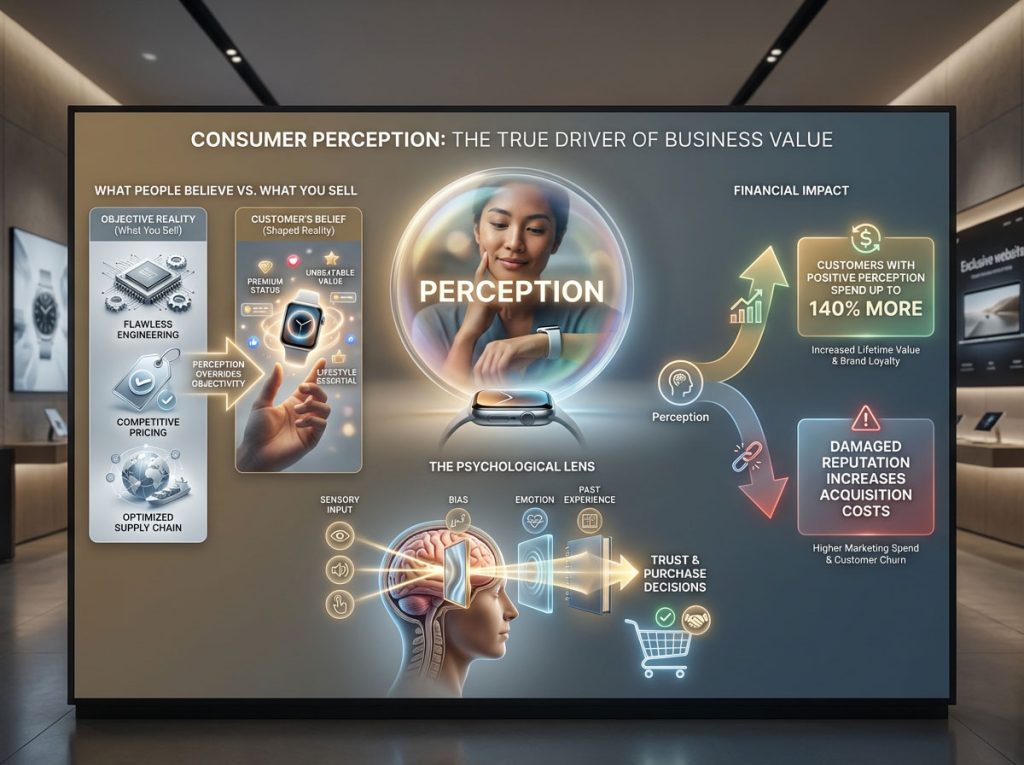
The financial stakes of managing this perception are incredibly high. According to extensive research from major consultancy firms like Deloitte and PwC, customers with a positive perception are willing to spend upwards of 140% more per transaction than those with a neutral or negative view. Conversely, a damaged reputation acts as a silent killer for your bottom line. It drains your marketing budget, forcing you to pay a premium to acquire customers who already mistrust you before they even click “Add to Cart.”
Understanding the deep nuance of this psychological process is the defining characteristic of market leaders. It is the difference between a commodity business that fights on price and a legacy brand that dominates on value.
What is Consumer Perception? The Core Definition and Business Importance
At its absolute core, consumer perception is a neurological and psychological function. It is the brain’s survival mechanism for making sense of noise. In the modern world, the average consumer is bombarded with thousands of brand messages, advertisements, and notifications every single day. If the brain attempted to process every single one of these stimuli with equal weight, it would shut down.
To function efficient, the human brain filters out approximately 99% of these inputs. The remaining 1% that penetrates the filter is what forms consumer perception. This concept is not merely about whether a customer likes your logo or finds your jingle catchy. It is about the deep-seated emotional and logical associations they unconsciously attach to your business entity. It is the “gut feeling” that overrides the spec sheet.
The Critical Difference Between Consumer Perception and Customer Perception
While these terms are frequently used interchangeably in casual marketing conversations, they represent two distinct stages of the buyer’s journey. For a comprehensive brand strategy, you must treat them as separate metrics with separate KPIs.
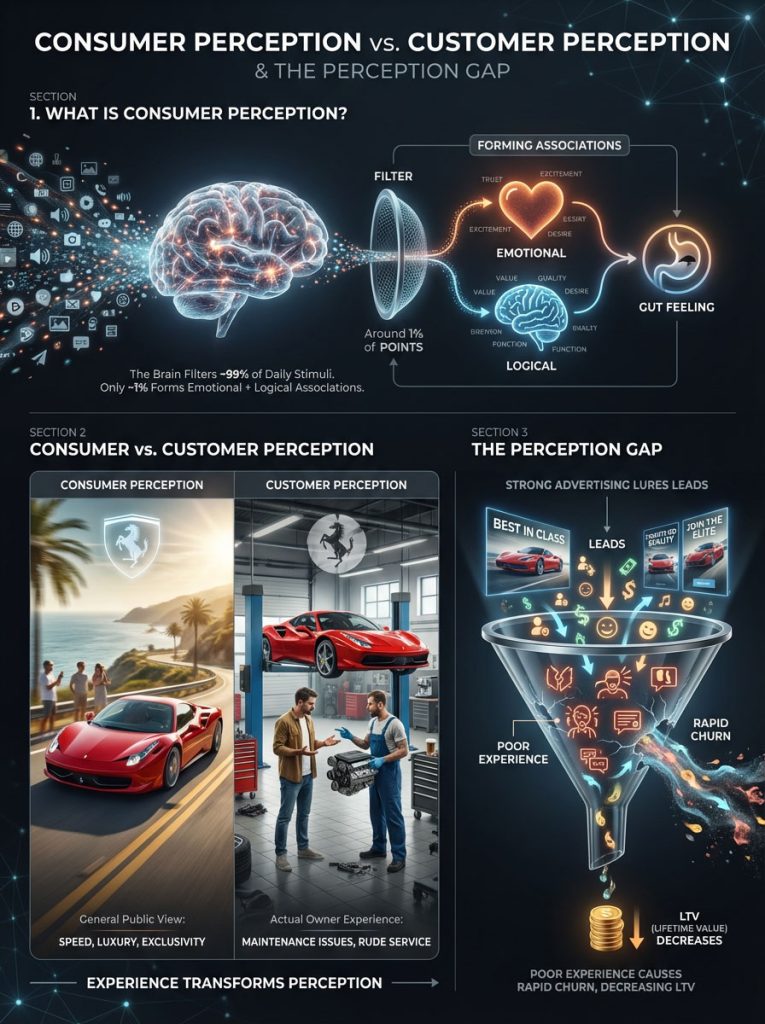
Consumer Perception refers to the broader market sentiment. This encompasses the opinion of the general public, including the vast majority of people who have never actually purchased from you.
- Example: Consider how the general public views Ferrari. Most people will never own one, yet they have a distinct perception of the brand: “Speed,” “Luxury,” “Exclusivity,” and “Italian Engineering.” This perception is derived entirely from marketing, pop culture, and brand positioning. It is aspirational.
Customer Perception is the specific reality held by your current buyers. It is formed through direct customer experience (CX) and product usage.
- Example: If a wealthy individual buys that Ferrari and finds the engine maintenance creates a headache or the dealer service is rude, their customer perception shifts to “High Maintenance” and “Poor Service,” contradicting the broader consumer perception.
The danger zone for businesses lies in the Perception Gap. If your consumer perception is high (driven by excellent advertising) but your customer perception is low (driven by poor product quality or support), you will experience high churn rates. You will fill the funnel with eager leads, only to lose them immediately after the sale, destroying your brand reputation and lifetime value (LTV).
The 4 Stages of the Consumer Perception Process in Marketing
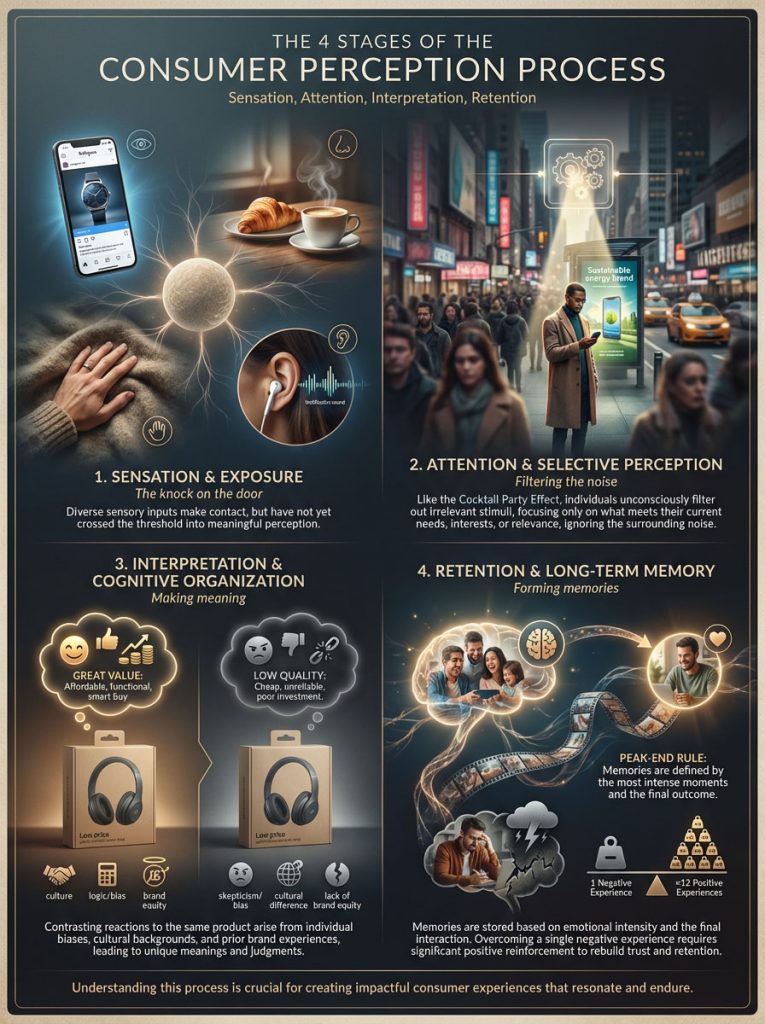
To effectively manage how the world views your business, you cannot simply “guess.” You must understand the four distinct neurological stages the brain goes through when processing a brand. This is the biology of business.
1. Sensation and Exposure (The Physical Stimulus)
This is the raw, physical contact with a stimulus. It happens when a potential buyer sees your Instagram ad, smells the aroma of your bakery, feels the texture of your product packaging, or hears the sound of your app notification. Sensation is immediate and direct. However, sensation alone does not equal perception. You can hear a noise without listening to it; you can see a billboard without reading it. Sensation is the knock on the door; perception is inviting the guest inside.
2. Attention and Selective Perception (The Filter)
This is where the battle for the mind is won or lost. Because cognitive resources are limited, consumers engage in selective perception. Their brains actively scan the environment for stimuli that satisfy a current need or align with a current interest, while ruthlessly ignoring the rest.
- The Cocktail Party Effect: Just as you can focus on one voice in a loud room while ignoring others, consumers will ignore a generic banner ad but lock onto a headline that addresses a specific pain point they felt that morning. Capturing attention requires breaking the pattern and offering immediate relevance.
3. Interpretation and Cognitive Organization (The Meaning)
Once you have successfully captured their attention, the consumer’s brain must assign meaning to what it is seeing. This stage is heavily influenced by cognitive bias, cultural background, and past experiences.
- The Ambiguity of Signals: If a consumer sees a product priced significantly lower than competitors, how do they interpret that signal? One consumer might interpret it as “Great Value,” while another interprets it as “Cheap/Low Quality.” That interpretation depends entirely on your existing brand equity and visual presentation.
4. Retention and Long-Term Memory (The Verdict)
This is the final stage. The interpretation is stored in long-term memory and becomes the reference point for all future interactions. This is your brand image. Crucially, human memory is not a video recorder; it is reconstructive. We tend to remember the peaks of an experience and the end of an experience. Data suggests it takes up to 12 positive experiences to overwrite one negative memory stored in this stage. This is why brand reputation management is a long-term game, not a quick fix.
Psychological Factors Influencing Buying Behavior and Brand Image
We like to believe we are rational economic actors who make decisions based on spreadsheets and logic. We are not. Purchase decision processes are driven largely by subconscious triggers and ancient psychological heuristics.
The Halo Effect: How Brand Equity Bleeds Across Products
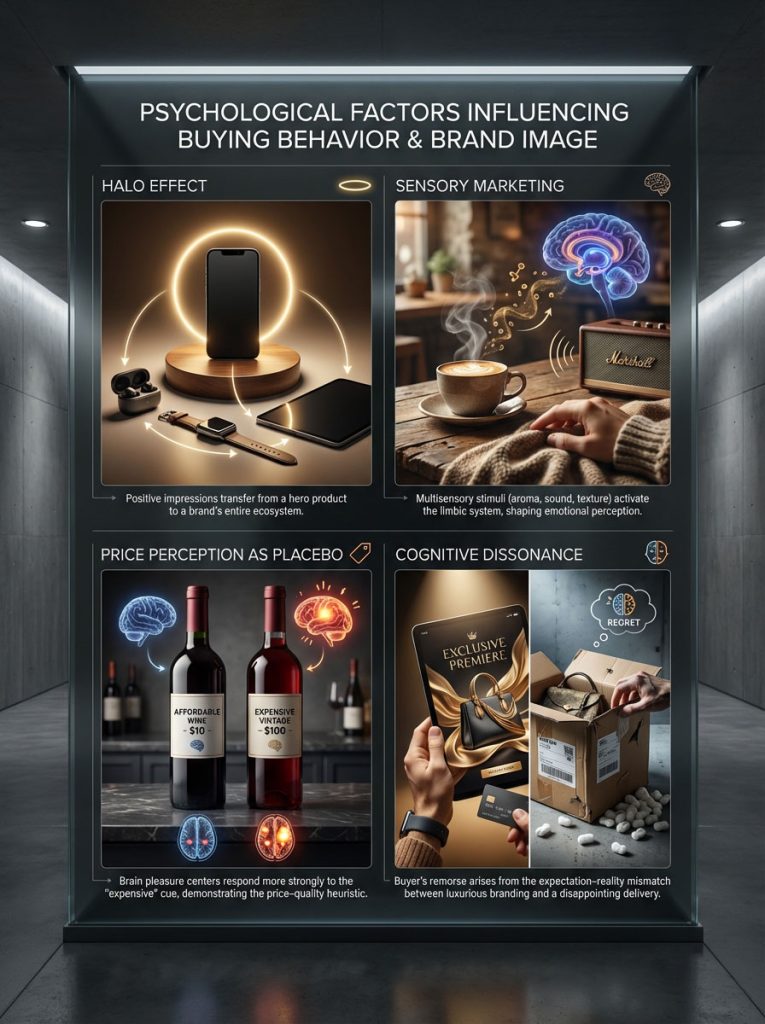
The Halo Effect is a cognitive bias where a positive impression in one specific area influences the consumer’s opinion in other, unrelated areas.
- The Apple Instance: Apple is the undisputed master of this. Because consumers perceive the iPhone as high-quality, secure, and intuitive, they automatically assume the Apple Watch, Apple TV, and Apple Services are also superior. They do not rigorously research the technical specifications of the new accessory because the “halo” of the parent brand reduces their perceived risk. This reduces friction in the buying cycle and allows for cross-selling with minimal marketing effort.
Sensory Marketing: The Biology of Emotional Connection
Smart brands understand that consumer perception is multi-sensory. The limbic system, which controls emotion and memory, is directly linked to our sense of smell and sound, bypassing the logical centers of the brain.
- The Starbucks Strategy: Starbucks did not conquer the global coffee market simply by roasting beans. They focused on sensory marketing. They engineered the specific smell of the store (banning employees from wearing perfume so as not to interfere with the coffee aroma), curated indie playlists to create a specific auditory vibe, and chose furniture textures that felt “warm.” Customers are not paying $6 for caffeine; they are paying for the perception of a “Third Place” (a haven between home and work).
Price Perception as a Placebo for Quality
Does price affect the consumer perception of quality? Absolutely. In many categories, price acts as a psychological placebo. This is known as the price-quality heuristic.
- The Wine Study: In famous blind taste tests, when consumers are told a wine is expensive, the pleasure centers of their brain (the medial orbitofrontal cortex) actually light up more than when they are told the same wine is cheap. The perception of value physically alters the experience of enjoyment. If you price your product too low, you may inadvertently damage your consumer perception by signaling low quality to the subconscious mind.
Cognitive Dissonance and Buyer’s Remorse
Cognitive dissonance in marketing occurs when reality clashes with expectation. It is the mental discomfort experienced by a person who holds two or more contradictory beliefs, ideas, or values.
- The Unboxing Letdown: If a consumer buys a “luxury” item based on a high-end website perception, but it arrives in a flimsy, beat-up cardboard box, they experience immediate dissonance. The physical reality contradicts the digital promise. This psychological discomfort leads to returns, negative reviews, and a refusal to repurchase. Aligning your delivery mechanics with your brand image is crucial to avoid this friction.
How Digital Transformation and AI Are Reshaping Consumer Perception
The factors affecting consumer perception in the modern digital era are vastly different from those of even a decade ago. We have entered an age of Digital Value Acceleration, where technology dictates trust.
The Need for Speed and Digital Reliability
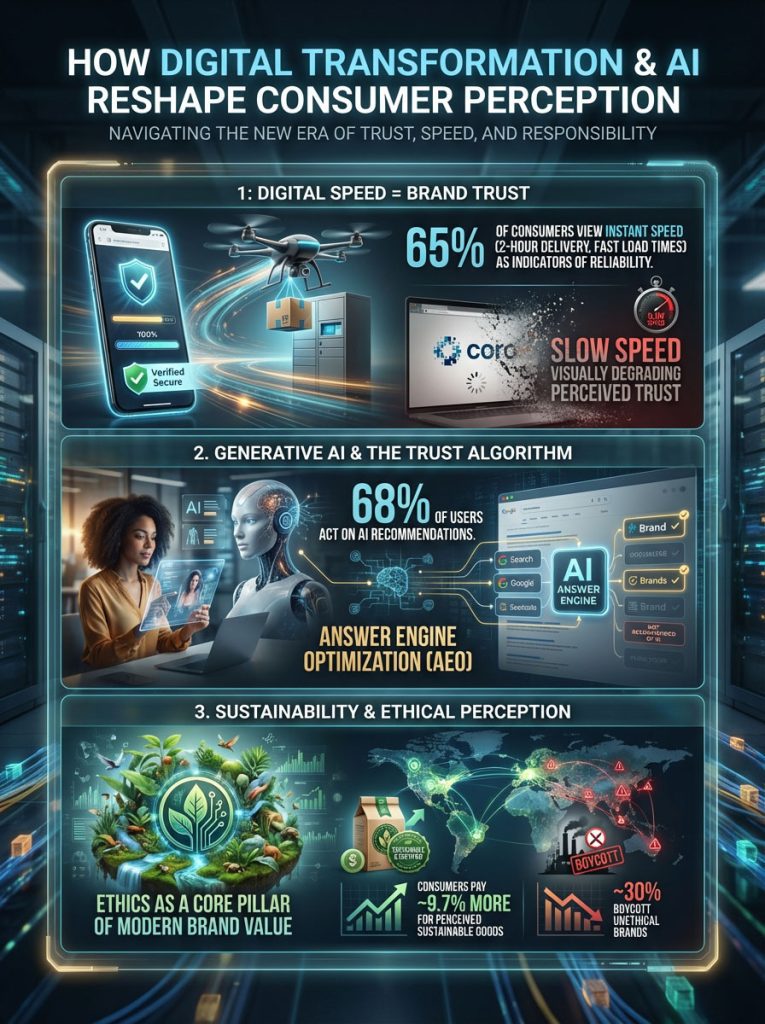
Patience is extinct. In the current landscape, customer perception of reliability is directly tied to digital speed. Recent logistics and e-commerce data suggest that over 65% of consumers view “2-hour delivery” or “instant website load times” as a proxy for a capable, trustworthy business. If your mobile site is slow, the user perceives your product as outdated or your security as lax, even if those backend systems are unrelated. Speed is no longer a feature; it is a pillar of brand trust.
Generative AI and the Trust Algorithm
The rapid rise of Generative AI has introduced a new layer of influence. Consumers are increasingly turning to AI tools (like ChatGPT or Google Gemini) for purchase advice. Recent trends show that nearly 68% of users are willing to act on product recommendations provided by AI algorithms.
- The Invisible Influence: If your brand does not appear in these AI-generated results, or if the AI summarizes your reviews negatively, you effectively do not exist for a large segment of the market. Consumer perception is now being shaped by machine consensus as much as human word of mouth. Optimizing for “Answer Engine Optimization” (AEO) is becoming as critical as traditional SEO.
Sustainability and Ethical Perception in the Modern Era
Ethics are no longer just a Public Relations maneuver. They are a core driver of brand perception and value. There is a measurable “Sustainability Premium.”
- The Data: Consumers are willing to pay roughly 9.7% more for goods they perceive as sustainable or ethically sourced. Conversely, the “cancel culture” effect means approximately 30% of consumers will boycott a brand immediately if they perceive it as unethical. The perception of your corporate soul matters as much as the quality of your product.
The Financial Reality: Why Customer Perception Makes or Breaks Your Business
Why is the title of this article “Why Customer Perception Makes or Breaks Your Business”? Because perception dictates the fundamental economics of your P&L statement. It is not an intangible “soft skill”—it is a hard financial lever.
The High Cost of Negative Perception
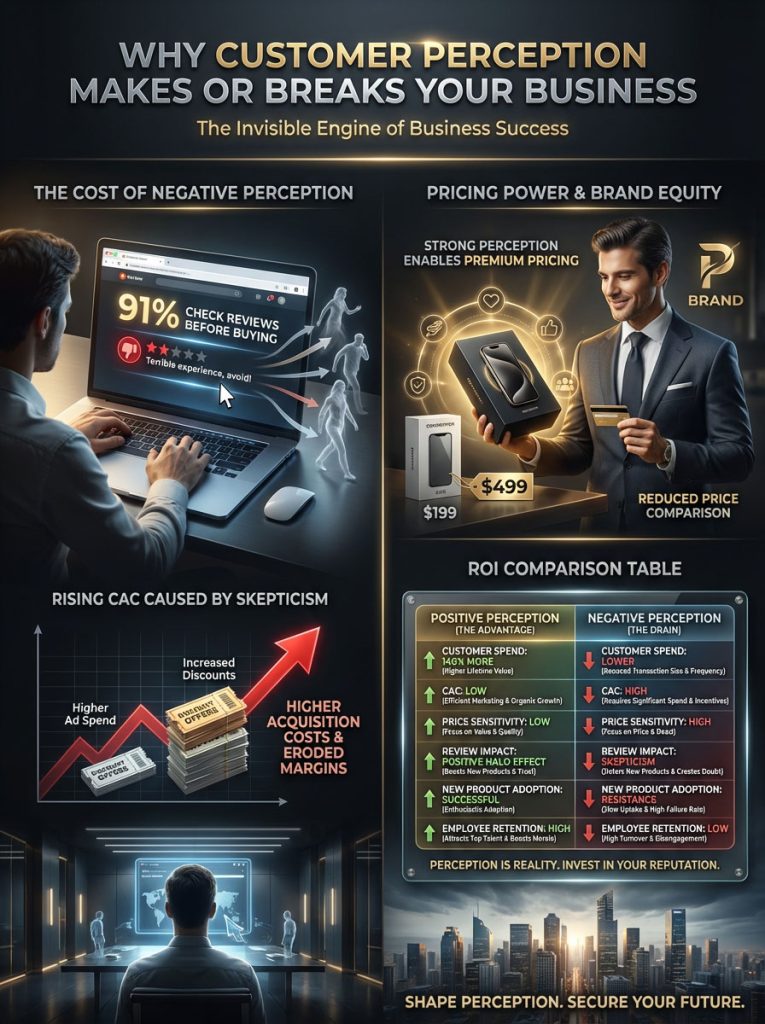
Bad news travels significantly faster than good news. 91% of consumers now check online reviews before making a purchase decision. A single negative review, if left unresolved on the first page of Google, can deter dozens of potential leads.
- The CAC Problem: This dramatically increases your Customer Acquisition Cost (CAC). When perception is poor, you have to pay more for ads and offer deeper discounts just to convince a skeptical audience to give you a try.
The Value of Brand Equity and Pricing Power
Positive consumer perception grants you pricing power. It allows you to charge a premium over your competitors without losing market share. This is the definition of brand equity. When perception is high, customers stop comparing prices and start looking for availability.
Comparison Table: The ROI of Positive vs. Negative Perception
The following table breaks down how perception directly impacts your key business metrics, demonstrating the tangible ROI of reputation management.
| Metric | Positive Brand Perception | Negative Brand Perception |
| Customer Spend | Spends 140% more per transaction due to trust and reduced risk. | Spends only on deep discounts, necessities, or when no other option exists. |
| Customer Acquisition Cost (CAC) | Low. Driven by word-of-mouth, referrals, and organic search. | High. Requires aggressive paid ads and heavy incentives to convert. |
| Price Sensitivity | Low. Willing to pay a premium for perceived value and status. | High. Comparison shops ruthlessly for the cheapest option. |
| Review Impact | Resilience against occasional bad reviews (brand forgiveness). | A single bad review validates the user’s negative confirmation bias. |
| New Product Launch | Immediate trust and rapid adoption (The Halo Effect). | Deep skepticism and slow market adoption rates. |
| Employee Retention | High. Top talent wants to work for respected, “winning” brands. | Low. Hard to recruit talent; employees may feel embarrassed by the brand. |
Measuring the Intangible: Metrics and Tools for Tracking Sentiment
You cannot fix what you do not measure. Many business owners fail because they rely on “gut feeling” rather than data to understand their brand perception. To truly manage how you are viewed, you need a robust stack of analytics tools and methodologies.
Key Metrics: NPS, CSAT, and CES
To accurately gauge customer perception, you cannot rely on a single number. You need a mix of metrics that track different stages of the lifecycle.
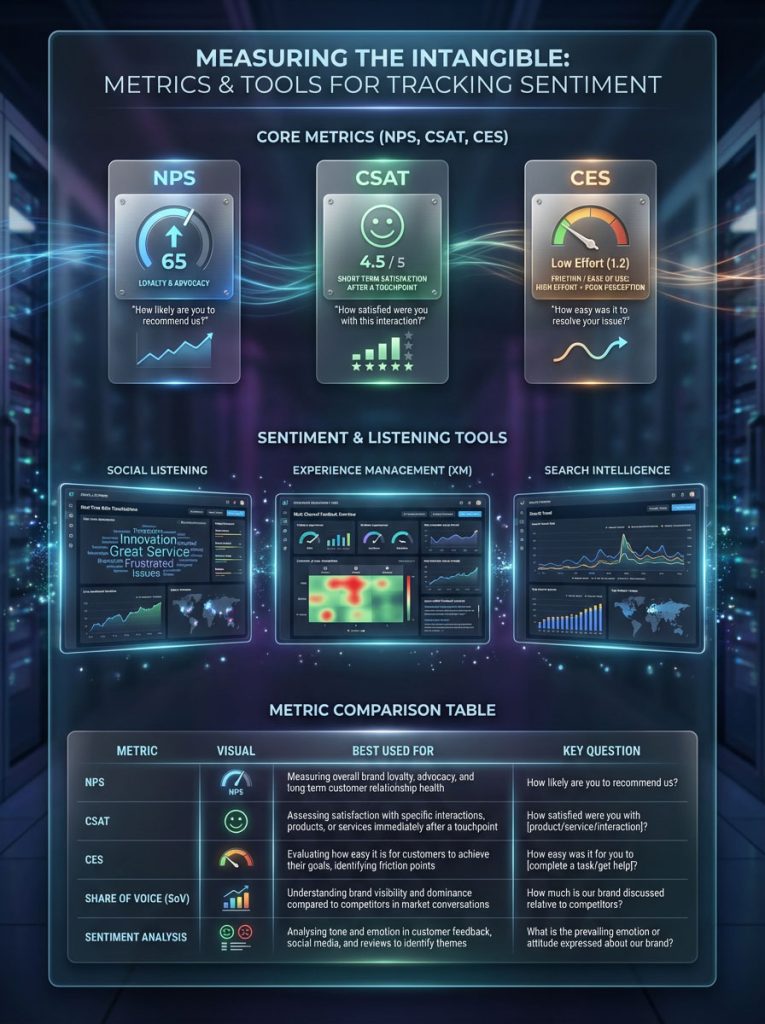
- Net Promoter Score (NPS): This is the industry standard for measuring customer loyalty and advocacy. It asks the ultimate question: “How likely are you to recommend us to a friend or colleague?” High NPS indicates a perception of value that exceeds the price paid.
- Customer Satisfaction Score (CSAT): This is a transactional metric. It measures customer satisfaction immediately after a specific touchpoint, such as a support ticket or a checkout process. It helps identify short-term friction.
- Customer Effort Score (CES): This measures ease of use. In the digital age, high effort leads to poor perception. If a customer has to jump through hoops to return an item, their perception of your “service” tanks, even if the return is eventually processed.
Tools for Tracking Brand Sentiment and Social Listening
In the age of big data, manual surveys are not enough. You need tools that “listen” to the internet 24/7.
- Social Listening Platforms: Tools like Brandwatch, Sprout Social, and Mentio allow you to monitor social media for mentions of your brand. They use AI-driven sentiment analysis to categorize mentions as Positive, Neutral, or Negative.
- Experience Management (XM) Software: Enterprise platforms like Qualtrics and Medallia go beyond surveys. They analyze text, voice, and behavioral data to provide a holistic view of customer experience (CX).
- Search Intelligence: Google Trends and SEO tools help you see if interest in your brand is growing or shrinking over time relative to competitors. Are people searching for “[Brand Name] scam” or “[Brand Name] reviews”?
Comparison Table: Choosing the Right Metric for the Job
| Metric Name | Full Form | Best Used For | Key Question Asked |
| NPS | Net Promoter Score | Measuring long-term Loyalty & advocacy. Best for strategic planning. | “How likely are you to recommend us to a friend?” |
| CSAT | Customer Satisfaction Score | Measuring short-term Happiness with a specific interaction. Best for fixing immediate bugs. | “How satisfied were you with your service today?” |
| CES | Customer Effort Score | Measuring Friction (Ease of use). Best for UX/UI improvements. | “How easy was it to resolve your issue?” |
| SoV | Share of Voice | Measuring Brand Awareness vs. Competitors. Best for PR and marketing reach. | “How much of the market conversation is about us?” |
| Sentiment | Sentiment Analysis | Measuring the Emotional Tone of public discussion. Best for crisis management. | “Is the conversation positive, negative, or neutral?” |
Actionable Strategies for Improving and Fixing Customer Perception
If your audit reveals that your consumer perception is negative or neutral, do not panic. Perception is plastic. It can be molded, shaped, and improved with the right strategy and consistent execution.
The Service Recovery Paradox: Turning Failure into Loyalty
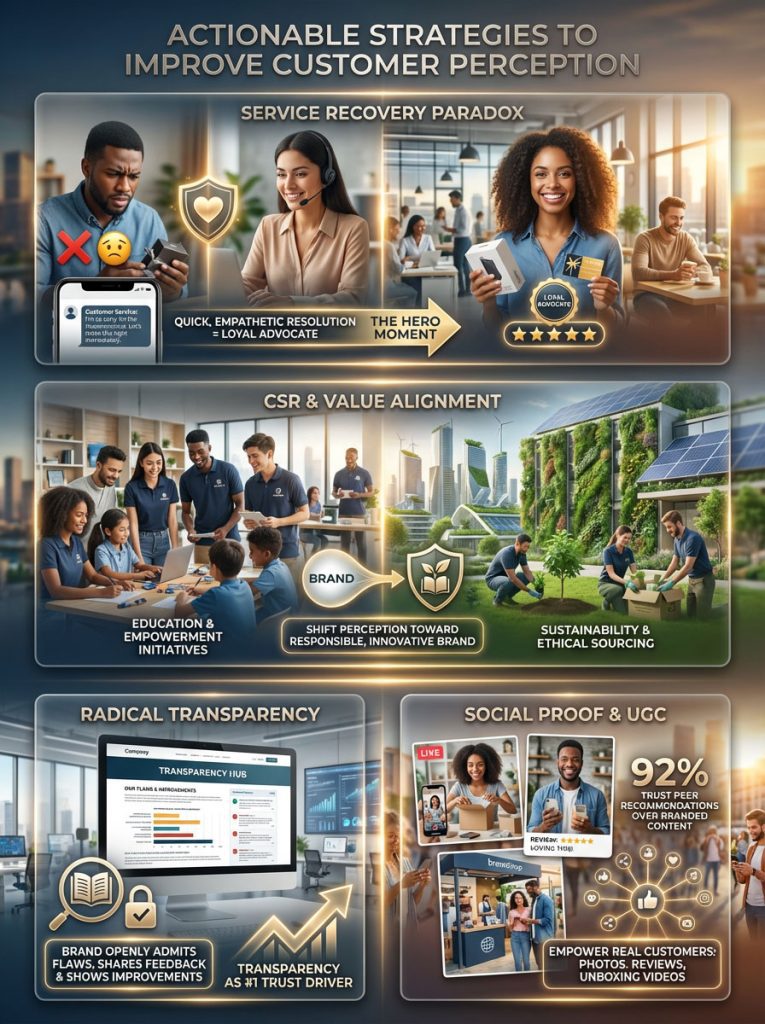
There is a counter-intuitive phenomenon in customer service impact known as the Service Recovery Paradox. Data suggests that a customer who experiences a problem that is resolved quickly, empathetically, and completely often ends up more loyal than a customer who never experienced a problem at all.
- The Strategy: Do not fear mistakes; fear silence. Empower your support team to solve issues immediately. A generic “we will get back to you in 48 hours” confirms a negative perception. A “let me fix this for you right now” creates a “Hero Moment” that the customer will remember and share.
Aligning with Social Values through Corporate Social Responsibility (CSR)
Corporate Social Responsibility (CSR) is a powerful lever for shifting brand reputation. It humanizes the corporation.
- The Samsung Example: Years ago, Samsung was viewed strictly as a hardware manufacturer—efficient but cold. By investing heavily in “Solve for Tomorrow” educational programs and sustainability initiatives, they shifted their consumer perception to that of a “Global Innovator” and a responsible partner. This alignment with consumer values creates a deeper emotional bond that transcends the product specs.
Radical Transparency to Build Trust
In an era of skepticism, transparency is the ultimate currency. If you try to hide flaws, the internet will find them.
- The Domino’s Turnaround: Domino’s Pizza executed one of the most famous brand pivots in history. They publicly admitted their pizza “tasted like cardboard” in national ad campaigns. They showed focus groups criticizing the product. Then, they showed how they fixed it. This radical transparency shocked the market, dismantled the negative perception, and rebuilt trust from the ground up. Today, transparency is a top-three driver of positive consumer perception in the US market.
Leveraging Social Proof and User-Generated Content (UGC)
You can tell people you are great, but they won’t believe you. They will believe their peers. 92% of consumers trust recommendations from strangers over branded content.
- The Tactic: To improve customer perception, you must aggressively leverage User Generated Content (UGC). Encourage your happy customers to post photos, unboxing videos, and detailed reviews. When a potential buyer sees a real person—who looks like them—enjoying your product, the risk perception drops immediately. This is why influencer marketing (when done authentically) works; it borrows the trust of the creator and lends it to the brand.
Summary & Key Takeaways: Mastering the Perception Game
Consumer perception is the sum total of every interaction, every ad, every click, and every rumor associated with your brand. It is a complex mix of sensory inputs, psychological biases, and digital experiences. It is the invisible hand that determines if your business scales or stalls.
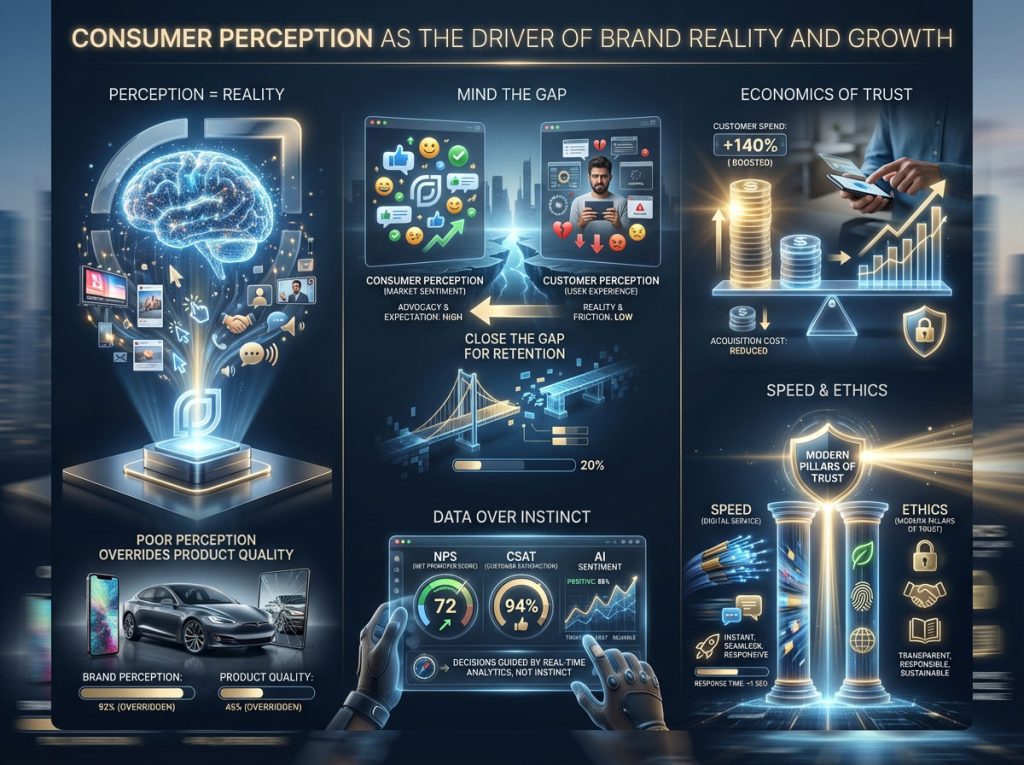
- Perception is Reality: It does not matter how good your product is objectively. If the consumer perception is poor, the business will fail.
- Mind the Gap: Constantly monitor the difference between what the market thinks (Consumer Perception) and what your users know (Customer Perception). Closing this gap is the key to retention.
- Economics of Trust: A positive perception leads to a 140% increase in customer spending and a massive reduction in acquisition costs.
- Data Over Instinct: Use NPS, CSAT, and AI-driven sentiment analysis to keep your finger on the pulse. Do not guess how people feel about you.
- Speed and Ethics: In the modern era, speed of service and ethical standing are the two new pillars of trust.
The businesses that win in the coming decade will not just be the ones with the best technology or the lowest prices. They will be the ones that best manage the psychology of their audience, understanding that every touchpoint is an opportunity to shape the narrative.
Frequently Asked Questions (FAQs) About Consumer Perception
What are the main factors affecting consumer perception?
The primary factors include personal experience, price points, advertising quality, social media influence, peer reviews, and cultural background. Psychological triggers like the halo effect, selective retention, and cognitive biases also play a massive role in how a brand is viewed by the public.
What is the difference between sensation and perception in marketing?
Sensation is the biological process of receiving raw data through the five senses (sight, smell, sound, touch, taste). Perception is the psychological process where the brain interprets that raw data and gives it meaning. Sensation is physical (seeing the color red); perception is mental (associating red with “sale” or “danger”).
How does culture influence consumer perception?
Culture acts as a filter for interpretation. Symbols, colors, humor, and values are interpreted differently across cultures. For example, the color white represents purity in Western cultures but can represent mourning in some Asian cultures. Marketers must adapt to these cultural nuances to avoid accidental negative perception.
Why is selective perception important in marketing strategy?
Selective perception is the brain’s defense mechanism against information overload. Since consumers are bombarded with thousands of ads daily, they only notice what aligns with their current needs or beliefs. Marketers must use strong hooks, personalization, and relevance to break through this filter and gain attention.
How can a brand fix negative consumer perception?
Fixing negative perception requires acknowledgment, action, and consistency. Brands should admit mistakes transparently, invest in service recovery strategies, and actively encourage positive user-generated content to drown out the negative sentiment over time. It is a marathon, not a sprint.
Does price really affect the perception of quality?
Yes, significantly. This is known as the price-quality heuristic. Consumers often use price as a mental shortcut to judge quality when they lack expertise. A higher price can signal luxury, exclusivity, and effectiveness, while a price that is too low can signal cheapness or poor manufacturing.
What is the role of packaging in consumer perception?
Packaging is often the first tactile interaction a consumer has with a brand. High-quality materials, weight, and design create a “premium” feel before the product is even used. Brands like Apple use packaging to heighten the sensory marketing experience and build excitement (dopamine release) during the unboxing process.
How does social media impact brand perception?
Social media amplifies word-of-mouth at scale. It allows consumer perception to spread globally in minutes. It creates “social proof,” where the number of likes, shares, and positive comments signals the trustworthiness and popularity of a brand to new users.
What is the halo effect in consumer behavior?
The halo effect is a cognitive bias where a positive experience with one aspect of a brand (like a helpful support agent or a beautiful website) causes the consumer to view the entire brand (including the product quality and ethics) more favorably.
What are the 4 stages of the perception process?
The four stages are Exposure (Sensation), Attention (Selection), Interpretation (Organization), and Retention (Memory). A consumer must pass through all four stages for a brand message to successfully result in a purchase or memory.
How does customer service impact brand reputation?
Customer service is the frontline of customer perception. A poor interaction can destroy years of loyalty in minutes, while a great interaction (Service Recovery) can create a lifelong advocate. In the modern era, service is considered part of the product itself.
What tools are best for measuring brand sentiment?
The best tools include NPS (Net Promoter Score) surveys for loyalty, Google Alerts for basic tracking, and advanced enterprise software like Brandwatch, Qualtrics, and Medallia for deep AI-driven sentiment analysis and social listening across the web.
Disclaimer: The content provided in this article is for informational and educational purposes only and does not constitute professional business, financial, or legal advice. The statistics, methodologies, and data points mentioned (including references to Deloitte, PwC, and others) are based on available industry reports and general market trends. Business owners should conduct their own due diligence and consult with qualified professionals before making significant operational changes.
References:
- Deloitte Consumer Review: The Growing Power of Consumers.
- PwC: Experience is Everything: Here’s How To Get It Right.
- Harvard Business Review: The New Science of Customer Emotions.
- Journal of Consumer Research: The Role of Sensory Marketing.
- Journal of Marketing Research: The Price-Quality Heuristic.