









AI keyword research utilizes advanced machine learning algorithms to automate the discovery of seed keywords, validate metrics against massive databases like Semrush’s 25B+ keywords, and group terms into semantic clusters. This strategic workflow streamlines keyword intent analysis AI, allowing marketers to target AI Overviews and build topical authority 30% faster than manual methods.
Table of Contents
The Shift from Manual Guesswork to AI Keyword Research Precision
You used to be able to rank a page with a simple spreadsheet, a few lucky guesses, and a high volume of backlinks. That era is over. The search landscape has fundamentally shifted from matching strings of text to understanding the semantic relationship between concepts. If you are still manually digging for keywords one by one, you are bringing a knife to a nuclear fight.

AI keyword research is not just about speed. It is about depth. It is the only reliable way to process the billions of data points necessary to understand what users actually want before they even finish typing. The difference between a failed campaign and a ranking asset often comes down to how well you leverage AI SEO tools to predict user behavior.
We are seeing a clear divide in the industry. On one side are the marketers who use ChatGPT to brainstorm and Semrush to validate. On the other are those stuck in the past, wondering why their single-keyword pages no longer drive traffic. This guide is your blueprint to joining the former. We will walk through the exact AI keyword research process step by step that turns raw data into revenue.
Why AI Keyword Research is Non-Negotiable for SEO Strategy
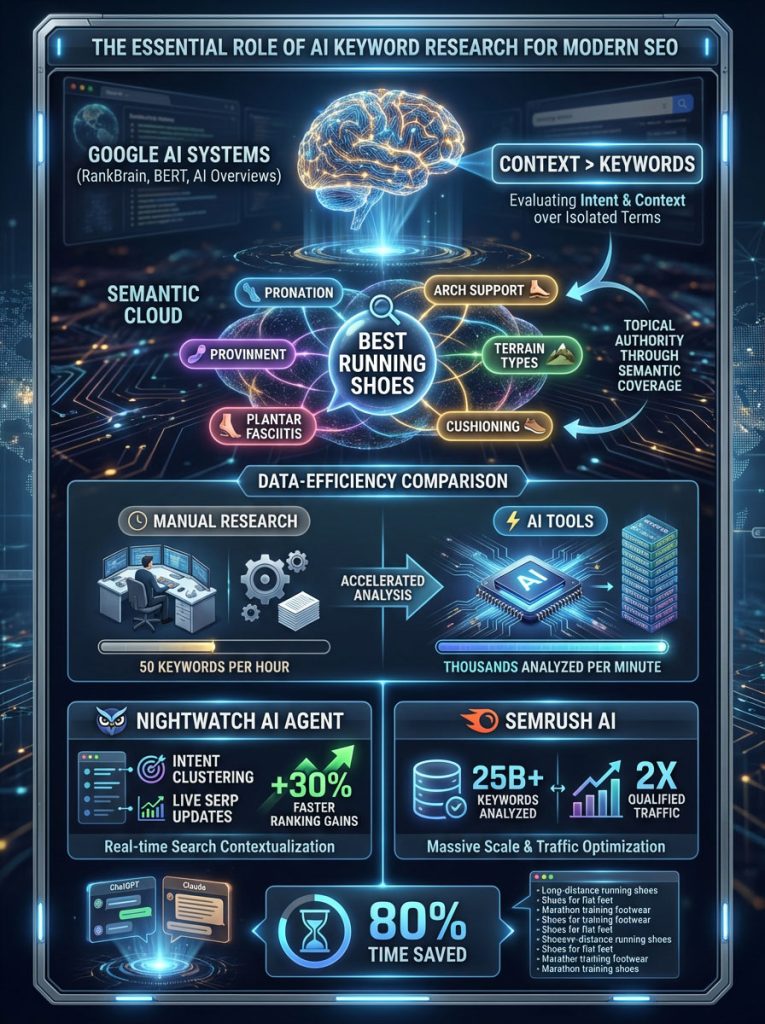
The algorithms governing Google have evolved into complex AI systems themselves. RankBrain, BERT, and the systems powering AI Overviews do not look at keywords in isolation. They look at context. To rank, you must mirror this sophistication in your AI keyword research process.
Leveraging Semantic Keywords AI for Topical Authority
Google now prioritizes topical authority over keyword density. This means you cannot just target “best running shoes” and expect to win. You must cover the entire semantic cloud around that term, including pronation, arch support, and terrain types. Semantic keywords AI tools excel here because they understand these relationships natively.
Where a human might miss the connection between “plantar fasciitis” and “running shoe cushioning,” an AI model sees the correlation immediately. By using AI keyword research, you ensure your content covers the entities and concepts that search engines expect to see from an expert.
Data Instances: Speed and Scale of AI SEO Tools
Let’s look at the numbers. Manual research is mathematically inefficient. An expert might analyze 50 keywords an hour. AI SEO tools can analyze thousands in minutes.
Consider Nightwatch SEO. Their AI Agent clusters keywords by intent and updates priorities based on live SERP data. Users leveraging this specific automation report 30% faster ranking gains because they are not wasting time on terms that have already peaked or are irrelevant.
Similarly, Semrush AI analyzes over 25 billion keywords to assess difficulty and intent. When you use this data, you are boosting qualified traffic by 2x via precise targeting. You are not guessing. You are executing based on the largest dataset available.
Efficiency Gains: How AI Reduces Research Time by 80%
The most tangible benefit of integrating keyword research AI is time. Generative tools like ChatGPT or Claude can produce initial lists and content briefs in seconds. ChatGPT generates 10+ semantic seed variations per prompt, which reduces the initial manual brainstorming time by roughly 80%. This frees you up to focus on strategy and content quality rather than data entry.
Step 1: Generating Seed Keywords AI for Strategic Ideation
Every great SEO campaign starts with a seed. These are the core themes you want to own. Historically, this involved staring at a blank whiteboard. Now, it involves precise prompting to utilize seed keywords AI capabilities effectively.

Utilizing Generative AI to Generate Long Tail Keywords
Seed keywords AI generation is where Large Language Models (LLMs) shine. Tools like ChatGPT and Claude act as tireless brainstorming partners. They can laterally associate concepts that you might miss.
For example, if you are selling “CRM software,” a manual brainstorm might give you “best CRM” or “sales software.” An AI model will suggest “customer retention systems,” “lead management automation,” and “pipeline tracking tools.” These are distinct entry points into the same market.
Mastering Prompt Engineering for Seed Keywords AI Discovery
To get the best results, you must engineer your prompts to act like an SEO strategist. Do not ask for “keywords.” Ask for “semantic variations based on user pain points.”
Try this specific prompt structure to generate long tail keywords with AI:
“Act as an SEO expert for the [Industry] market in the USA. Generate 20 semantic seed keyword variations for [Topic] focusing on informational intent. Focus on problems the user is trying to solve rather than just product names.”
This approach helps you generate long tail keywords with AI that are often less competitive but highly relevant.
Warning Against Hallucinations in AI Keyword Research
You must exercise caution. LLMs are prediction engines, not databases. They will often invent search volumes or difficulty metrics if you ask for them. Never rely on ChatGPT for numbers. Use it strictly for the seed keywords AI ideation phase, then move those ideas to a dedicated data tool for validation.
Step 2: Validating Metrics with Semrush AI and High-Data Tools
Once you have your list of ideas, you must determine if anyone is actually searching for them. This is where we move from creativity to hard logic using AI SEO tools with access to clickstream data.

Integrating Semrush AI for Keyword Difficulty Analysis
Take your AI-generated seed list and import it into Semrush (Keyword Magic Tool) or Ahrefs. These platforms use machine learning to predict search volume trends and ranking difficulty.
Semrush AI is particularly powerful here. It allows you to filter your raw list against its 25 billion keyword database. You can instantly see which of your “creative ideas” have zero search volume and which are hidden gems.
Analyzing Click Potential for Long Tail Keywords AI
In modern SEO, high volume does not always equal high traffic. Zero-click searches are rising. AI keyword research tools now offer metrics like “Click Potential” or “Traffic Potential.”
You should prioritize long tail keywords that show a high probability of a click. A keyword with 500 searches and an 80% click rate is far more valuable than a keyword with 2,000 searches and a 10% click rate. Semrush AI helps you visualize this trade-off instantly.
Strategy: Filtering for Low-Competition Long Tail Keywords
The biggest opportunity lies in the long tail. These are queries with low individual volume but massive aggregate potential. By using AI keyword research to identify hundreds of these variations, you can build a “net” that catches traffic from thousands of specific queries.
Generate long tail keywords with AI by asking your tool to find “question-based queries” related to your seed topics. These questions often represent the highest intent users who are on the verge of making a decision.
Step 3: Mastering AI Keyword Clustering for Topical Authority
If you only take one thing from this guide, let it be this: Stop optimizing for single keywords. Start optimizing for clusters. AI keyword clustering is the secret weapon of top-tier SEOs.

The Mechanics of AI Keyword Clustering
AI keyword clustering uses natural language processing (NLP) to analyze the SERPs and determine which keywords can be ranked with a single page.
For instance, a manual review might treat “how to clean sneakers” and “sneaker cleaning guide” as two different articles. A clustering tool like the Nightwatch SEO AI Agent or Surfer SEO will analyze the live results. If the same URLs rank for both terms, the AI tells you to group them.
This prevents keyword cannibalization, where your own pages compete against each other. It ensures you focus your link-building and content efforts on one powerhouse asset rather than diluting value across five weak pages.
Building Topical Authority via Semantic Keywords AI
Google gives preferential treatment to sites that demonstrate expertise across a whole topic. By publishing a “cluster” of content—a pillar page supported by 10 supporting articles—you signal deep authority.
Semantic keywords AI analysis allows you to map out these clusters in minutes. You can see exactly which supporting articles you need to write to prop up your main commercial pages. This structure is essential for triggering AI Overviews, which heavily favor authoritative sources.
Comparison Table: Manual Research vs. AI Keyword Clustering
The efficiency gap here is massive. Attempting to cluster 1,000 keywords manually requires checking the SERPs for every single pair to see if they overlap. It is impossible to do accurately at scale.
| Feature | Manual Research | AI Keyword Clustering |
| Speed | 5+ Hours per 100 keywords | < 5 Minutes for 1,000+ keywords |
| Accuracy | Prone to human bias/error | Data-driven semantic matching |
| Scale | Limited to head terms | Captures full long-tail scope |
| SERP Alignment | Often misses intent shifts | Updates with live SERP data |
| Authority | Fragmented content | Topical Authority (Cluster 3) |
Step 4: Decoding User Intent with Keyword Intent Analysis AI
Keywords are just proxies for intent. To rank, you must understand what the user wants to achieve. Keyword intent analysis AI automates this classification with high accuracy.

Categorizing Micro-Intents with AI SEO Tools
The classic binary of “Info vs. Buy” is too simple. AI keyword research tools categorize intent into micro-moments:
- Navigational: Looking for a specific site.
- Informational: Looking for an answer.
- Commercial Investigation: Comparing options (Best X vs. Y).
- Transactional: Ready to purchase.
Nightwatch SEO and Semrush tag every keyword with these intents automatically. This allows you to segment your strategy. You can send “Informational” keywords to your blog team and “Transactional” keywords to your product page team.
Improving Conversational Query Growth via Intent Matching
Misaligned intent is the #1 reason for high bounce rates. If a user searches “best CRM software” (Commercial Investigation) and lands on a generic “What is a CRM” (Informational) page, they will leave.
Semrush AI helps you match your content format to the intent. If the top results are listicles, you write a listicle. If they are tools, you build a tool. This alignment boosts qualified traffic by preventing wasted clicks from users who will never convert on that specific page type.
By using keyword intent analysis AI, you can drive 70% conversational query growth because you are answering the specific question the user is asking, in the format they expect.
Step 5: Live AI SERP Analysis and Content Optimization
The final step in the AI keyword research process step by step is analyzing the battlefield. You need to see what is currently winning to understand how to beat it.

Conducting Real-Time AI SERP Analysis
AI SERP analysis tools like Surfer SEO and Frase scan the top 20 results for your target cluster. They extract data points that are invisible to the naked eye:
- Average word count.
- Keyword density of specific NLP terms.
- Heading structure usage.
- Image count and alt text optimization.
This data provides a roadmap. You are no longer writing in the dark; you are writing to a specific data-based standard.
Optimizing for AI Overviews with AI SERP Keyword Optimization
With AI Overviews now triggering on 13%+ of low-volume queries, your content needs to be structured for machine readability. This means clear headings, direct answers to questions early in the content, and robust schema markup.
AI SERP keyword optimization involves finding the questions that AI Overviews are answering and ensuring your content provides a better, more concise answer. This increases your chances of being cited as the source in that prime real estate at the top of the search results.
Identifying Content Gaps Using AI SEO Tools
AI SEO tools excel at finding what is missing. They can compare your content against competitors and highlight topics they covered that you missed. This “Content Gap” is often the difference between position #1 and position #6. By filling these gaps, you make your content the most comprehensive resource on the web, which is the primary signal for E-E-A-T.
Best AI Tools for Keyword Research: A Comparative Review
To execute this strategy, you need the right technology stack. There is no single tool that does everything perfectly, so most experts use a combination. Here is how the top AI SEO tools stack up.

Semrush: The Standard for Deep Data Analysis
Semrush is the industry standard for a reason. Its Keyword Magic Tool is unrivaled for the sheer volume of data. If you need to validate metrics across global markets or dive deep into historical data, this is the tool. The Semrush AI features for intent profiling are highly accurate.
Nightwatch SEO: Best for AI Keyword Clustering
For pure rank tracking and clustering, Nightwatch SEO is a powerhouse. Its ability to access accurate local SERP data and cluster keywords automatically makes it indispensable for agencies. The Nightwatch AI Agent saves hours of manual reporting time.
Surfer SEO: Essential for AI SERP Analysis
Surfer SEO bridges the gap between research and writing. It is the best tool for AI SERP analysis and content planning. It tells you exactly which terms to use and how often to use them to match the topical relevance of current market leaders.
Comparison Table: Top AI SEO Tools for Keyword Research
| Tool | Best Use Case | AI Feature Highlight | Pricing Model |
| Semrush | Deep Data Analysis | Intent & Difficulty Profiling | Subscription |
| ChatGPT | Seed Ideation | Semantic Brainstorming | Free / Plus |
| Nightwatch | Ranking & Clustering | Automated Intent Categorization | Subscription |
| Surfer SEO | Content Planning | SERP Analyzer & NLP scoring | Subscription |
| Ahrefs | Competitor Analysis | Content Gap AI | Subscription |
Advanced Techniques in AI Keyword Research for Competitive Markets
While the standard workflow is robust, highly competitive niches require deeper strategies. The following advanced techniques leverage AI keyword research to uncover opportunities that even intermediate SEO professionals often overlook.
Leveraging Predictive Analytics in AI SEO Tools
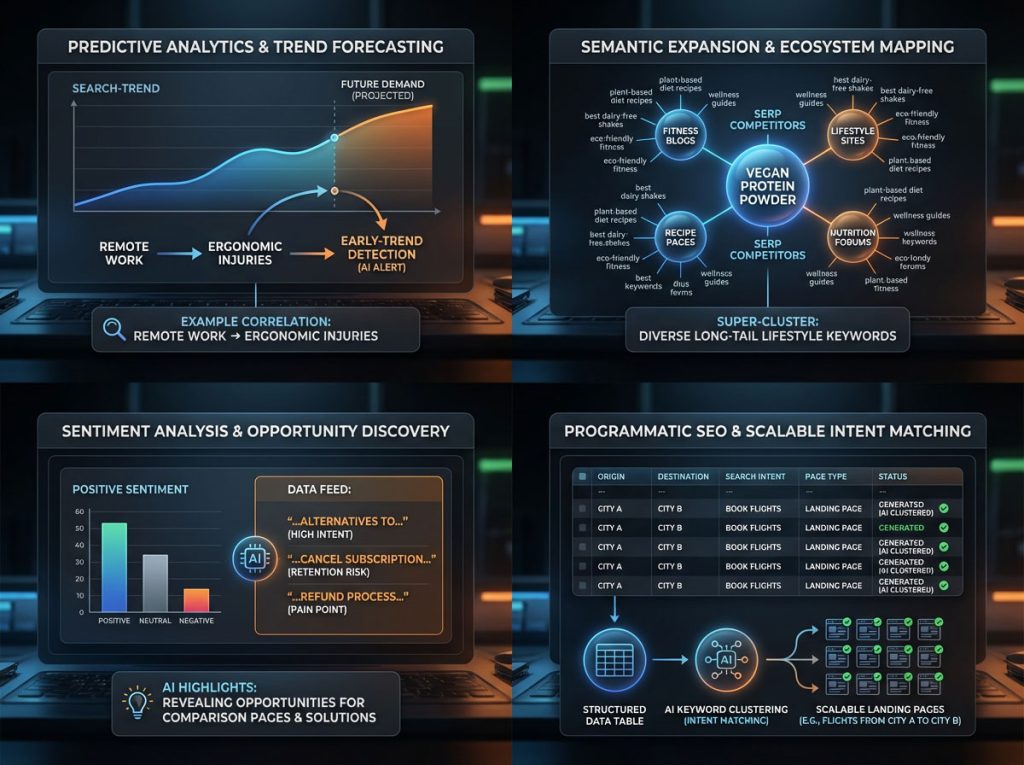
The future of search is not just about what is trending now. It is about what will trend next month. Advanced AI SEO tools are beginning to offer predictive analytics. This involves analyzing historical data patterns to forecast rising search demand before it peaks.
By using tools that integrate predictive modeling, you can identify seasonal spikes or emerging sub-niches weeks before your competitors. For example, if AI keyword research indicates a rising correlation between “remote work” and “ergonomic injuries,” a furniture retailer could prepare content around “preventing back pain at home” before the trend reaches maximum volume. This proactive approach is only possible when you move beyond static search volumes and utilize machine learning to spot trajectory.
Semantic Expansion Beyond Direct Competitors
Most marketers only analyze their direct competitors. However, semantic keywords AI allows you to analyze “SERP competitors.” These are sites that may not sell what you sell but rank for the terms you want.
For instance, if you sell “vegan protein powder,” your direct competitors are other supplement brands. But your SERP competitors might include fitness blogs, lifestyle magazines, or recipe sites. An AI SERP analysis can ingest the content strategies of these diverse entities to build a “super-cluster” of keywords. This helps you generate long tail keywords with AI that cover the lifestyle aspects of your product, not just the transactional ones. By answering queries about “vegan diet planning” or “plant-based recovery,” you capture the user earlier in the funnel.
Analyzing Sentiment with Keyword Intent Analysis AI
Standard intent analysis categorizes keywords into broad buckets like “informational” or “transactional.” However, advanced keyword intent analysis AI can also detect sentiment. It can determine if the queries around a specific brand or topic are generally positive, negative, or neutral.
If you discover that search queries around a competitor often include negative modifiers like “alternatives,” “cancel,” or “refund,” this is a massive opportunity. You can create comparison pages targeting those specific pain points. For example, “Best [Competitor] Alternatives for Small Business” captures users who are already dissatisfied and looking to switch. AI tools can scrape thousands of these reviews and forum discussions to find the exact language users use to describe their frustration, allowing you to mirror that language in your copy.
Programmatic SEO and Scalable Content Generation
For enterprise-level sites, writing content one page at a time is too slow. Programmatic SEO involves using AI to generate thousands of landing pages based on structured data. While this approach carries risks, when done correctly with AI keyword research, it can dominate local or e-commerce search results.
Imagine you are a travel booking site. You need pages for “Flights from [City A] to [City B].” There are thousands of combinations. You cannot write these manually. By feeding an AI model a database of cities, prices, and flight times, combined with a clustered keyword list, you can generate unique, valuable pages for every route. The key here is using AI keyword clustering to ensure you don’t create duplicates and that every generated page targets a specific, valid search intent.
The Role of Natural Language Processing (NLP) in Ranking
To truly master AI keyword research, one must understand the technology that powers Google: Natural Language Processing (NLP). This is the branch of AI that enables computers to understand human language as it is spoken and written.
Understanding Vector Embeddings in Search
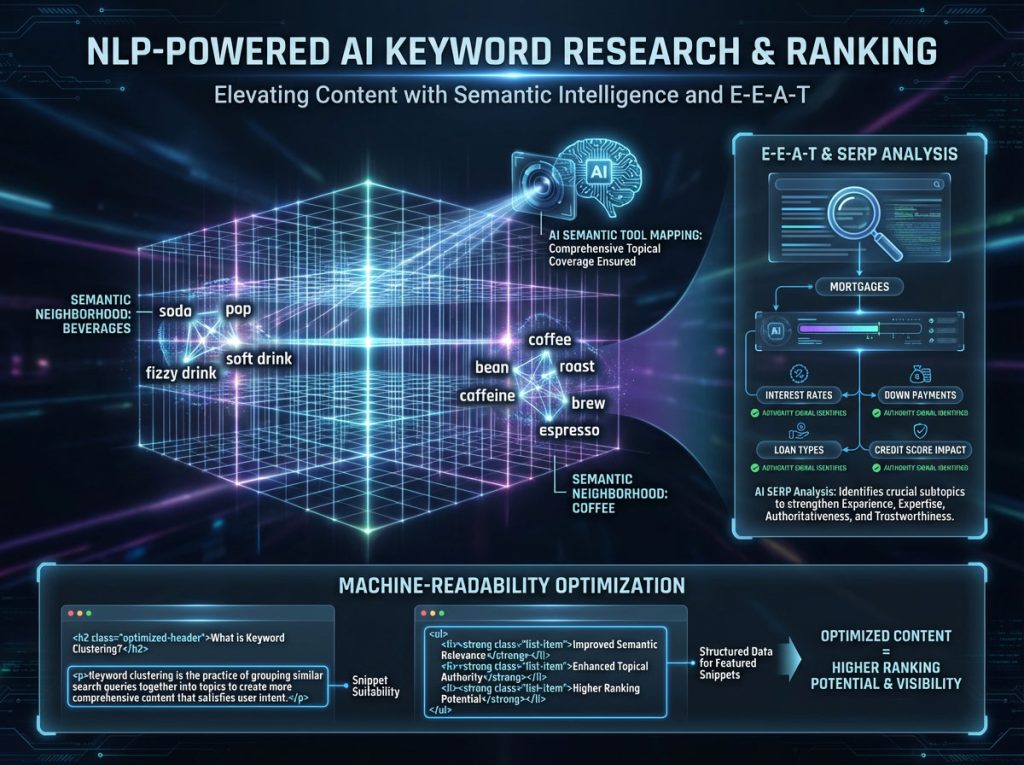
Modern search engines convert words into numbers known as “vectors.” These vectors represent the meaning of the word in a multi-dimensional space. Words with similar meanings are located close together in this space. This is why Google knows that “soda” and “pop” are the same thing in the context of soft drinks.
When you use semantic keywords AI tools, you are essentially asking the tool to find keywords that are vectorially close to your target topic. This ensures that your content covers the “neighborhood” of the topic. If you write about “coffee,” the AI knows you must also mention “bean,” “roast,” “caffeine,” and “brew” because they are mathematically linked in the vector space. Ignoring these connections is a signal to Google that your content is shallow.
Google’s E-E-A-T and AI-Generated Signals
While Google advocates for helpful content regardless of how it is produced, AI keyword research helps you satisfy E-E-A-T (Experience, Expertise, Authoritativeness, Trustworthiness) by ensuring comprehensiveness.
Authoritativeness is often determined by coverage. If a user lands on your page about “mortgages” and you fail to mention “interest rates” or “down payments,” you appear inexpert. AI SERP analysis tools act as a checklist for expertise. They scan the most authoritative pages on the web and tell you exactly what topics they cover. By matching or exceeding this coverage, you statistically increase your “authority score” in the eyes of the algorithm.
Structuring Content for Machine Readability
It is not enough to just have the keywords; they must be structured in a way that machines can easily parse. AI Overviews and Featured Snippets rely on clean HTML structure. AI SERP keyword optimization involves placing your core definitions in <p> tags immediately following an <h2> question.
AI tools can analyze your draft and suggest structural changes. They might recommend breaking a long paragraph into a bulleted list because the data shows that listicles are winning the snippet for that query. This level of granular optimization is tedious for humans but effortless for AI SEO tools.
Common Pitfalls in AI Keyword Research and How to Avoid Them
Adopting AI keyword research is powerful, but it comes with specific risks. Many marketers fall into traps that can actually harm their rankings if they rely too heavily on automation without strategic oversight.
The Danger of Over-Reliance on Generative Volume
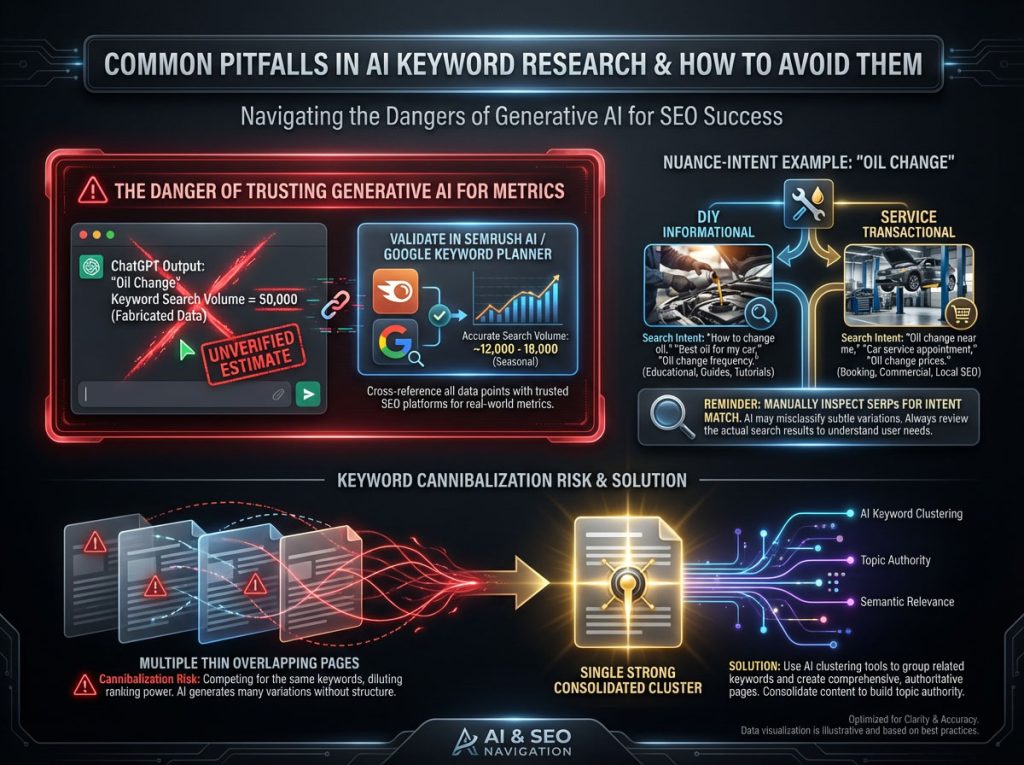
We touched on this earlier, but it bears repeating in detail. Generative AI models like ChatGPT are probabilistic. They predict the next word in a sentence; they do not query a live database of search logs. If you ask ChatGPT, “What is the search volume for ‘AI SEO tools’?”, it might give you a number like “10,000/month.” This number is a hallucination. It is a plausible-sounding guess, not a fact.
Always, without exception, validate your lists. Use Semrush AI or Google Keyword Planner as the source of truth for metrics. Use the LLM for creativity and the database tool for reality.
Ignoring the “Human Element” in Intent
AI is excellent at categorizing intent, but it can struggle with nuance. A keyword like “oil change” could be informational (how to do it) or transactional (where to get it). An AI might tag it as purely transactional based on ad spend, but a human understands that a significant portion of searchers are DIY enthusiasts.
If you blindly follow the keyword intent analysis AI without checking the SERP yourself, you might create a sales page when the user wanted a tutorial. Always perform a manual spot-check on your high-priority clusters to ensure the AI’s classification aligns with common sense and actual SERP results.
Keyword Cannibalization via Over-Optimization
It is possible to use AI keyword research to find too many keywords. If you create a separate page for every single long-tail variation you find, you will bloat your site with thin, overlapping content. This confuses search engines.
Trust the AI keyword clustering process. If the tool says two keywords belong together, do not try to outsmart it by separating them to “get more traffic.” Consolidated authority almost always beats fragmented relevance.
The Future of Search: Integrating AI Keyword Research with Voice and Visual Search
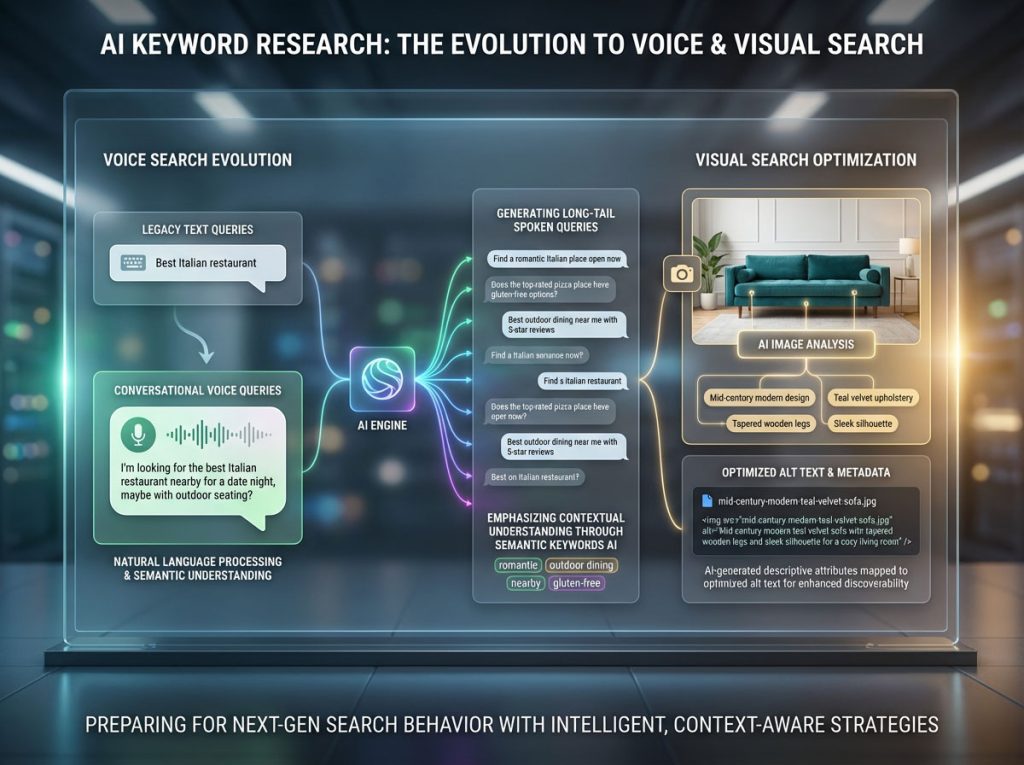
As we look toward the horizon, AI keyword research is expanding beyond text. The rise of voice search and visual search requires a new approach to keyword strategy.
Optimizing for Conversational Voice Queries
Voice searches are typically longer, more conversational, and phrased as questions. “Best Italian restaurant” (text) becomes “Hey Google, where is the best Italian place near me that is open right now?” (voice).
Generate long tail keywords with AI that mimic this natural speech pattern. Use prompts that ask for “conversational questions” or “spoken queries.” Semantic keywords AI becomes even more critical here, as voice assistants rely heavily on context to provide a single, direct answer.
Visual Search and Alt-Text Strategy
Visual search (using Google Lens) is growing. Users are snapping photos of products to find where to buy them. AI keyword research can help here by identifying the descriptive terms users apply to visual attributes.
If you sell furniture, an AI tool can analyze the adjectives associated with your product images. It might find that users search for “mid-century modern teal velvet sofa.” By including these specific, descriptive long tail keywords in your image alt text and file names, you optimize your visual assets for discovery.
Summary and Action Plan: Implementing Your AI Keyword Research Process
AI keyword research is not a magic button that does the work for you. It is a force multiplier that allows you to work smarter. By following this workflow, you move from guessing to knowing.

- Ideate: Use ChatGPT to generate creative seed keywords AI lists based on deep persona analysis.
- Validate: Use Semrush to check metrics, filter by “Click Potential,” and remove zero-volume duds.
- Cluster: Use Nightwatch SEO to group terms, prevent cannibalization, and build topical authority.
- Optimize: Use Surfer SEO to align your content structure and vocabulary with AI SERP analysis data.
This process reduces manual research time by 80% and accelerates your path to ranking. The future of SEO belongs to those who can combine human strategy with AI efficiency. Start generating your seed list today and stop leaving your traffic to chance.
Frequently Asked Questions (FAQ)
What is AI keyword research?
AI keyword research is the use of artificial intelligence and machine learning tools to automate the discovery, analysis, and grouping of search terms. It goes beyond simple search volume data to understand user intent, semantic relationships, and ranking probability, allowing for more effective SEO strategies.
Which AI keyword tool has the highest ROI?
For most businesses, Semrush offers the highest ROI because it consolidates keyword research, competitor analysis, and site auditing into one platform. However, for specific tasks like automated clustering and local tracking, Nightwatch SEO provides exceptional value and efficiency.
How does AI improve keyword clustering?
AI improves clustering by analyzing the semantic meaning behind keywords rather than just their spelling. AI keyword clustering tools look at live SERP data to see if Google ranks the same pages for different terms. If it does, the AI groups those keywords together, preventing cannibalization and boosting authority.
Can I use ChatGPT for keyword research alone?
No, you should not use ChatGPT alone. While it is excellent for generating seed keywords and brainstorming ideas, it does not have access to live, accurate search volume or difficulty data. You must validate any ideas from ChatGPT with a tool like Semrush or Ahrefs.
How do I generate long-tail keywords with AI?
To generate long tail keywords with AI, use specific prompts asking for “question-based queries” or “user pain points” related to your main topic. You can also use tools like AnswerThePublic or the “Questions” filter in Semrush to find high-intent, low-competition phrases.
What are the best free AI tools for seed keywords?
The best free combination is ChatGPT (for ideation) and Google Keyword Planner (for basic volume data). ChatGPT can generate hundreds of creative variations, while Google’s tool gives you a baseline for which terms actually have search volume.
How does AI help with SERP analysis?
AI SERP analysis tools scan the top-ranking pages for a keyword to identify patterns. They analyze word count, heading structure, and semantic term usage. This provides a data-driven blueprint for creating content that is statistically likely to rank.
Is AI keyword research better than manual research?
Yes, it is superior in terms of speed, scale, and depth. Manual research is prone to bias and cannot process the billions of data points needed to understand modern search algorithms. AI tools can process this data instantly, highlighting opportunities a human would miss.
What is the role of semantic keywords in AI SEO?
Semantic keywords AI (LSI keywords) help search engines understand the context and depth of your content. Including these related terms signals to Google that you are a subject matter expert, which is a critical factor for ranking in competitive niches.
Does AI help with local keyword research in the USA?
Yes. AI tools can filter search intent and volume by specific geo-locations. This allows you to identify “near me” opportunities and hyper-local long-tail keywords relevant to specific states or cities in the USA.
Will AI replace human SEO specialists?
No. AI SEO tools replace the manual drudgery of data entry and basic analysis. However, they cannot replace the strategic oversight, empathy, and creative direction that a human specialist provides. The best results come from humans leveraging AI, not surrendering to it.