








Your Discover traffic dropped 40% last week. You checked Search Console. Regular search rankings? Fine. But Discover impressions fell off a cliff.
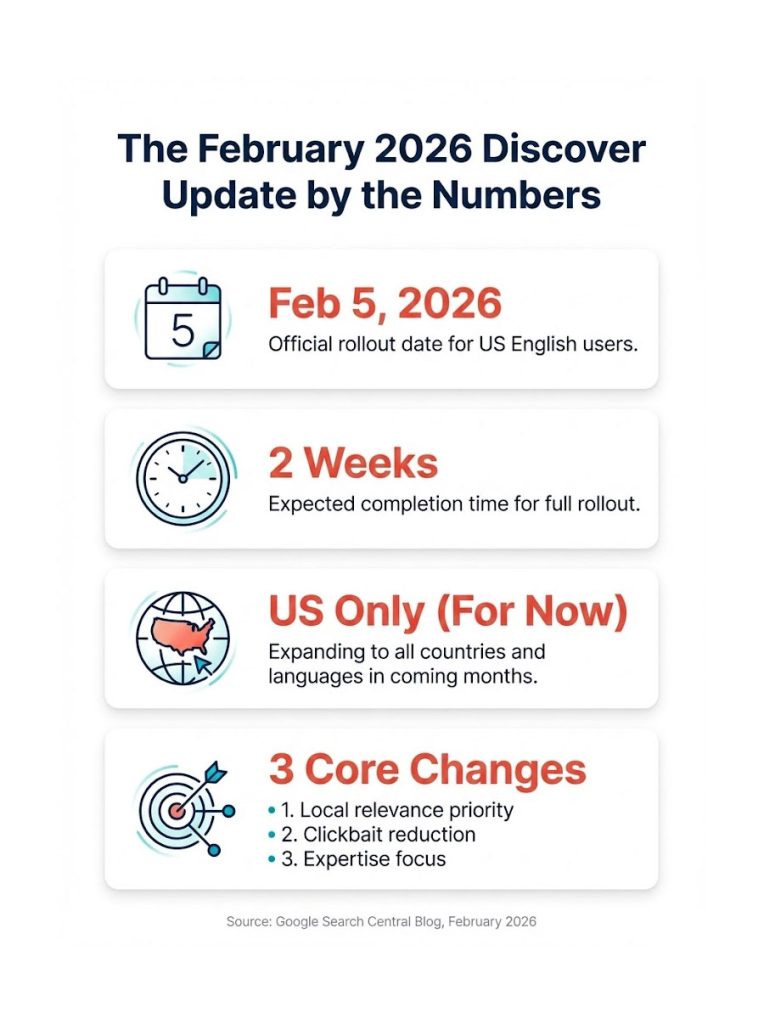
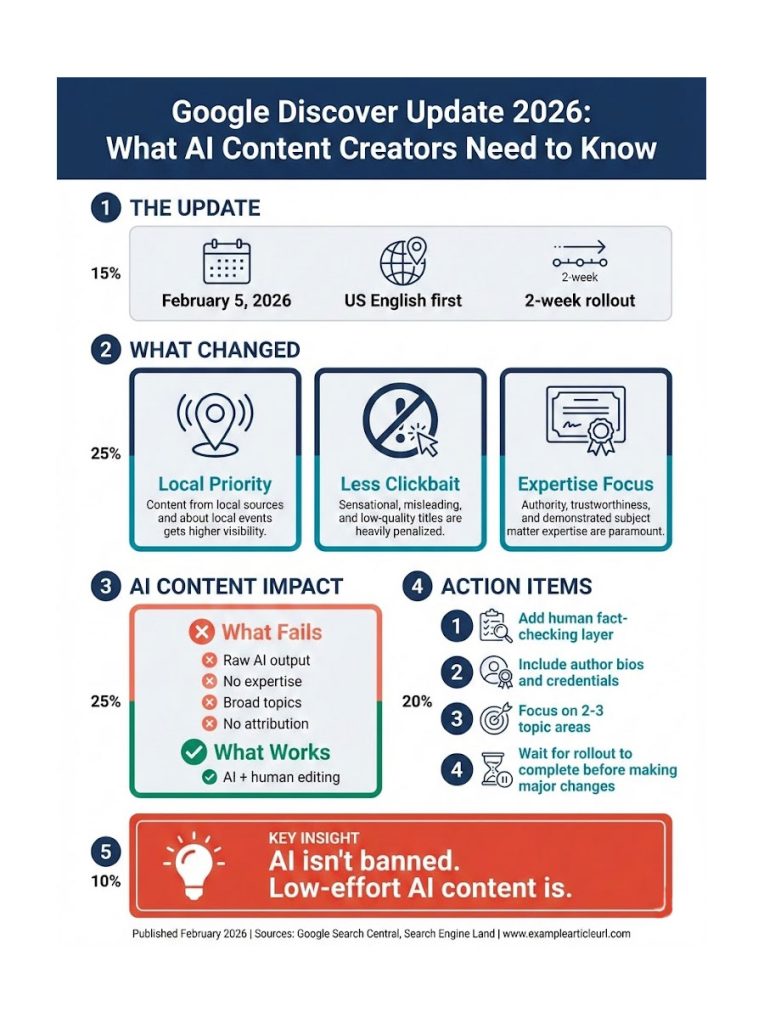
Here’s what happened. On February 5, 2026, Google rolled out the February 2026 Discover Core Update. And if you’ve been relying on AI tools to pump out content at scale, this update is speaking directly to you.
This isn’t about banning AI content. Let’s get that straight right now. Google has said repeatedly that AI-assisted content is fine. What changed is how aggressively the algorithm can now spot the difference between AI content that adds value and AI content that’s just filling space.
What Actually Changed in the Discover Algorithm
Google’s February 2026 Discover Core Update targets three specific areas. Local relevance gets priority (US sites rank higher for US Discover users). Clickbait gets demoted. And here’s the big one: Google now surfaces content from sites with demonstrated topical expertise.
That third point is where AI content creators are feeling the pressure.
The update rolled out first to English-language users in the United States. Google says it’ll expand to other countries and languages over the coming months. The rollout window is about two weeks, which means effects are still shaking out as of mid-February.
According to Google’s official announcement on the Search Central Blog, internal testing showed that people find the Discover experience “more useful and worthwhile” with this update. Translation: the old stuff wasn’t cutting it anymore.
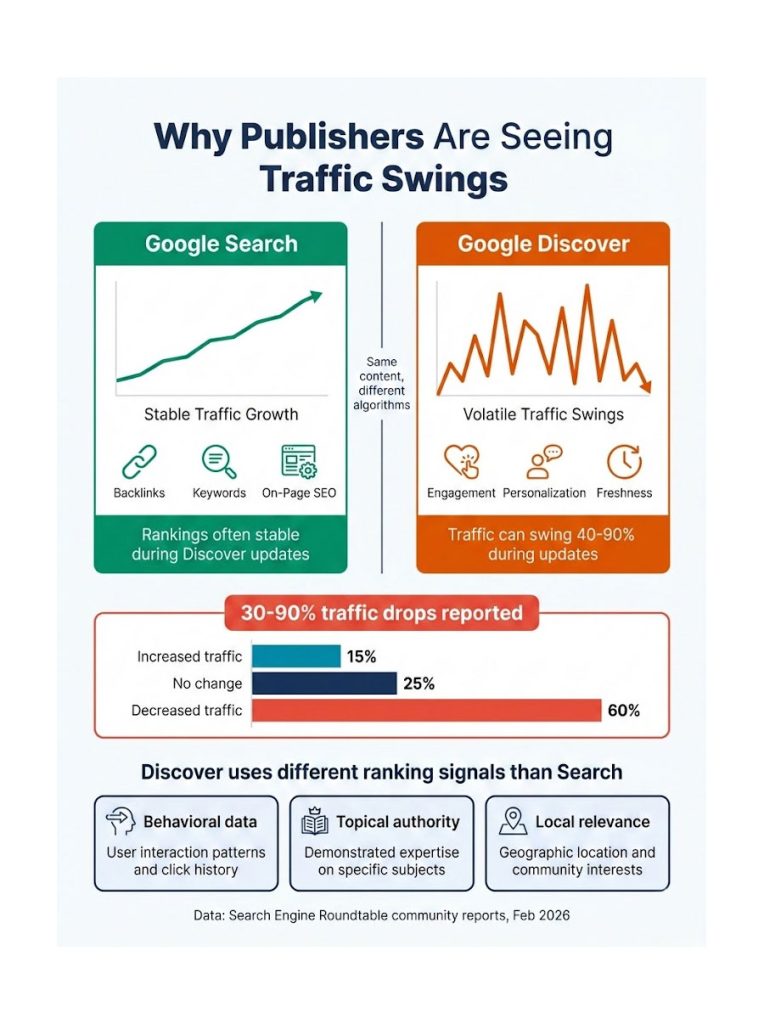
Barry Schwartz, founder of Search Engine Roundtable and a longtime Google watcher, noted that publisher comments about Discover volatility “over the past couple of days is insane.” Sites that relied heavily on Discover traffic saw drops ranging from 30% to 90% overnight.
But some sites saw increases. The difference? Expertise signals.
Why This Hits AI Content Creators Differently
Discover operates differently than regular search. You’re not searching for something. Google predicts what you’ll want to read based on your interests, location, and behavior. That predictive model relies heavily on engagement signals and content quality markers.
AI-generated content tends to have a tell. It’s smooth. It’s grammatically perfect. It hits all the SEO keywords. But it often lacks the specificity, personal experience, and original insight that human experts bring to the table.
Google’s systems are getting better at detecting this gap. Not through some “AI detector” tool (those don’t work reliably). Instead, the algorithm evaluates whether your content demonstrates genuine expertise in the topic area.
A local news site with a dedicated gardening section could establish expertise in gardening, even though it covers other topics. That’s Google’s example from their documentation. But a movie review site that wrote one article about gardening? Not likely to rank in Discover for gardening content.
The update doesn’t care if you used AI to write that gardening article. It cares whether you have a track record of gardening expertise. And that’s where most AI content strategies fall apart.
When you use AI to churn out 50 articles across 50 different topics, you’re not building topical authority. You’re building a content farm. Google’s update can tell the difference.
The Three Signals Google Uses to Spot Weak AI Content
Let’s talk about how the algorithm actually evaluates this. Google doesn’t scan your content and say “this is AI-generated, reject it.” Instead, it looks for quality signals that weak AI content tends to lack.
Signal one: depth and originality. AI models are trained on existing content. They recombine information that’s already out there. If your article doesn’t include original research, firsthand experience, unique data, or a fresh perspective, it registers as derivative. Discover prioritizes original reporting and in-depth analysis. If AI wrote your piece and you published it without adding anything unique, it’s not going to perform.
Signal two: topical consistency. Google’s systems evaluate your site as a whole, not just individual pages. If you publish about cryptocurrency one day, weight loss the next, and real estate the third, your site looks like it’s chasing trends rather than demonstrating expertise. AI makes it easy to write about anything. But Discover rewards sites that focus on specific topic clusters where they’ve built credibility over time.
Signal three: engagement and satisfaction. Discover uses behavioral data. How long do people spend on your page? Do they scroll through the whole article? Do they click through to other pages on your site? AI content that answers the surface-level query but doesn’t engage readers deeper shows weak performance metrics. Google’s update amplifies those signals.
“Google is getting much smarter at spotting low-quality AI-generated content,” noted industry analyst Glenn Gabe in early February coverage. “The systems can detect that generic, hollow tone that AI models have when they aren’t guided by a human.”
Translation: if you’re hitting publish on raw AI output, you’re cooked.
What AI Content Creators Should Actually Do
So does this mean you should stop using AI entirely? Absolutely not. But the workflow has to change.
Here’s what’s working in the post-update environment. Use AI as a research assistant and first-draft generator, not as your final writer. Let ChatGPT or Claude outline your article structure. Have it pull together background information. Ask it to generate ten different headline options. But then a human needs to step in.
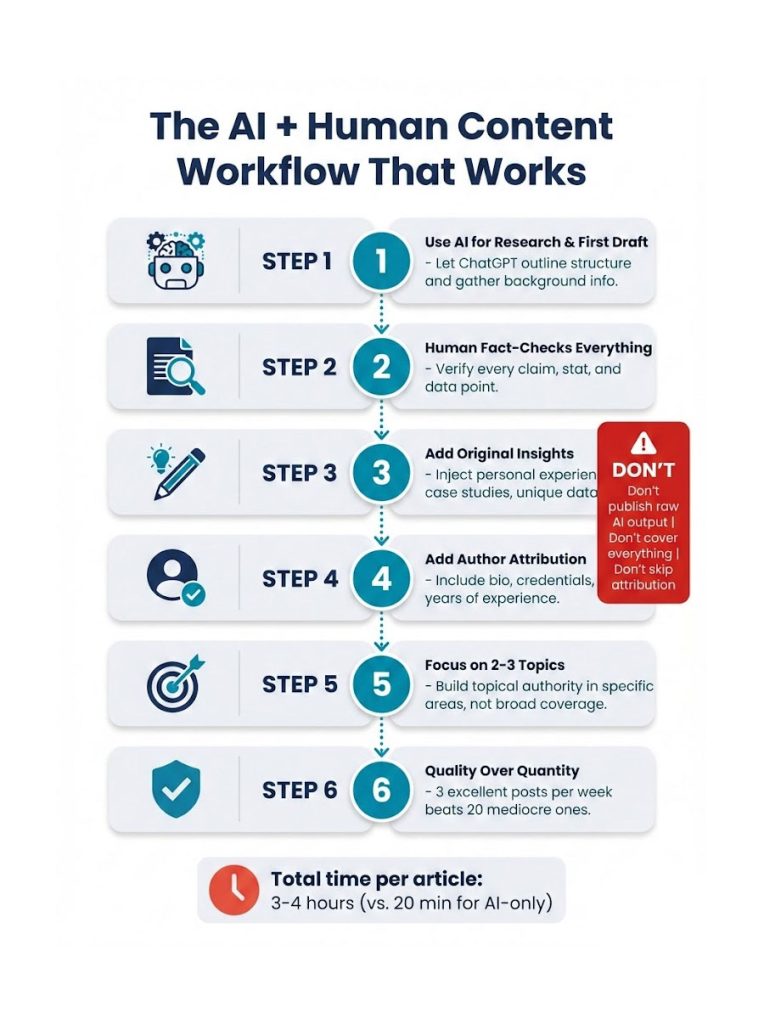
That human adds the expertise layer. They fact-check every claim. They inject personal experience or case study examples that AI can’t fabricate. They rework generic phrasing into something specific. Instead of “many businesses struggle with email marketing,” they write “43% of ecommerce brands we surveyed said cart abandonment emails generate less than 2% recovery rates.”
See the difference? One is vague. One is specific, data-backed, and useful.
Your AI-assisted content also needs author attribution now more than ever. Google added a new “Authors” section to Search Central documentation right around the same time as this update. Coincidence? Unlikely. The algorithm is leaning harder on author credentials as a trust signal. If there’s no byline, no bio, no expertise attribution, your content loses credibility in Google’s eyes.
Add author bios to every article. Include credentials, years of experience, relevant certifications, or published work. Link to author social profiles or LinkedIn. This builds the E-E-A-T (Experience, Expertise, Authoritativeness, Trustworthiness) signals that Google uses to evaluate quality.
And stop covering everything. Pick two or three topic areas where you have genuine expertise or access to experts. Build out 30, 50, 100 pieces of content in those areas. That’s topical authority. A site with 200 mediocre articles across 50 topics will lose to a site with 50 excellent articles on five topics.
This shift requires slowing down. You can’t publish daily anymore if you’re doing it right. But three well-researched, human-edited, expert-backed articles per week will outperform 20 AI-generated posts.
The Nuance That Most Coverage Is Missing
Here’s what other articles aren’t telling you. The February 2026 update is specific to Discover. Not regular search. Your Google Search rankings might be fine while your Discover traffic tanks.
That distinction matters because Discover and Search use overlapping but different ranking systems. Discover leans heavier on engagement, personalization, and freshness. Search weighs backlinks and keyword relevance more. So you can have content that ranks well in search but bombs in Discover.
Also, this update rolled out to US English users first. If you’re publishing in other languages or targeting non-US audiences, you haven’t felt the full impact yet. But it’s coming. Google explicitly said they’ll expand to all countries and languages in the months ahead.
One more thing. Core updates cause volatility during rollout. Rankings swing day to day. Some sites drop on day three and recover by day fourteen. Google’s guidance is clear: don’t make major changes mid-rollout. Wait until it completes (about two weeks from February 5). Then assess whether changes are temporary fluctuations or permanent shifts.
If your Discover traffic dropped but your content is genuinely valuable, it might recover on its own as the algorithm stabilizes. Panicking and rewriting everything immediately can actually make things worse.
The Bottom Line for AI Content in 2026
Google’s February 2026 Discover update didn’t kill AI content. It killed low-effort AI content. If you’re using AI as a shortcut to avoid doing real work, you’re going to struggle.
But if you’re using AI to enhance your expertise, speed up research, and improve your writing process while still maintaining editorial control and adding unique value, you’re fine. Better than fine. You’re positioned to win as competitors who relied on pure AI output fall off.
The update rewards depth, originality, and topical focus. Those things take time. They require human judgment. They can’t be fully automated. And that’s exactly the point.
Discover traffic isn’t dead. But the playbook just changed.
DISCLAIMER
This article is meant to keep you informed about algorithm changes, not to replace professional SEO or content strategy advice. Before making major changes to your content workflow or publishing strategy, it’s a good idea to consult with an SEO specialist who understands your specific business goals and site history. Every website responds differently to algorithm updates, and what works for one publisher might not be the right approach for another. If you’re seeing traffic drops, consider getting a professional audit before making drastic changes.
REFERENCES
[1] Google Search Central. “February 2026 Discover Core Update.” Google Search Central Blog, February 5, 2026. https://developers.google.com/search/blog/2026/02/discover-core-update
[2] Schwartz, Barry. “February 2026 Google Discover Core Update Rolling Out.” Search Engine Roundtable, February 6, 2026. https://www.seroundtable.com/google-february-2026-discover-core-update-40887.html
[3] Southern, Matt G. “Google Releases Core Update Targeting Discover Feed.” Search Engine Journal, February 5, 2026. https://www.searchenginejournal.com/google-releases-discover-focused-core-update/566647/
[4] Schwartz, Barry. “Google Releases February 2026 Discover Core Update.” Search Engine Land, February 5, 2026. https://searchengineland.com/google-releases-discover-core-update-february-2026-468308
[5] Google Search Central. “Get on Discover.” Google Search Documentation. https://developers.google.com/search/docs/appearance/google-discover
[6] Google Search Central. “Core Updates.” Google Search Documentation. https://developers.google.com/search/docs/appearance/core-updates