









The most effective targeting option for brand awareness depends on your primary objective and growth stage. For cost-effective scalability, Meta Advantage+ (Broad Targeting) is statistically superior, often reducing Cost Per Action (CPA) by over 30% by leveraging machine learning rather than manual constraints. For topical relevance and authority, Google Custom Affinity audiences are the industry standard, allowing brands to target users based on specific interests and competitor interactions. However, for maximum brand safety in a privacy-first environment, Contextual Targeting 2.0 remains the most resilient strategy, aligning brands with content sentiment rather than relying on restricted personal data.
Table of Contents
The era of hyper-granular tracking is over. The third-party cookies and device IDs that marketers relied on for over a decade have largely disappeared behind privacy walls and browser updates. If you are still building your brand awareness strategies based on the playbooks of the past, you are likely noticing a sharp rise in costs and a decline in measurable impact.

The challenge today is no longer just about who you can target; it is about how relevant you can be when the data signals are faint.
Achieving brand awareness in the modern USA market requires a fundamental pivot. You must move from “spraying and praying” with generic impressions to a strategy of precision relevance. The days of simply buying a list of user IDs are behind us. In their place is a more sophisticated, algorithmic approach that values context and intent over raw identity.
This guide analyzes the most effective targeting options available today. We will dissect the data, the mechanisms, and the specific use cases for Google, Meta, and emerging programmatic channels to help you decide which path is best for your business.
The State of Awareness: Targeting in a Privacy-First World
The digital marketing ecosystem has fundamentally shifted. We have moved from an era of “Identity-Based Targeting” to “Signal-Based Targeting.” Understanding this shift is the prerequisite for running any successful campaign in the current landscape.

Why Traditional Targeting Rules Have Changed
For years, the default strategy for brand awareness was simple: buy a list of user IDs that matched a specific persona, follow them across the web, and retarget them until they clicked. That method is becoming obsolete.
Regulations and browser-level restrictions have created “Signal Loss.” This means advertisers have less direct visibility into who a user is. When a user asks an app not to track them, the direct line between their behavior and your ad platform is severed.
If you rely solely on third-party data for your strategy, you are building on a foundation of sand. The platforms can no longer see every move a user makes across the internet, which means the old way of “micro-targeting” based on precise browsing history is becoming less accurate and significantly more expensive.
From “Who They Are” to “What They Consume”
The industry is pivoting back to the fundamentals of advertising but leveraging advanced technology. Instead of asking “Who is this person?”, the most successful campaigns now ask “What is this person interested in right now?”
This shift elevates contextual targeting and affinity audiences from secondary tactics to primary drivers of growth. It is a move toward respecting user privacy while maintaining ad relevance. By focusing on the content being consumed rather than the identity of the consumer, brands can bypass privacy restrictions entirely while still delivering a highly relevant message.
Google Ads Brand Awareness: Precision at Scale
When most people think of Google Ads, they think of search intent—capturing demand at the bottom of the funnel. However, the Google Display Network (GDN) and YouTube remain two of the most powerful engines for generating demand at the top of the funnel.
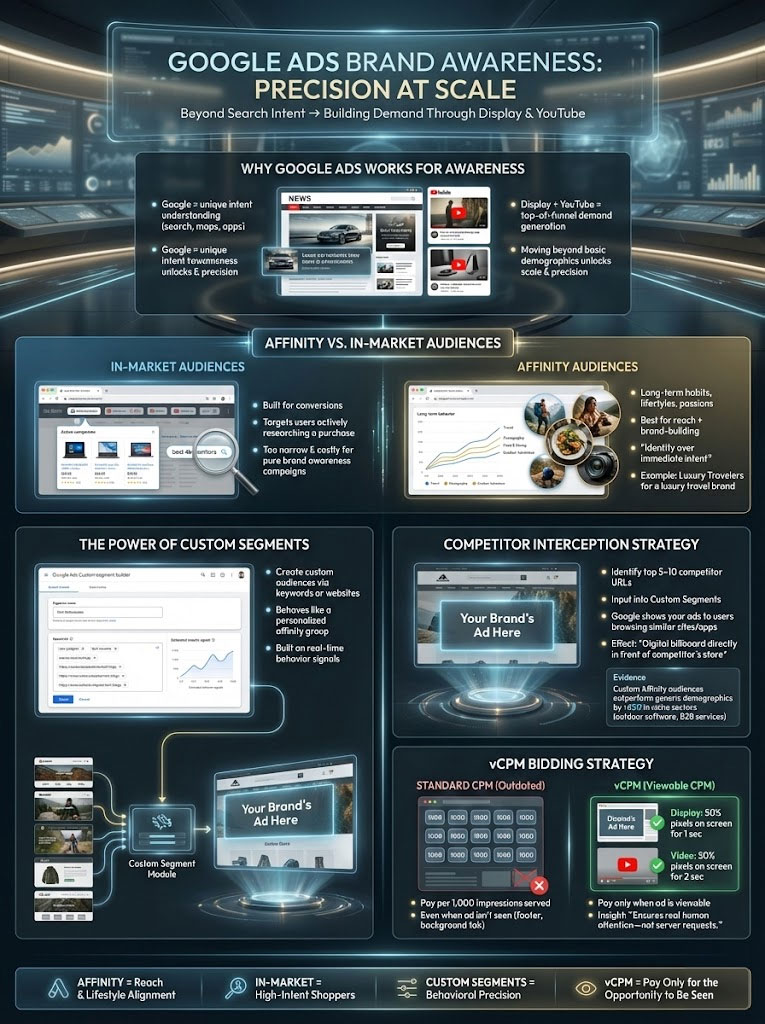
The secret lies in moving beyond basic demographics. Google possesses the unique ability to understand user intent not just through social signals, but through search behavior, map data, and app usage.
Affinity vs. In-Market Audiences
To select the best targeting option, you must understand the distinction between “In-Market” and “Affinity” segments within Google’s ecosystem. These are often confused, leading to wasted budget.
Understanding In-Market Audiences
In-Market Audiences are designed for conversion. They target users who are actively researching a purchase. For example, someone who has searched for “best winter boots” and visited three shoe retailer sites in the last week is considered “In-Market.” While valuable, these audiences are often too narrow and expensive for pure awareness goals. You are paying a premium to reach people who are already deciding, rather than introducing your brand to those who might be interested later.
The Strategic Value of Affinity Audiences
Affinity Audiences are the true powerhouse for reach. These segments allow you to target users based on their long-term habits, lifestyles, and passions. This is about identity, not just immediate intent.
For example, a luxury travel brand should not just target high-income earners. They should target the “Luxury Travelers” affinity segment. This ensures the budget is spent on users who have a demonstrated history of travel-related behavior over months or years. This builds a pipeline of future customers rather than just fighting for the immediate sale.
The Power of Custom Segments
If standard affinity lists feel too broad, Google Ads offers a highly effective tool: Custom Segments. This feature allows you to build a unique audience based on specific keywords users search for or websites they visit. It essentially allows you to create your own “Affinity” group based on real-time data.
How to Execute a Competitor Interception Strategy
One of the most effective ways to use Custom Segments is through competitor targeting.
- Identify Top Competitors: List the URLs of your top 5 to 10 direct competitors.
- Input into Custom Segments: Google will then show your display and video ads to users who browse websites similar to those or use apps similar to your competitors’.
- The Result: You effectively place your digital billboard directly in front of your competitor’s store, stealing Share of Voice before the user has made a purchase decision.
Evidence of Success: Recent data confirms that Custom Affinity audiences often outperform generic demographic targeting by roughly 25% in niche sectors like outdoor software and specialized B2B services. This proves that behavioral relevance beats demographic assumptions.
vCPM Bidding Strategy
Targeting is only half the battle. How you pay for that targeting determines your efficiency. For awareness campaigns, utilize vCPM (viewable Cost Per Mille) bidding.
Standard CPM charges you for every 1,000 impressions served, regardless of whether the user actually saw the ad. The ad could load in the footer of a page that the user never scrolled to, or in a background tab. You still pay for that.
With vCPM, you only pay when the ad is considered “viewable.”
- Display: 50% of the ad pixel is on screen for at least 1 second.
- Video: 50% of the ad pixel is on screen for at least 2 seconds.
This ensures your strategy is backed by actual human attention, not just server requests. It aligns your financial incentives with your marketing goals: you only pay for the opportunity to be seen.
Meta Ads Targeting: Artificial Intelligence Takes the Wheel
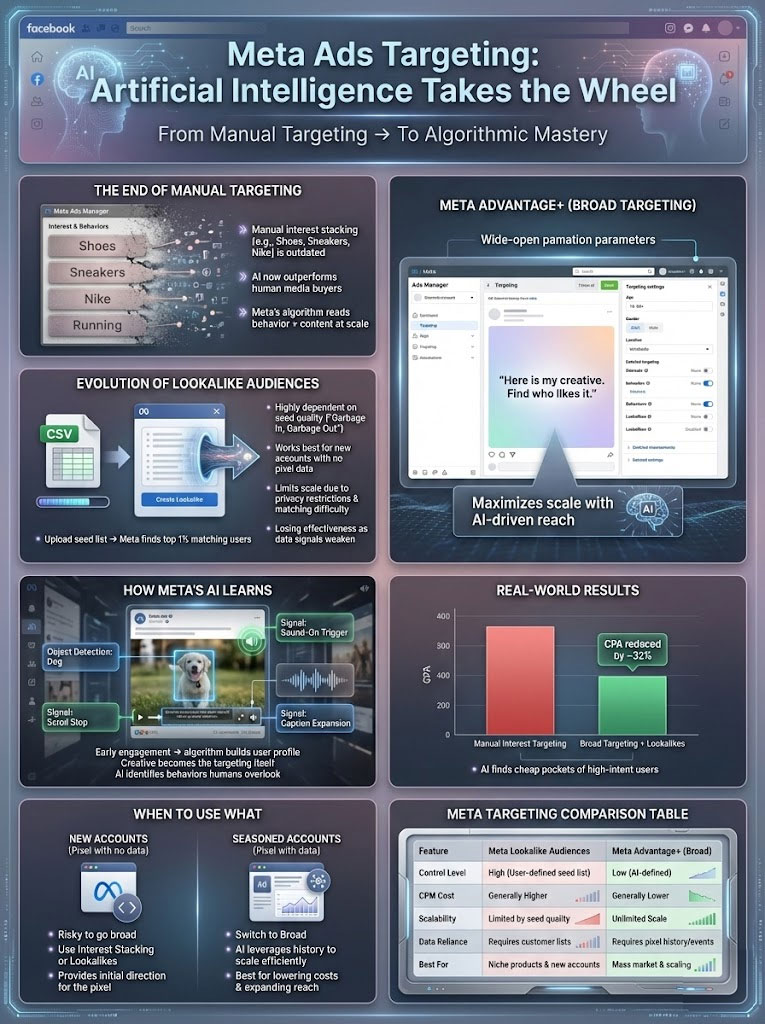
On Facebook and Instagram, the manual era is ending. The platform’s algorithm has become smarter than any human media buyer. The days of manually selecting twenty different interests like “Shoes,” “Sneakers,” and “Nike” are largely over.
The debate for Meta ads targeting usually centers on two contenders: Lookalikes vs. Broad Targeting. Understanding the nuance between these two is critical for scaling.
The Evolution of Lookalike Audiences
For a long time, lookalike audiences were the undisputed king of social targeting. The premise was simple and seductive: You upload a CSV list of your best customers (email addresses or phone numbers). Meta matches those identifiers to user profiles. Then, it finds the top 1% of users who look just like your seed audience.
This method relies heavily on the quality of your seed data. If your customer list is old, or if it contains low-value customers, your lookalike audience will be low quality. This is the “Garbage In, Garbage Out” principle.
Lookalikes still work for new ad accounts that lack pixel data. They act as a set of “training wheels” for the pixel, guiding it toward the right type of person when the account has no history of its own. However, relying solely on lookalike audiences limits your scale. You are restricted by the quality of your seed list and the platform’s matching rate. As privacy laws make matching emails to profiles harder, the effectiveness of lookalikes is slowly eroding.
Enter Meta Advantage+ (The “Broad” Approach)
The modern champion for brand awareness targeting on social media is the Meta Advantage+ audience. This is often referred to as “Broad Targeting.”
In this setup, you remove almost all targeting constraints. You leave the age wide open (e.g., 18-65+). You remove interests. You remove lookalikes. You simply tell Meta: “Here is my creative. Find the people who like it.”
How the Algorithm Works
The AI analyzes thousands of data points in real-time. It looks at who stops scrolling to watch your video. It looks at who turns on the sound. It checks who clicks “expand caption.” It even analyzes the visual elements of your video. If your video features a dog, the AI will naturally start showing it to dog lovers, even if you didn’t select “Dogs” as an interest.
The creative becomes the targeting. The algorithm uses the early engagement signals from your ad to build a profile of the ideal viewer and then aggressively seeks out more people like them.
Real-World Data: Rigorous testing indicates that broad targeting leveraged with lookalikes can cut Cost Per Action (CPA) by approximately 32% compared to manual interest-based targeting. This efficiency comes from the algorithm’s ability to find cheap pockets of high-intent users that a human buyer would never think to target.
When to Use Which?
It is not always a binary choice. The decision depends on your account’s maturity.
- New Accounts (Pixel with no data): It doesn’t know what a “customer” looks like for your business. In this case, going Broad can be risky because the AI has no compass. Use Interest Stacking or Lookalike Audiences to give the system a baseline direction.
- Seasoned Accounts (Pixel with data): The system knows exactly who buys from you. Switch to Broad targeting. Let the AI lower your costs while maintaining relevance. It is smarter than you are at finding your next customer.
Meta Targeting Comparison Table
| Feature | Meta Lookalike Audiences | Meta Advantage+ (Broad) |
| Control Level | High (User defined seed list) | Low (AI defined) |
| CPM Cost | Generally Higher | Generally Lower |
| Scalability | Limited by seed quality | Unlimited Scale |
| Data Reliance | Requires specific customer lists | Requires Pixel history/events |
| Best For | Niche products & New Accounts | Mass Market & Scaling |
The Resurgence of Contextual Targeting
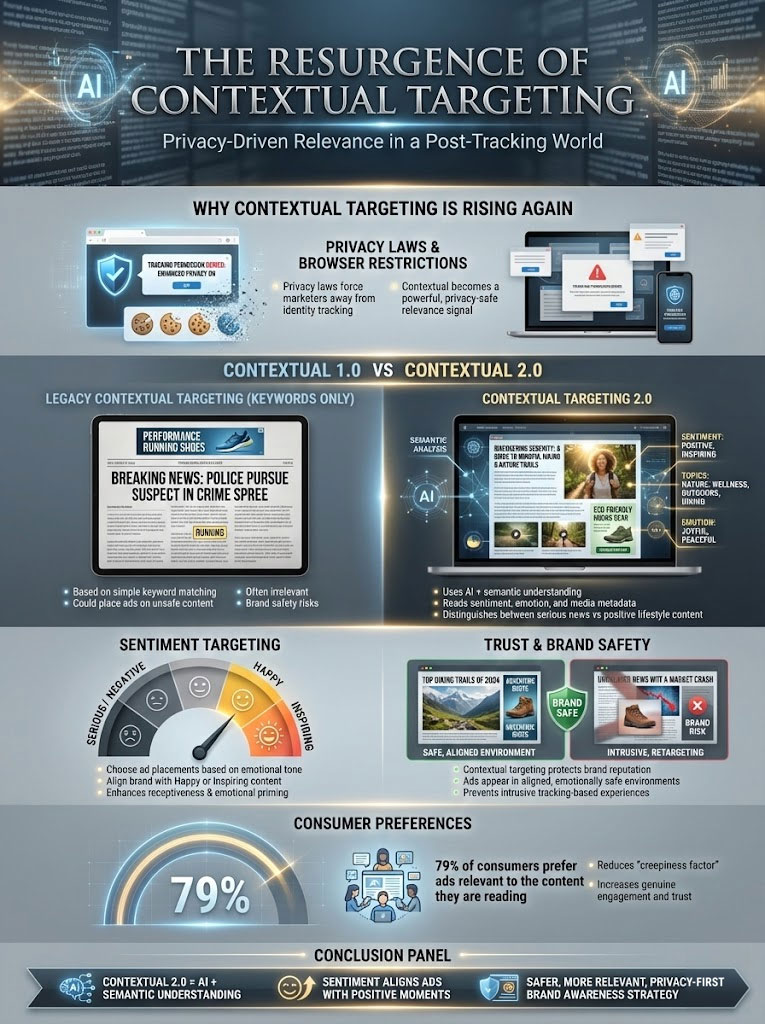
As discussed, brand awareness strategies must adapt to privacy laws. This is driving a massive resurgence in contextual targeting. But this is not the contextual targeting of the past decade.
Contextual 2.0: Beyond Keywords
Legacy contextual targeting was simple keyword matching. If your keyword was “running,” your ad appeared on any page with that word. This often led to ads appearing on irrelevant or unsafe content. For example, a running shoe ad might appear on a news story about a crime involving a runner. This is a brand safety nightmare.
Contextual 2.0 utilizes semantic analysis and Artificial Intelligence. The technology scans the entire page to understand the sentiment and emotion of the content. It understands the difference between a “serious news article” and a “positive lifestyle blog.” It reads the images and the video metadata on the page.
This allows for Sentiment Targeting. You can choose to place your ads only on pages that have a “Happy” or “Inspiring” sentiment. This aligns your brand with positive emotions, which psychologically primes the user to be more receptive to your message.
Trust and Brand Safety
For brands concerned about reputation, contextual targeting ads offer a safety net that behavioral targeting cannot. You are ensuring your ad appears in an environment that aligns with your brand values.
Furthermore, consumers are becoming increasingly aware of privacy. When a user sees an ad for a product they looked at three weeks ago, it can feel intrusive. When they see an ad for hiking boots while reading an article about the best hiking trails, it feels helpful.
Consumer Sentiment Data: Reports indicate that roughly 79% of consumers prefer ads relevant to the content they are currently reading over ads that track their behavioral history. By aligning with the user’s current mindset, you reduce the “creepiness factor” and increase genuine engagement.
Emerging Channels: Connected TV (CTV) and Audio
If you want to dominate brand awareness targeting, you cannot ignore the formats that capture the most attention: Television and Audio. These channels were once the domain of massive corporate budgets, but programmatic technology has democratized them.

Connected TV Advertising (CTV)
The living room has gone digital. CTV refers to streaming content watched on a TV set (e.g., Hulu, Roku, YouTube TV, Pluto TV).
CTV allows you to bring the precision of digital targeting to the big screen. You can target specific households based on income, location, and interests, serving unskippable high-definition ads. Unlike traditional linear TV, where you buy a “spot” and hope the right people see it, CTV provides measurable impressions and completion rates.
Most people watch TV with their phone in their hand—the “Second Screen” effect. A strategic CTV campaign can drive immediate search volume on mobile. A user sees your ad on the big screen and immediately Googles you on the small screen. This synergy is powerful.
The Audio Advantage (Podcasts)
Audio is an intimate medium. When a user is listening to a podcast, they are often wearing headphones. The distraction level is low. They are actively listening, not passively scrolling.
Podcast ad networks allow for two main types of targeting:
- Programmatic Audio: Inserting your pre-recorded ad into breaks across thousands of podcasts based on listener demographics (e.g., Men 25-34 interested in Finance).
- Host-Read Ads: Paying the host to read your script. This acts as an influencer endorsement and typically has higher engagement but higher costs.
Case Data: Nielsen studies reveal that podcast advertising can generate an aided recall rate of up to 71%. This is significantly higher than many visual formats because the listener is actively engaged with the content host. The trust the listener has in the host transfers to the advertiser.
Comparative Analysis: Which is Best for YOU?
There is no single “best” option. The right choice depends on your business model, your budget, and your audience location. A local bakery needs a completely different strategy than a national software company.

Choosing the Best Targeting Strategies for Your Business Type
1. For Local Small Businesses
If you are a physical gym, bakery, or local service provider, your best targeting for brand awareness is Geo-targeting. You cannot afford to pay for impressions outside your service area.
- Strategy: Use Meta Ads with a strict radius (e.g., 5 miles) around your location. Do not go broad on interest; let the location be the filter. Combine this with Google Map Ads to appear when locals search for “near me” services.
- Why: Local awareness is about density. You want everyone in your neighborhood to see you 10 times, rather than 10,000 people across the state seeing you once.
2. For National D2C E-commerce
If you ship nationwide, you need efficiency at scale.
- Strategy: Focus on Meta Advantage+ for the heavy lifting. Use video creative to demonstrate the product’s value proposition. Retarget viewers on the Google Display Network using Custom Affinity audiences built from your competitor’s URLs.
- Why: Social creates the demand through visual discovery; Display captures the lingering interest and reinforces the brand message across the web.
3. For B2B Services
If you sell software or consulting to other businesses, mass market channels may be wasteful.
- Strategy: LinkedIn Ads are the primary driver for job-title targeting, but they are expensive. Supplement this with Contextual Targeting on industry news sites (e.g., Forbes, Wired, Industry Dive).
- Why: B2B buyers read industry content to stay smart. Placing your brand next to authoritative articles builds trust and positions you as a thought leader.
Strategy Selection Matrix
| Business Goal | Best Primary Platform | Best Targeting Option | Key Metric to Watch |
| Local Awareness | Google Maps / Meta | Geo-Targeting (Hyper-local) | Reach / Store Visits |
| Viral Product | TikTok / Meta Reels | Interest-Based & Broad | Video View Rate (VVR) |
| Thought Leadership | LinkedIn / Display | Contextual & Affinity | Share of Voice (SOV) |
| Mass Market Brand | YouTube / CTV | Demographics & Affinity | Brand Lift / Recall |
Measuring the Invisible: Brand Lift and Recall
One of the biggest mistakes marketers make with brand awareness strategies is measuring them like conversion campaigns. If you judge a billboard by how many people touched it, you will think it failed. The same logic applies to digital awareness.

Moving Beyond CTR
Click-Through Rate (CTR) is a poor metric for awareness. A user might see your ad, remember it, and search for you three days later. The click never happened on the ad itself, but the impact did. If you optimize for CTR, you often end up targeting “click-happy” users who browse aimlessly but never buy. You want to target “intent-driven” users who see, remember, and search.
How to Run a Brand Lift Study
Both Google and Meta offer Brand Lift studies, often free if you meet minimum spend requirements.
- The Method: The platform automatically splits your target audience into two groups: a Test Group (who sees your ads) and a Control Group (who does not).
- The Survey: Both groups are shown a poll within the feed asking, “Have you heard of [Brand Name]?”
- The Result: The difference in “Yes” responses between the two groups is your Brand Lift. This gives you a statistically significant percentage that proves your ads are working.
Real-World Application: Major beauty brands like L’Oréal Paris have utilized this exact measurement to validate double-digit lifts in awareness. Without this study, they would have only seen impression numbers, missing the true value of the campaign.
Share of Voice (SOV) and Search Lift
You should also monitor your Share of Voice. Tools like Semrush or Brand24 allow you to track how often your brand is mentioned online compared to your competitors.
Additionally, track Search Lift. Look at your Google Search Console data or Google Trends. Did the volume of searches for your specific brand name increase during and after your awareness campaign? This is the clearest indicator that your top-of-funnel activity is driving bottom-of-funnel demand.
The Role of First-Party Data
While we have focused on finding new audiences, the most durable strategy involves building your own data assets. First-party data refers to the information you collect directly from your audience—emails, phone numbers, and purchase history.

In a signal-loss world, owning your data is the only insurance policy. You should use your awareness campaigns not just to get views, but to drive users to sign up for newsletters, quizzes, or exclusive offers. Once you have that email, you no longer need to pay Google or Meta to reach that person. You have “owned” reach.
Furthermore, this first-party data can be fed back into the platforms (via tools like Conversions API) to help train the AI. Even if you are using Broad targeting, feeding the system your list of high-value customers helps it learn what a “good” user looks like faster.
Summary & Key Takeaways
The landscape of brand awareness targeting in the USA is evolving rapidly. We are moving away from invasive tracking and toward intelligent modeling and contextual relevance. The winners in this new era will be the brands that trust the AI for scale but use human insight for strategy.
Here are your actionable takeaways:
- Embrace AI: Stop micro-managing your audiences on social. Test Meta ads targeting with broad settings and let the creative do the work. The algorithm is your friend, not your enemy.
- Get Granular on Google: Use Google Ads brand awareness features like Custom Affinity segments to target user passions and competitor audiences, not just their demographics.
- Respect the Context: Invest in contextual targeting to future-proof your strategy against privacy changes. Align your brand with content that uplifts your message.
- Measure What Matters: Move your reporting away from vanity metrics like CTR and toward business-impact metrics like Brand Lift, vCPM, and Share of Voice.
- Think Cross-Channel: Your customers do not live on one app. A robust strategy uses CTV for impact, Social for engagement, and Display for ubiquity.
The best targeting option is the one that reaches your customer where they are paying attention, not just where they are browsing. Audit your current setup today. If you are still relying on third-party cookies and manual interest stacking, it is time to upgrade your strategy.
Frequently Asked Questions (FAQ)
What is the single best targeting option for brand awareness?
There is no single “best” option, but a hybrid approach is most effective. Use Meta Advantage+ for cost-effective social scale and Google Custom Affinity audiences for high relevance. This combination covers both discovery (push marketing) and intent (pull marketing).
How does lookalike audience targeting work for brand awareness?
Lookalike audiences analyze your existing high-value customers (from an email list or pixel data) to identify common traits. The platform then targets the top 1% to 10% of users who share those traits, effectively finding new people who resemble your best buyers. However, this is less effective now than in previous years due to signal loss.
Is Geo-targeting or Interest targeting better for small businesses?
For local small businesses, Geo-targeting is superior. It ensures you do not waste budget on people outside your service area. Interest targeting is better suited for national brands or e-commerce stores that can ship products anywhere and need to find niche buyers.
How do I set up a Google Ads brand awareness campaign using vCPM?
When creating a campaign in Google Ads, select “Brand Awareness and Reach” as your objective. In the bidding strategy section, choose vCPM (Viewable Cost Per Mille). This ensures you are charged only when your ad is actually visible on the user’s screen, maximizing the efficiency of your spend.
What is the difference between aided and unaided brand recall?
Unaided recall is when a consumer remembers your brand without any prompts (e.g., “Name a soft drink”). This is the holy grail of branding. Aided recall is when they recognize your brand from a list (e.g., “Which of these soft drinks have you heard of?”). Awareness campaigns typically aim to improve aided recall first.
Why is contextual targeting considered “privacy-safe”?
Contextual targeting analyzes the content of the webpage (keywords, sentiment, topic) rather than the user’s personal browsing history. Since it does not rely on cookies or personal data, it is compliant with privacy regulations like GDPR and CCPA, making it a sustainable long-term strategy.
Is Meta Advantage+ better than manual targeting for scale?
Yes, for scaling brand awareness, Meta Advantage+ (broad targeting) is generally better. It allows the AI to find efficiencies and lower CPMs by exploring a larger audience pool than manual targeting permits. It also reduces “audience fragmentation” which can hurt performance.
How much does a Connected TV (CTV) ad campaign cost in the USA?
Costs vary, but CTV generally commands a higher CPM than standard display ads, typically ranging from $20 to $40 CPM. However, the high completion rates (often 90%+) and “big screen” impact often justify the higher investment for building premium brand perception.
What is the ideal frequency for a brand awareness campaign?
While it depends on the industry, a common benchmark is a frequency of 3 to 6 exposures over a 4-week period. This is generally sufficient to move a user from “unaware” to “aware” without causing ad fatigue. Anything above 10 usually results in diminishing returns.
Can I combine Affinity Audiences with Demographic targeting?
Yes, and you should. For example, you can target the “Health & Fitness Buffs” Affinity Audience and overlay it with a Demographic filter for “Women ages 25-34” and an “Income” filter for the top 20%. This creates a highly specific audience segment that is both relevant and qualified.
How does Programmatic advertising differ from Google Display Network?
The Google Display Network is a closed ecosystem of sites that use Google AdSense. Programmatic advertising uses a DSP (Demand Side Platform) to access inventory across the entire web, including premium publishers, audio apps, and CTV platforms that may not be on Google’s network. Programmatic typically offers more granular control over inventory and data layering.
What metrics should I track for a Top-of-Funnel (ToFu) campaign?
Focus on Reach (unique people), Frequency (how often they saw it), vCPM (cost for viewable impressions), Video View Rate, and Brand Lift. Avoid focusing on direct conversions or CTR at this stage, as these metrics do not accurately reflect the long-term impact of awareness.
Disclaimer: The strategies and data points mentioned in this article are based on digital marketing trends and platform capabilities relevant to the current landscape. Ad platform algorithms (Google Ads, Meta) update frequently. Always test targeting options with small budgets before scaling.
References:
- Nielsen Podcast Ad Effectiveness Studies
- Google Internal Data on Custom Affinity Performance
- Meta Case Studies on Advantage+ Efficiency
- IAB (Interactive Advertising Bureau) Reports on Signal Loss & Contextual Trends