









Digital marketing serves as the comprehensive umbrella term for all online promotional activities, including channels like social media, email, and PPC. Search Engine Optimization (SEO) is a specialized, high-impact subset of digital marketing focused exclusively on driving organic traffic from search engines like Google. While broader digital marketing tactics provide immediate brand awareness, SEO offers superior long-term business growth by lowering customer acquisition costs and capturing high-intent users. For maximum profitability, successful businesses integrate both strategies rather than choosing one over the other.
Every Monday morning, marketing directors and business owners across the United States face the same uncomfortable, high-stakes question regarding their budget allocation.
Table of Contents
You have a limited amount of capital to deploy for the quarter. The pressure to show immediate returns is immense, yet the need for sustainable growth is undeniable.
The dilemma is always the same. Should you pour that budget into paid advertising for immediate traffic and instant gratification? Or should you invest in a long-term organic strategy that might not pay off for months but secures your market position for years?
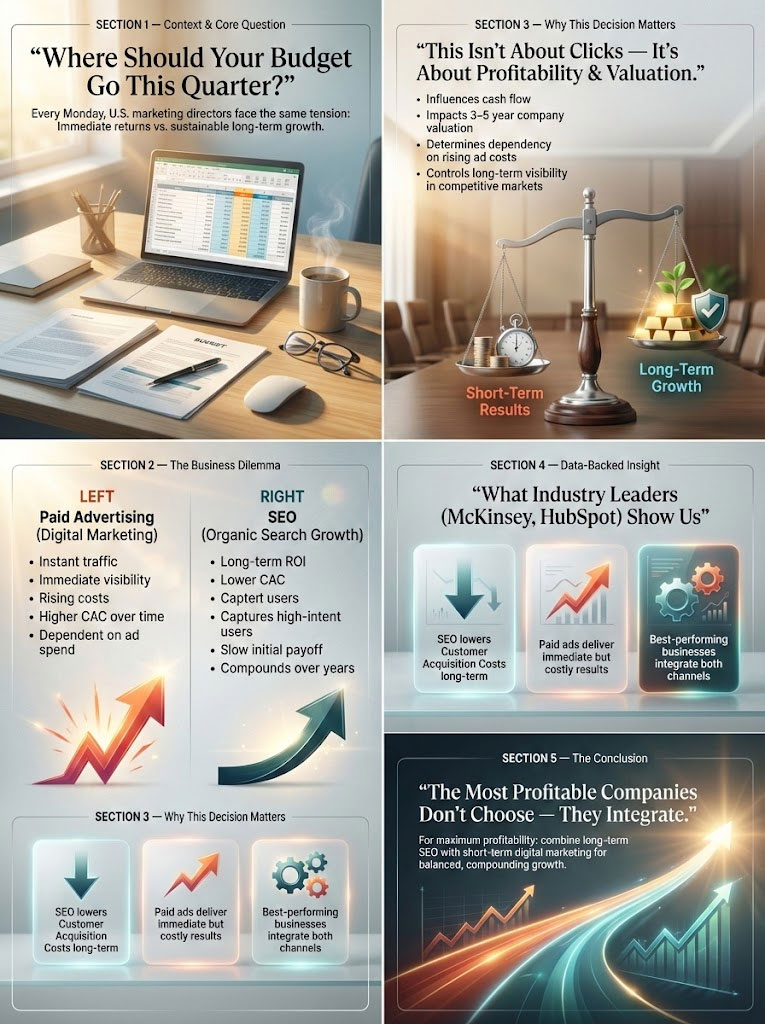
This is not just a tactical choice about where to buy clicks. It is a fundamental business decision that dictates your profitability, your cash flow, and your company’s valuation for the next three to five years.
Understanding the nuance of SEO vs digital marketing is critical because making the wrong choice can lead to skyrocketing Customer Acquisition Costs (CAC), dependency on rising ad costs, or total invisibility in a crowded market.
We are going to dismantle this debate using data from industry leaders like McKinsey and HubSpot to provide a clear, evidence-based framework for your growth strategy. We will move beyond surface-level definitions to understand the economic mechanics of how these channels operate, how they impact your bottom line, and how they should work together.
Core Concepts: Defining the Landscape
To make an informed decision, we must first strip away the jargon and define the actual mechanisms at play. Many business leaders use these terms interchangeably, but they represent two completely different operational models.
What is Digital Marketing? (The Umbrella)
Digital marketing strategy is the holistic ecosystem of all marketing efforts that use an electronic device or the internet to connect with customers.
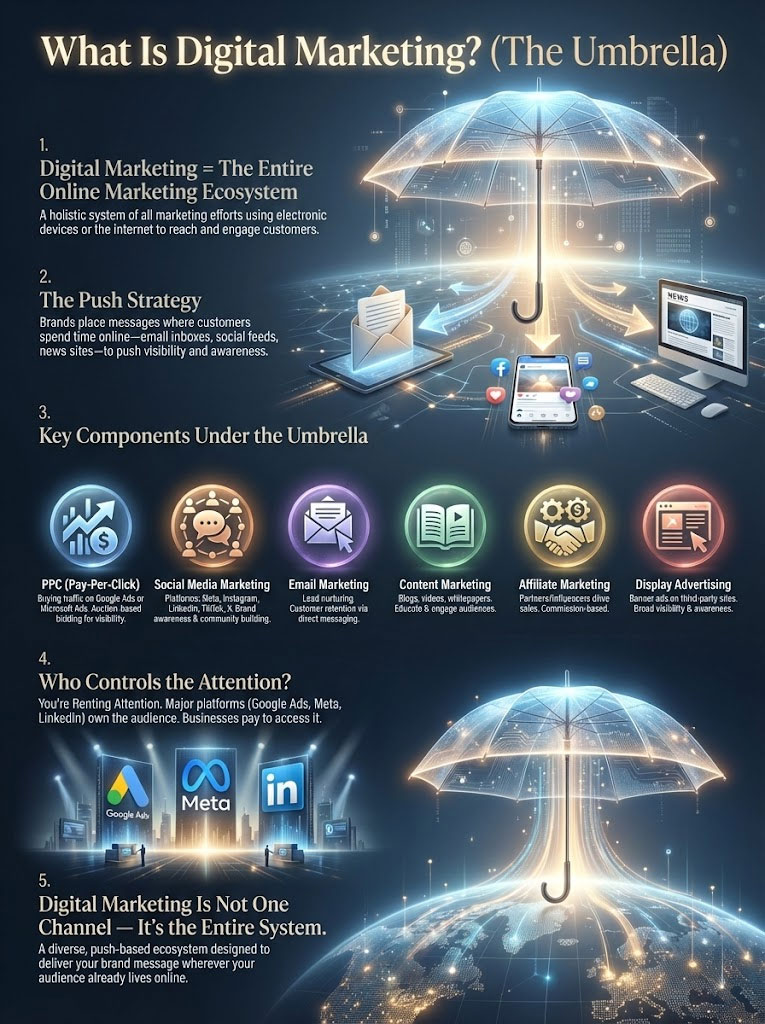
Think of digital marketing as the “umbrella” that covers every single tactic used to reach customers where they spend their time online. It is not a single channel; it is a collection of diverse methodologies designed to push your brand message to a target audience.
It encompasses the “Push” marketing philosophy. You are identifying where your customers hang out—whether that is in their email inbox, on a social media feed, or browsing a news site—and you are pushing a message in front of them.
Key components of this ecosystem include:
- PPC (Pay-Per-Click): Buying traffic via platforms like Google Ads or Microsoft Ads. This is an auction-based system where you bid for visibility.
- Social Media Marketing: Building brand awareness and community on platforms like Meta (Facebook/Instagram), LinkedIn, TikTok, and X (formerly Twitter).
- Email Marketing: The practice of nurturing leads and retaining existing customers through direct communication.
- Content Marketing: Creating assets (videos, blogs, whitepapers) to educate and engage users.
- Affiliate Marketing: Leveraging third-party partners or influencers to drive sales in exchange for a commission.
- Display Advertising: Visual banner ads that appear on third-party websites to build awareness.
Entities like Google Ads, Meta, and LinkedIn dominate this space. They provide the infrastructure for businesses to “rent” attention. When you engage in broad digital marketing, you are often paying for access to an audience that someone else owns.
What is SEO? (The Engine)
Search Engine Optimization (SEO) is the engine that drives sustainable, organic visibility.
It is a specialized, highly technical digital marketing strategy focused on optimizing your website and content to rank higher in search engine results pages (SERPs) without paying for every click.
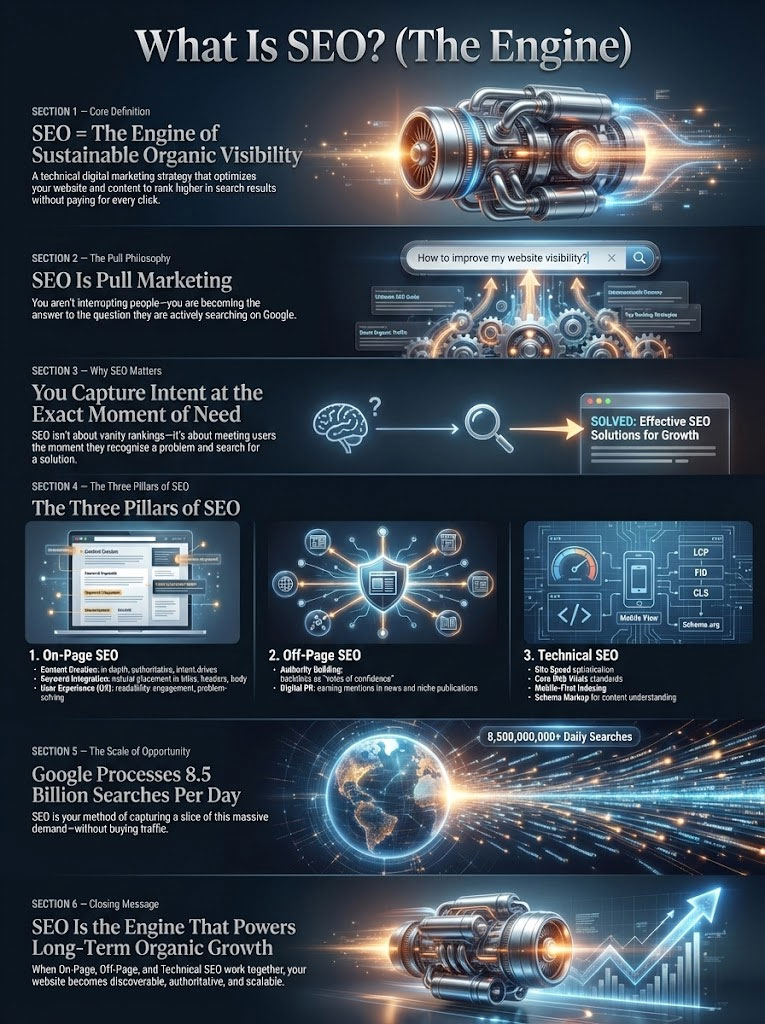
Unlike the “Push” nature of general digital marketing, SEO is “Pull” marketing. You are not interrupting a user’s day with an ad. You are positioning your business as the answer to a question the user is actively asking.
SEO is not just about “ranking” for vanity metrics. It is about capturing user intent at the exact moment a potential customer realizes they have a problem and turns to Google for a solution.
The Three Pillars of SEO
Successful execution requires three distinct operational layers that must work in harmony:
1. On-Page SEO
This involves optimizing individual web pages to rank higher and earn more relevant traffic. It includes:
- Content Creation: Writing in-depth, authoritative guides that satisfy user intent.
- Keyword Integration: Placing primary and secondary keywords naturally in titles, headers, and body text.
- User Experience (UX): Ensuring the page is readable, engaging, and solves the user’s problem quickly.
2. Off-Page SEO
This focuses on increasing the authority of your domain through actions taken outside of your own website. The primary driver here is backlinks (links from other websites to yours).
- Authority Building: Search engines view links as votes of confidence. If a reputable site like The New York Times or a niche industry blog links to you, it signals to Google that you are a trusted resource.
- Digital PR: Earning coverage in news outlets and industry publications.
3. Technical SEO
This is the foundation. It ensures search engines can crawl, index, and understand your site. Without strong technical SEO, your content may never be seen.
- Site Speed: Optimizing load times to ensure users don’t bounce.
- Core Web Vitals: Meeting Google’s standards for visual stability and interactivity.
- Mobile-First Indexing: Ensuring your site performs perfectly on smartphones, as Google predominantly indexes the mobile versions of websites.
- Schema Markup: Adding code that helps search engines understand the context of your content (e.g., identifying a page as a product, a recipe, or a job posting).
Consider the scale here. Google processes approximately 8.5 billion searches per day. SEO is your method for capturing a slice of that massive volume without a direct media spend.
SEO vs Digital Marketing: The Great Comparison
Business owners often ask about SEO vs digital marketing which is better. This question implies they are mutually exclusive competitors.
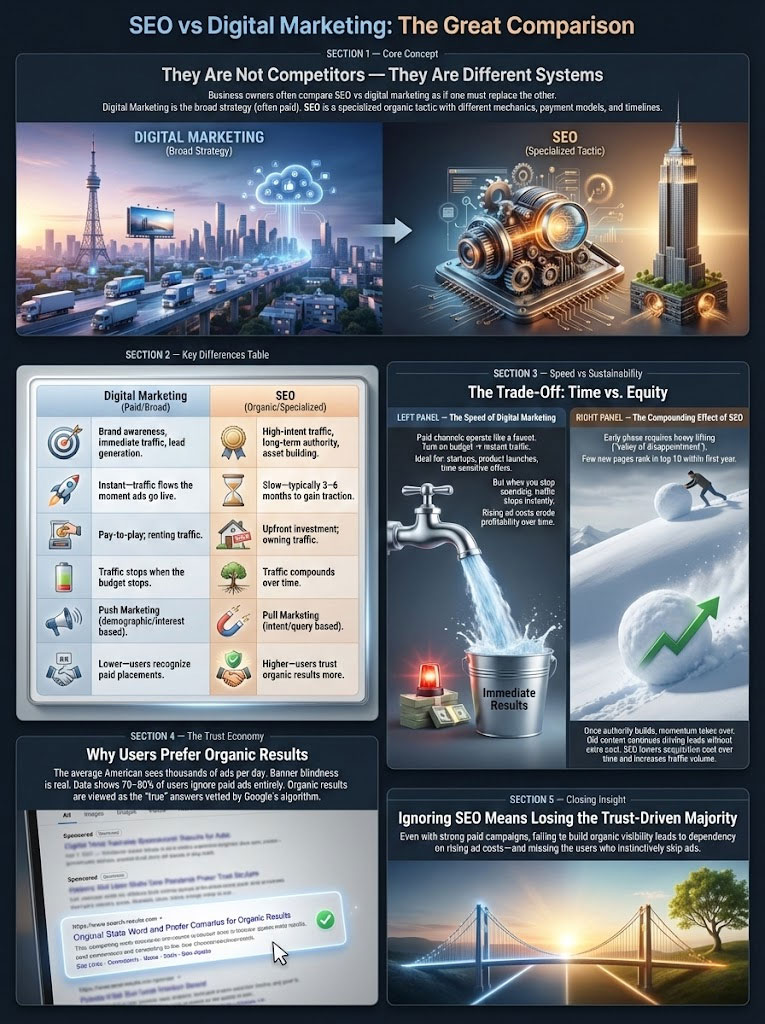
They are not. One is the strategy; the other is the tactic. However, their mechanics, payment models, and timelines differ constantly. To manage expectations and budget effectively, you must understand these differences.
Key Differences Between SEO vs Digital Marketing
The following table breaks down the operational differences between a holistic digital marketing strategy (specifically paid channels) and organic Search Engine Optimization (SEO).
| Feature | Digital Marketing (Paid/Broad) | SEO (Organic/Specialized) |
| Primary Goal | Brand awareness, immediate traffic, & lead generation. | High-intent traffic, long-term authority, & asset building. |
| Speed to Results | Instant. Traffic starts flowing the moment ads go live. | Slow. Typically requires 3–6 months to gain traction. |
| Cost Model | Pay-to-play (High ongoing expense). Renting traffic. | Upfront investment (Low ongoing cost). Owning traffic. |
| Sustainability | Traffic stops the moment the budget pauses. | Traffic compounds and grows over time. |
| Traffic Intent | Push Marketing (Demographic/Interest based). | Pull Marketing (Intent/Query based). |
| Trust Factor | Lower. Users recognize it as a paid placement. | Higher. Users inherently trust organic rankings more. |
Speed vs. Sustainability
The primary trade-off in the SEO vs digital marketing debate is time versus equity. It is the classic debate of renting versus owning real estate.
The Speed of Digital Marketing (PPC & Social)
Paid digital channels operate like a faucet.
You turn the valve (budget) on, and the water (traffic) flows instantly. If you launch a Google Ads campaign on Tuesday morning for “emergency plumbing services,” you can have your first lead by Tuesday afternoon.
This speed is seductive. It is also vital for startups needing immediate validation, businesses launching a new product, or companies promoting time-sensitive offers like a holiday sale.
However, the moment you close the valve (stop spending), the water stops completely. You own nothing. You were merely renting the traffic. If the cost of advertising rises—which it historically does every year—your profitability erodes, and there is nothing you can do about it except pay the higher rate or exit the market.
The Compounding Effect of SEO
SEO operates like a snowball rolling down a hill.
In the beginning, you are pushing the snowball uphill. It takes significant effort, time, and resources. You might write content for three months and see very little movement in your analytics. This is the “valley of disappointment” where many businesses quit.
Data suggests that only a minority of new pages rank in the top 10 within their first year. It is a slow burn.
However, once you crest the hill and build authority, momentum takes over.
The traffic begins to stack. A blog post you wrote two years ago regarding “best CRM software” continues to generate leads today without a single additional dollar spent on promotion. You are no longer paying for every click. You own the asset.
This compounding effect is why SEO is often cited as the superior driver of long-term business growth. Your cost per acquisition drops over time, while your traffic volume increases.
The Trust Economy
There is a psychological component to this debate that cannot be ignored. We live in a world of ad saturation. The average American is exposed to thousands of ads per day.
As a result, “banner blindness” is real. Users have trained themselves to scroll past the “Sponsored” tags at the top of Google’s search results.
Data indicates that 70-80% of users ignore paid ads entirely, choosing to click on organic listings instead. They view the organic results as the “true” answer to their question, vetted by Google’s algorithm, whereas the ads are viewed as companies buying their way to the front of the line.
By ignoring SEO, you are effectively invisible to the vast majority of your potential market—specifically the skeptical, high-value portion of the market that does their own research.
ROI Analysis: Which Drives Better Business Growth?
When we analyze SEO vs digital marketing ROI, we have to look beyond simple vanity metrics like “clicks” or “impressions.” We must look at the economics of the funnel.
Metrics like Customer Acquisition Cost (CAC) and close rates tell the real story of profitability.
Analyzing the Economics: Renting vs. Owning
Customer Acquisition Cost (CAC) is the total cost of sales and marketing efforts needed to acquire a new customer.
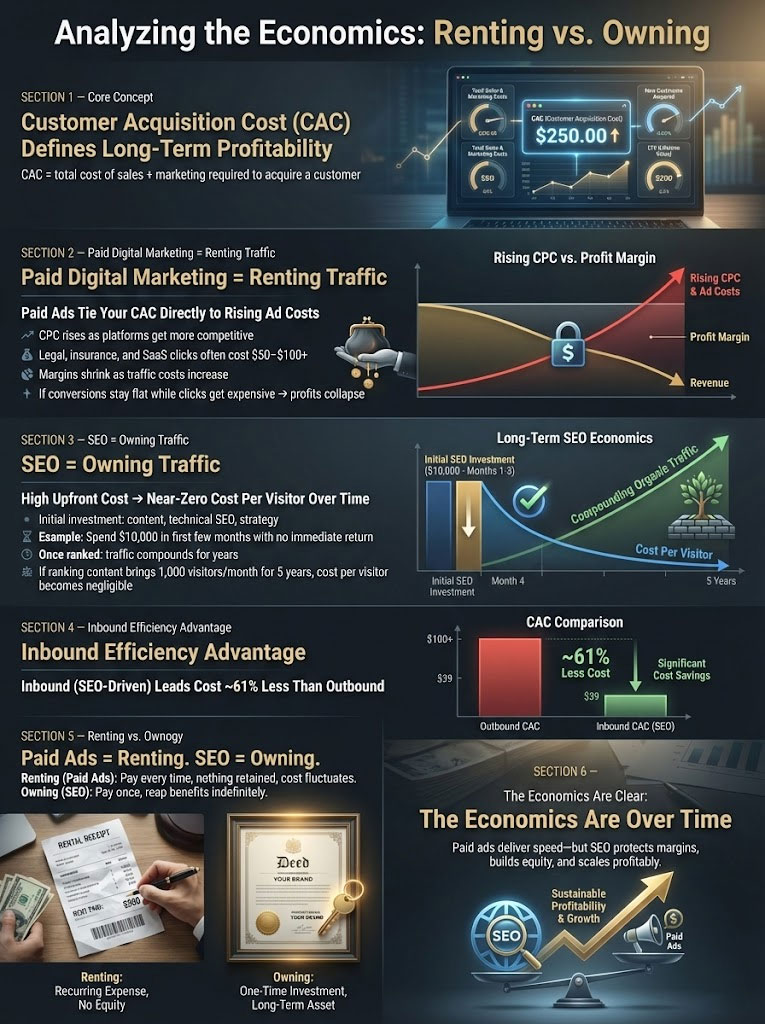
In paid digital marketing, your CAC is tied linearly to ad costs. As ad platforms like Facebook and Google become more competitive, the Cost Per Click (CPC) rises. In legal, insurance, and SaaS industries, a single click can cost upwards of $50 to $100.
This effectively squeezes your margins over time. If your conversion rate stays the same but the cost of traffic doubles, your profit vanishes.
Conversely, SEO requires a heavy upfront investment in content creation and technical optimization. You might spend $10,000 in the first few months on strategy and writing with zero return.
However, once that content ranks, the cost to acquire each subsequent visitor drops toward zero. If that $10,000 investment brings in 1,000 visitors a month for five years, your cost per visitor becomes negligible.
Studies and industry data consistently show that inbound marketing leads (which are primarily derived from SEO) cost roughly 61% less to acquire than outbound leads.
Conversion and Close Rates: The Power of Intent
The source of the traffic dictates the quality of the lead. Not all clicks are created equal.
When we compare organic search vs paid search, the intent is the key differentiator.
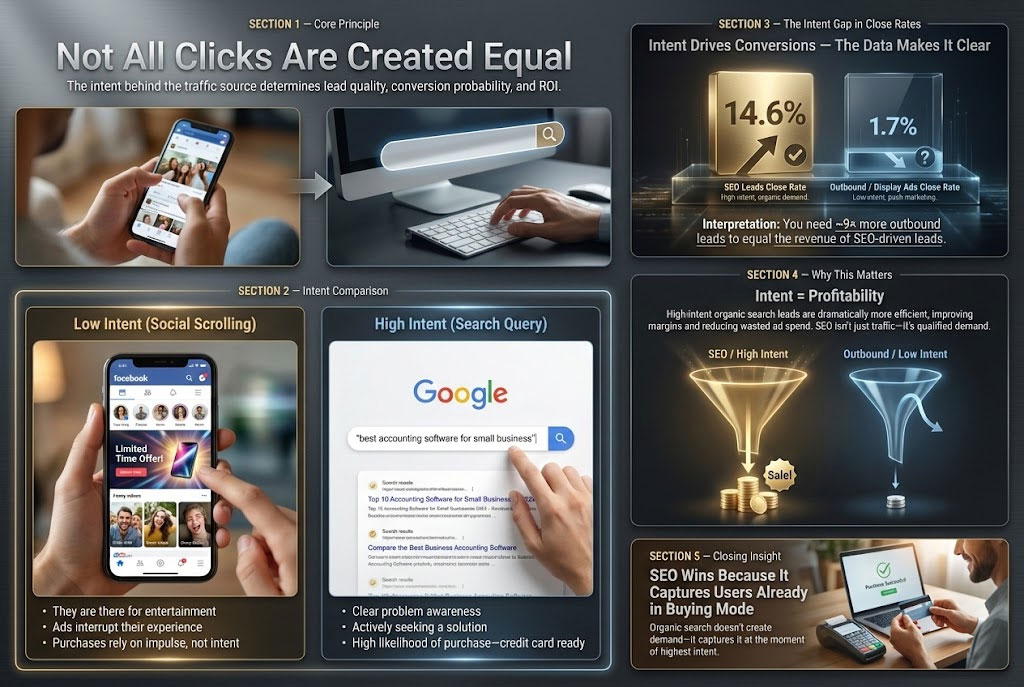
Consider a user scrolling through Facebook. They are there to see photos of their friends or watch funny videos. If you interrupt them with an ad for a new pair of shoes, you are relying on impulse. Their intent to buy is low.
Now consider a user who types “best accounting software for small business” into Google. They are not browsing for fun. They have a specific problem, and they are actively hunting for a solution. They have their credit card ready.
This difference in intent creates a massive gap in close rates.
According to search industry benchmarks, SEO leads close at roughly 14.6%, whereas outbound leads (such as cold outreach or display ads) have a close rate of approximately 1.7%.
This means you need nearly 9x the volume of outbound leads to generate the same revenue as your SEO leads. This efficiency is why SEO is critical for maintaining healthy profit margins.
Long-Term ROI Multipliers of SEO vs Digital Marketing
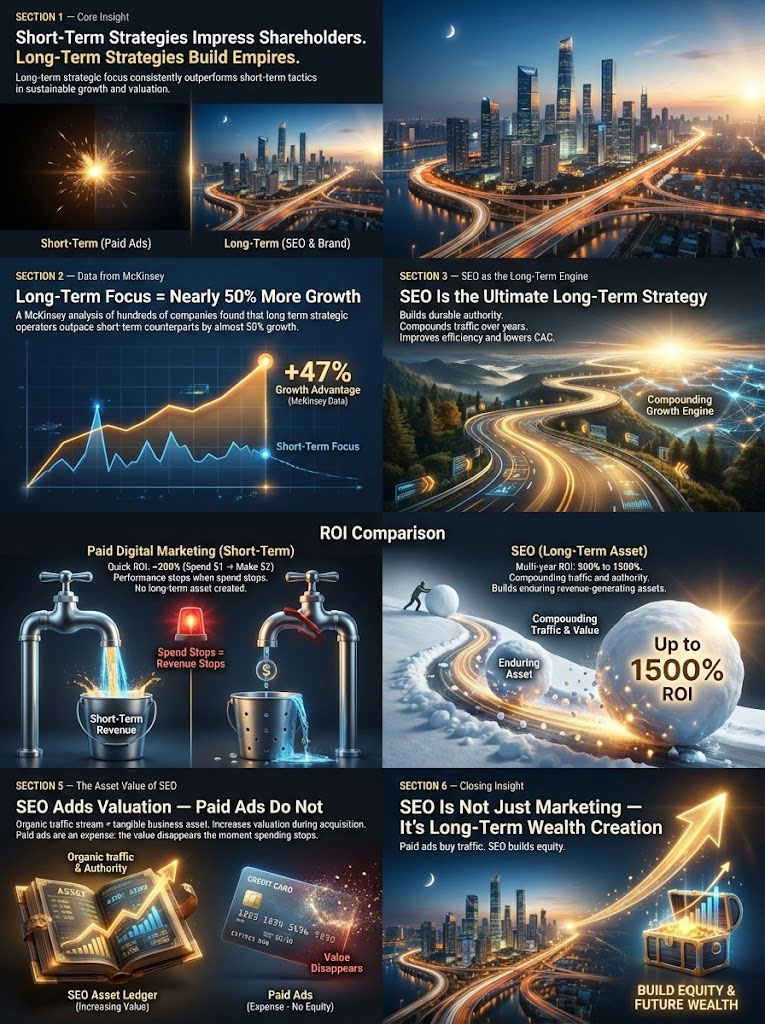
Short-term strategies look good on a quarterly report. Long-term strategies build empires.
A comprehensive study by McKinsey analyzed hundreds of companies and found that those with a long-term strategic focus delivered nearly 50% more growth than their short-term counterparts.
SEO is the epitome of a long-term strategy.
While digital marketing strategy utilizing paid ads can generate a quick ROI of 200% (spend $1, make $2), successful SEO campaigns often see ROI figures of 500% to 1500% over a multi-year horizon.
The asset value of SEO cannot be overstated. If you decide to sell your business, a robust organic traffic stream is a tangible asset that increases your valuation. A paid ad account is an expense liability that holds no value once the credit card is removed.
Sector-Specific Strategies (Context Matters)
The answer to SEO vs digital marketing which is better also depends heavily on your business model. A monolithic approach does not work.
A local bakery in Ohio needs a completely different approach than a global project management software company based in San Francisco.
SEO vs Digital Marketing for Small Businesses (USA)
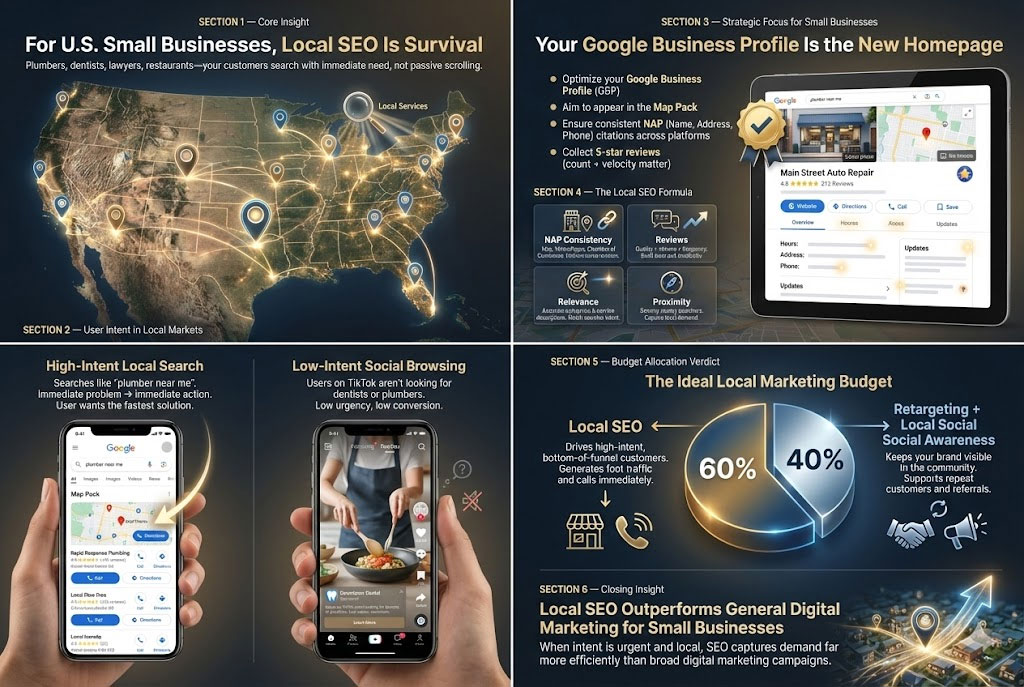
For the millions of small businesses in the USA—plumbers, dentists, lawyers, restaurants—Local SEO is the lifeblood of survival.
If you run a plumbing company, your customers are searching for “plumber near me” or “emergency water heater repair.” They are not looking for your brand on TikTok. They have an immediate need.
Strategic Focus:
Small businesses must prioritize their Google Business Profile. This is the listing that appears in the “Map Pack” at the top of local search results.
Ensuring consistent NAP (Name, Address, Phone) citations across the web (Yelp, YellowPages, Chamber of Commerce) is crucial. Gathering five-star reviews is equally important, as review count and velocity are major ranking factors.
Verdict:
For small businesses, Local SEO should consume the first 60% of the budget. It captures the high-intent, bottom-of-funnel traffic.
The remaining 40% should go toward retargeting ads or local social media awareness to keep the community engaged. Local SEO delivers high-intent foot traffic that general digital marketing cannot match efficiently.
SEO vs Digital Marketing for B2B SaaS
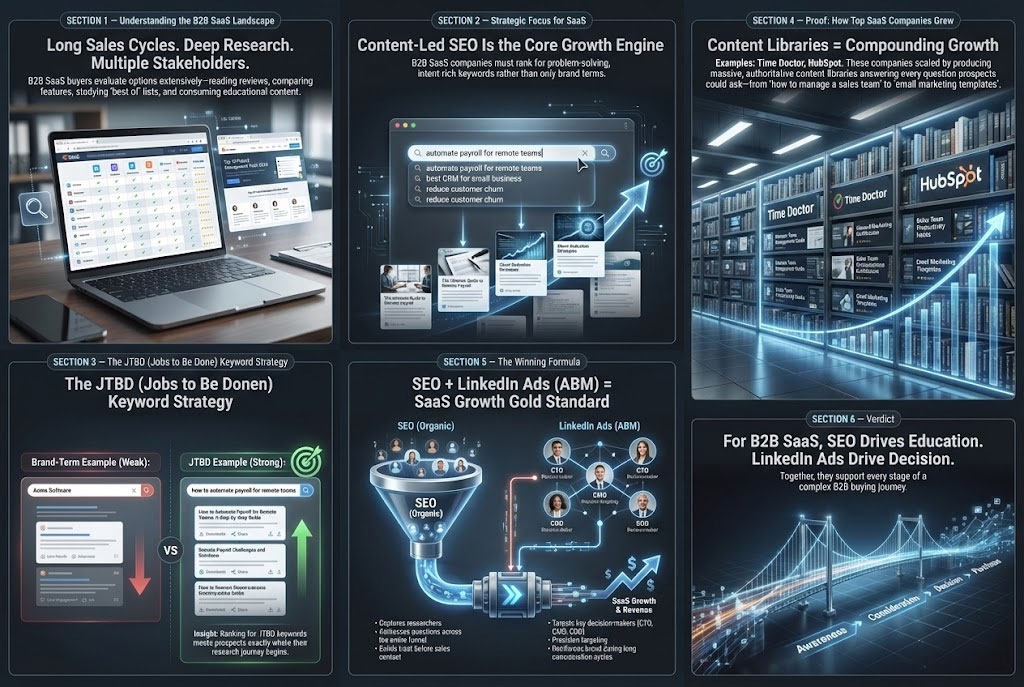
For B2B SaaS (Software as a Service) companies, the sales cycle is long and complex.
Buyers conduct deep research before talking to a salesperson. They read reviews, compare features, look for “best of” lists, and read whitepapers.
Strategic Focus:
These companies must invest heavily in content-led Search Engine Optimization (SEO).
The goal is to rank for “Jobs to be Done” keywords—phrases that describe the problem the software solves rather than just the brand name.
For example, instead of just ranking for “Acme Software,” they need to rank for “how to automate payroll for remote teams.”
Instance:
Consider how companies like Time Doctor or HubSpot grew.
They didn’t just buy ads. They created massive libraries of content answering every possible question their prospects had, from “how to manage a sales team” to “email marketing templates.”
Verdict:
A heavy mix of SEO combined with LinkedIn Ads (Account-Based Marketing) is the gold standard for B2B.
SEO captures the researchers who are educating themselves. LinkedIn Ads target the decision-makers (CTOs, CMOs) who hold the budget.
SEO vs Digital Marketing for E-commerce
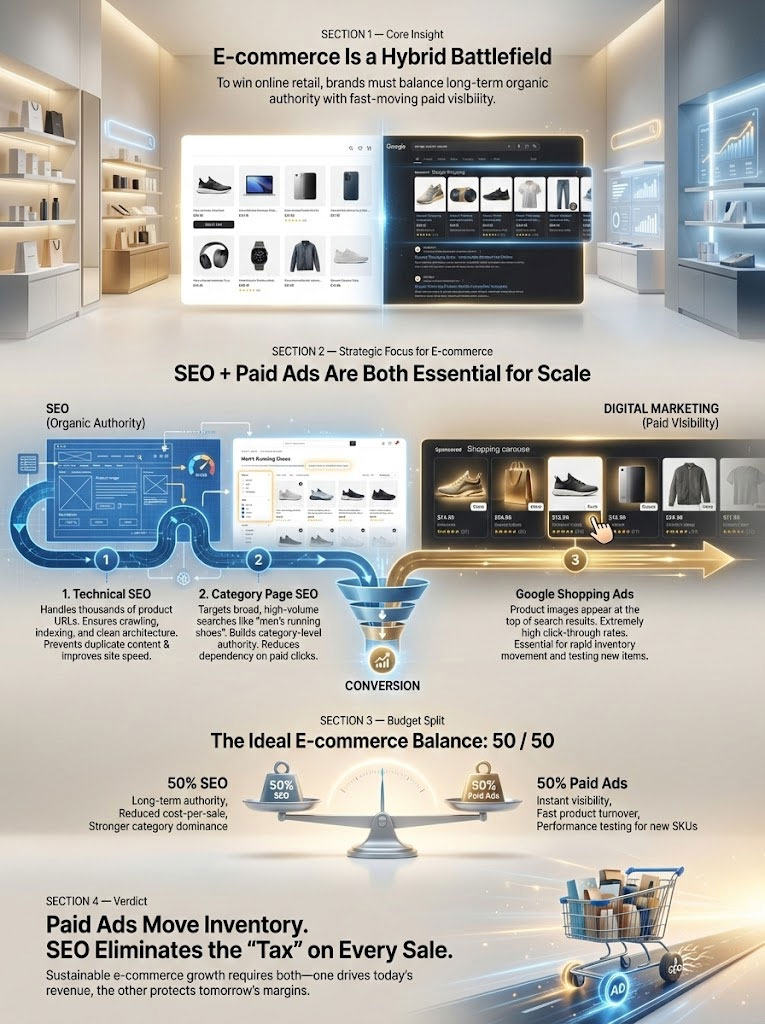
For online retailers, the landscape is a hybrid battlefield.
Strategic Focus:
E-commerce brands need Technical SEO to handle thousands of product pages. They need “Category Page” SEO to capture broad searches like “men’s running shoes.”
However, they also need Google Shopping Ads (a digital marketing tactic) because product images at the top of search results drive massive click-through rates.
Verdict:
The split is often 50/50. You need paid ads to move inventory quickly and test new products. You need SEO to build category authority so you aren’t paying a “tax” on every single pair of shoes you sell.
Strategic Integration: The Hybrid Approach
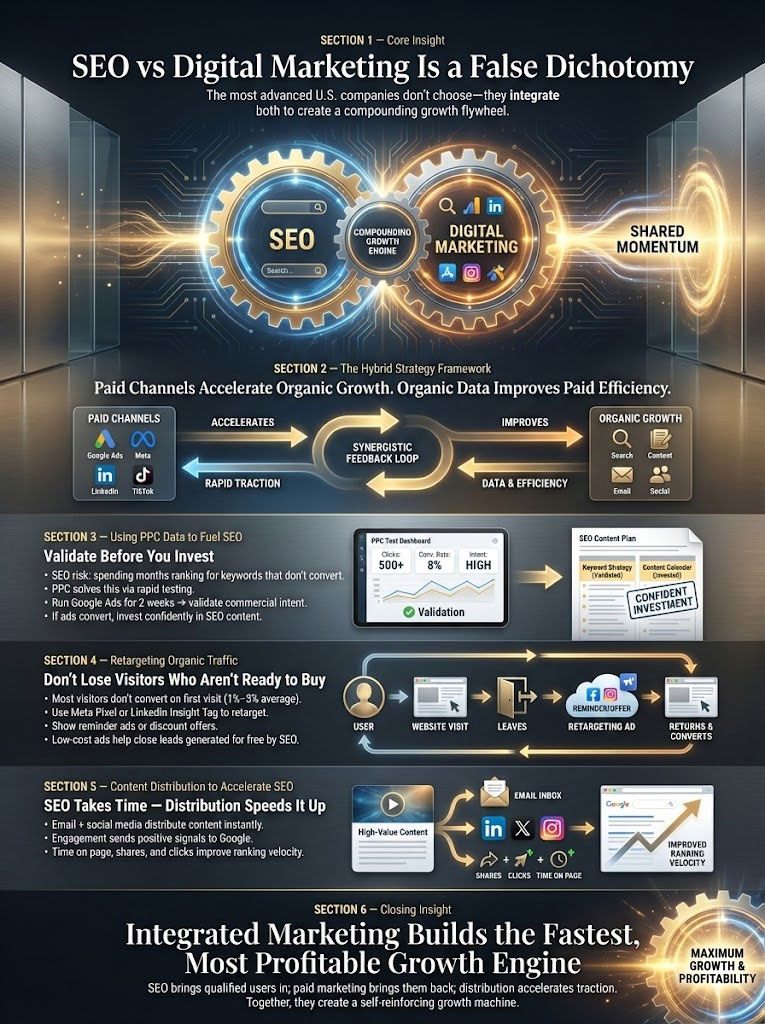
The debate of SEO vs digital marketing is often a false dichotomy.
The most sophisticated companies in the US do not choose one. They integrate them to create a flywheel effect.
An integrated digital marketing strategy uses paid channels to accelerate organic growth and organic data to improve paid efficiency.
Using PPC Data to Fuel SEO
One of the biggest risks in SEO is spending months creating content for keywords that do not convert. You might rank #1 for a term, get 10,000 visitors, and make zero sales because the intent wasn’t right.
PPC solves this.
You can run a Google Ads campaign for a specific set of keywords for two weeks. It acts as a rapid prototype.
If those keywords generate sales via ads, you have validated the commercial intent. You can then confidently invest in long-form Search Engine Optimization (SEO) content for those terms, knowing the traffic is valuable.
Retargeting Organic Traffic
Most visitors will not buy on their first visit to your site. The average conversion rate for e-commerce is often between 1% and 3%.
If a user finds your blog post via organic search but leaves without converting, they might be lost forever.
By installing tracking pixels (like the Meta Pixel or LinkedIn Insight Tag), you can use broader digital marketing tactics to “follow” that user.
You can show them a retargeting ad on Instagram or LinkedIn reminding them of your value proposition or offering a discount code.
This drastically improves the ROI of your organic traffic. You used free SEO to get them to the site, and a low-cost ad to bring them back to close the deal.
Content Distribution
Great content that no one sees is useless. SEO takes time to index and rank.
While you wait for Google to do its work, you should use email marketing and social media to distribute that content to your existing audience.
This traffic sends positive signals to Google. If users engage with your content, spend time on the page, and share it, it signals that the page is high quality. This user engagement data can actually speed up your SEO rankings.
Future Trends: AI and Search Evolution
The landscape of SEO vs digital marketing is shifting rapidly due to Artificial Intelligence.
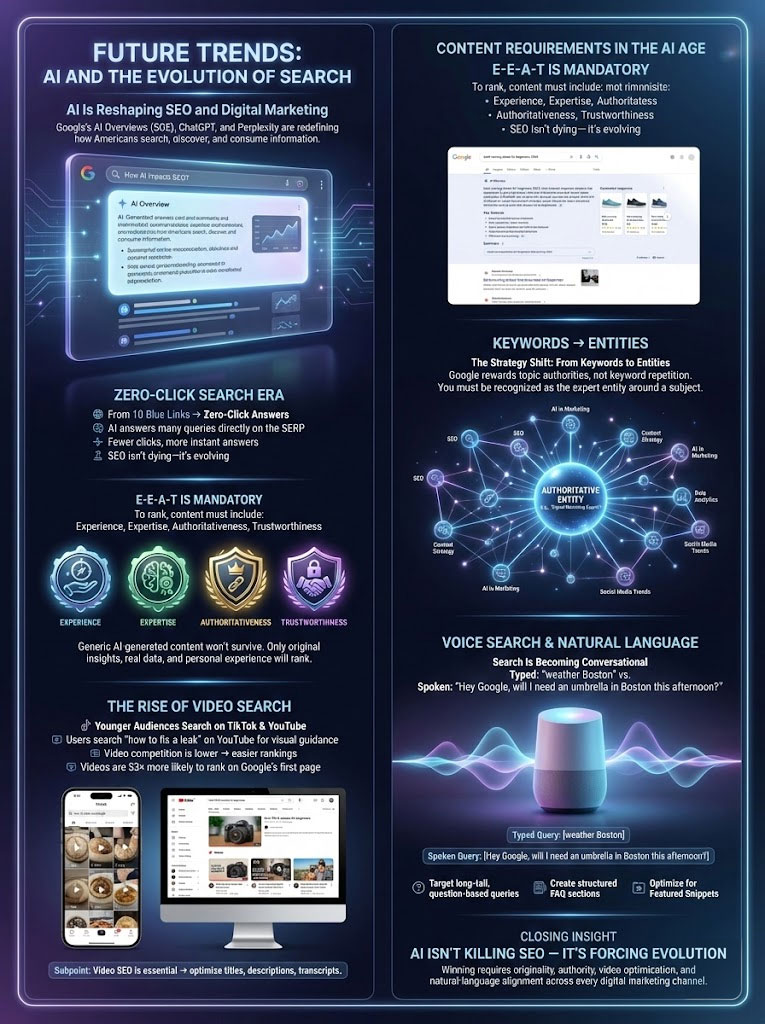
Platforms like Google’s AI Overviews (SGE) and tools like ChatGPT and Perplexity are changing how users find information.
The Impact of AI on SEO and Digital Marketing
In the past, users searched and clicked ten blue links.
Now, AI often answers the query directly on the search results page. This is known as a “Zero-Click Search.”
This does not mean SEO is dead. It means SEO is evolving.
To survive, content must demonstrate deep E-E-A-T (Experience, Expertise, Authoritativeness, Trustworthiness).
Generic, surface-level content generated by AI will be filtered out. Google wants to rank content that offers unique insights, original data, or personal experience that an AI cannot hallucinate.
The strategy is shifting from “ranking for keywords” to “optimizing for entities.” You need to be the authority on the topic, not just the page that mentions the word the most times.
The Rise of Video Search
Search is no longer just text.
Younger demographics in the USA are using TikTok and YouTube as primary search engines. They search for “how to fix a leak” on YouTube to see a video, not to read a blog.
Video content is significantly easier to rank than text in many verticals because the competition is lower.
Data suggests that a video is 53x more likely to rank on the first page of Google than a text-only page.
A modern digital marketing strategy must include video SEO. You must optimize video titles, descriptions, and transcripts just like you would a blog post.
Voice Search and Natural Language
With the prevalence of smart speakers and mobile assistants, searches are becoming more conversational.
People don’t speak like they type. They type “weather Boston.” They say, “Hey Google, will I need an umbrella in Boston this afternoon?”
SEO strategy must adapt to target these long-tail, question-based queries. This often involves creating FAQ sections and optimizing content for “Featured Snippets”—the answer boxes at the top of Google.
Real-World Examples of Growth
To illustrate the power of these channels, let’s look at the mechanics of growth in the real world with detailed scenarios.
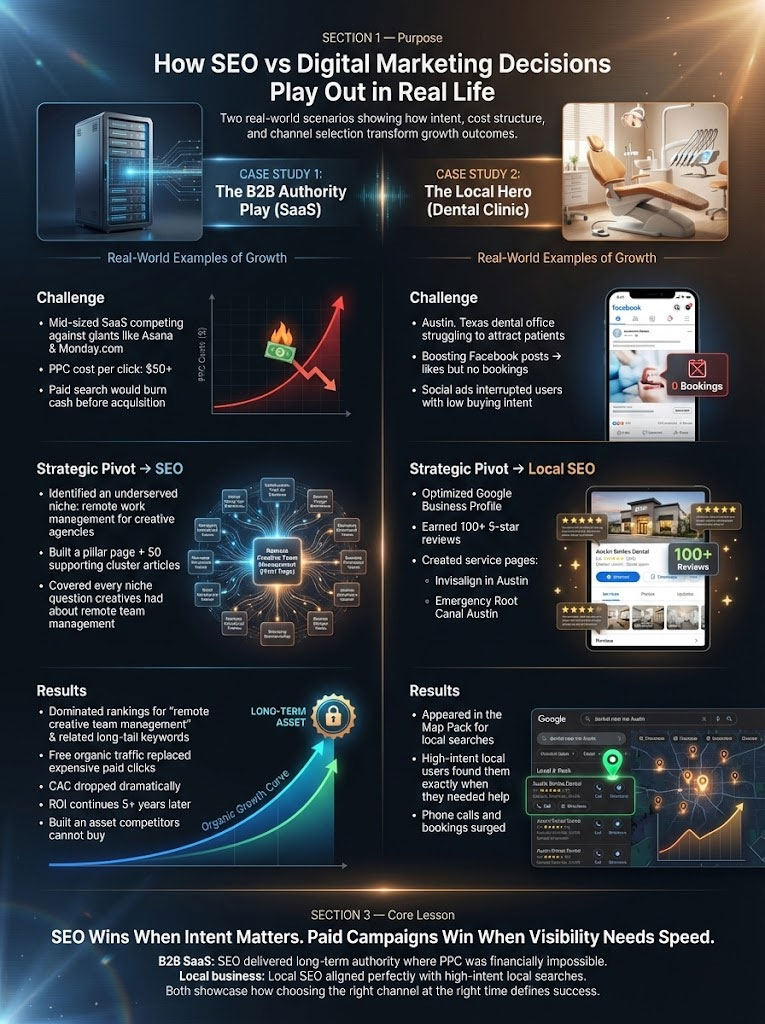
Case Study 1: The B2B Authority Play
Consider a mid-sized SaaS company competing in the project management space.
They faced a massive SEO vs digital marketing decision. Competitors like Asana and Monday.com were spending millions on PPC for terms like “project management software.” The Cost Per Click (CPC) was over $50.
For this mid-sized company, buying that traffic was financial suicide. They would bleed cash before acquiring enough customers.
Instead of fighting a losing war in paid ads, they invested in SEO.
They identified a gap in the market: Remote work management for creative agencies.
They created a “pillar page” guide on remote work productivity specifically for creatives. They supported it with 50 cluster articles answering every niche question about managing creative teams remotely.
Within 12 months, they dominated the search results for “remote creative team management” and hundreds of related long-tail keywords.
The traffic was free. Their CAC plummeted. The ROI of that content hub continues to pay dividends five years later. They built an asset that their competitors could not buy their way into.
Case Study 2: The Local Hero
A dental practice in Austin, Texas, was struggling to get new patients.
They were boosting posts on Facebook (digital marketing) showing pictures of the office. They were getting “likes,” but very few bookings.
Why? Because seeing a picture of a dentist’s chair on Facebook doesn’t make someone want to book an appointment unless they currently have a toothache. The timing was wrong.
They shifted their budget to Local SEO.
They optimized their Google Business Profile, gathered 100+ five-star reviews from happy patients, and created dedicated service pages for specific high-value services like “Invisalign in Austin” and “Emergency Root Canal Austin.”
The result? They started appearing in the “Map Pack” whenever someone in their zip code searched for a dentist.
The intent of those searchers was immediate. Their phone started ringing.
The difference between SEO and digital marketing here was the difference between interrupting people on social media and being the solution when people were actively looking for help.
Summary & Key Takeaways
The battle of SEO vs digital marketing is not about picking a winner. It is about understanding the role of each tool in your arsenal.
Digital marketing is your survival kit. It allows you to generate cash flow immediately through paid channels. It keeps the lights on while you build your foundation. It is essential for testing, validating, and retargeting.
SEO is your wealth-building strategy. It is the investment that compounds over time, lowering your costs and cementing your authority. It is the only channel where your past efforts continue to pay you in the future.
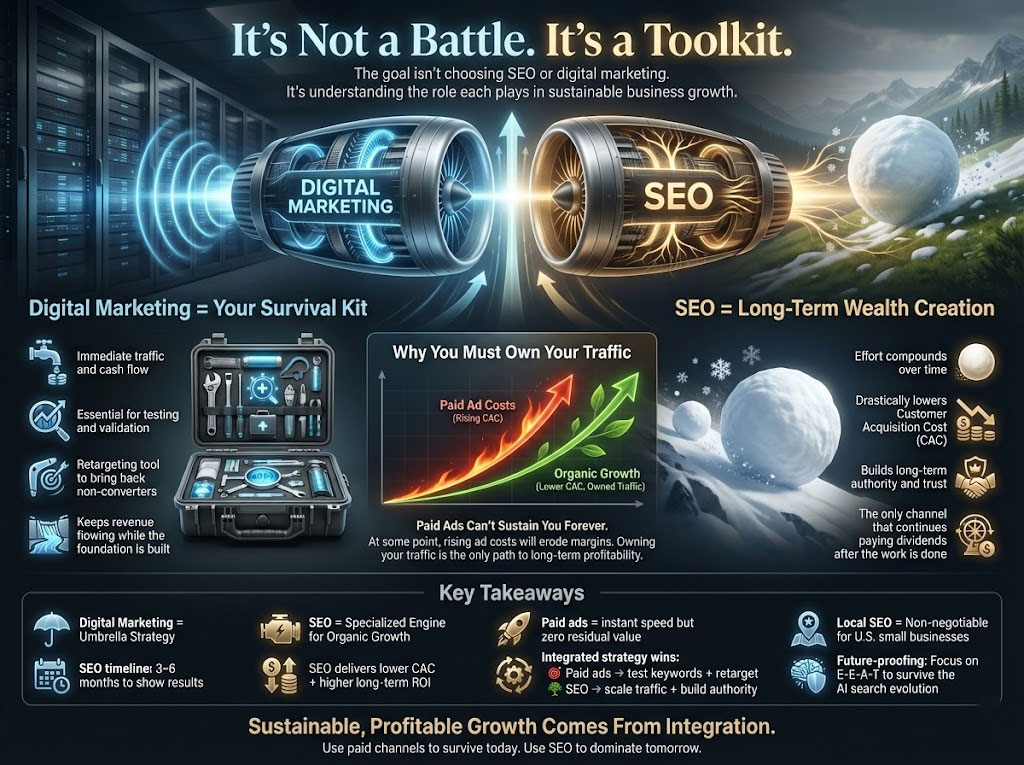
If you want business growth that is sustainable and profitable, you cannot rely on paid ads forever. At some point, you must own your traffic, or the rising cost of ads will destroy your margins.
Key Takeaways:
- Digital Marketing is the umbrella; SEO is the specialized engine for organic growth.
- SEO typically takes 3–6 months to show results but offers a significantly lower CAC and higher long-term ROI.
- Paid Digital Marketing offers instant speed but zero residual value once the budget stops.
- Integrated marketing strategy is the winner: Use paid ads to test keywords and retarget users, while using SEO to scale traffic and build brand authority.
- For small businesses, Local SEO is non-negotiable and should be the primary focus.
- Future-proof your business by focusing on E-E-A-T principles to survive the AI search revolution.
Frequently Asked Questions (FAQs)
What is the main difference between SEO and digital marketing?
SEO is a specific channel focused exclusively on improving organic rankings in search engines to drive unpaid traffic. Digital marketing is the broad term that encompasses all online marketing tactics, including SEO, PPC, social media, email marketing, and affiliate marketing.
Is SEO better than paid advertising for long-term growth?
Yes. SEO builds an asset that generates traffic indefinitely without a direct cost per click. Paid advertising stops generating revenue the moment you stop paying. This makes SEO superior for long-term ROI and asset building, whereas paid ads are better for short-term bursts.
How long does SEO take to show results compared to PPC?
SEO generally requires 3 to 6 months of consistent effort to show meaningful traction, as search engines need time to crawl, index, and trust your site. In contrast, PPC campaigns can generate traffic and leads instantly, often within hours of launching the campaign.
What is the average ROI of SEO vs digital marketing?
While paid digital marketing often sees an ROI of around 200% (due to media costs eating into margins), mature SEO campaigns can deliver an ROI of 500% to 1500%. This is because the cost of acquiring traffic decreases over time while the volume of traffic usually increases.
Can I do digital marketing without SEO?
You can, but it is expensive and risky. Relying solely on paid digital marketing means you are “renting” your traffic. If ad costs rise or your budget is cut, your business visibility disappears immediately. SEO allows you to own your traffic.
Should my startup invest in SEO or digital marketing first?
Most startups should use paid digital marketing (PPC or Social Ads) first to validate their product and get immediate users. However, they should begin an SEO strategy on day one so that organic traffic can eventually replace the reliance on paid ads as the company scales.
How does customer acquisition cost (CAC) differ between SEO and PPC?
PPC has a fixed or rising CAC because you pay for every visitor. SEO has a high upfront cost but a declining CAC over time. Eventually, SEO leads become significantly cheaper than paid leads, improving overall company profitability.
Is SEO worth it Now with the rise of AI?
Absolutely. While AI is changing how people search, the need for authoritative, trusted content (E-E-A-T) is higher than ever. SEO is shifting toward “Answer Engine Optimization” and building brand authority, but the core value of organic visibility remains critical.
How much budget should I allocate to SEO vs digital marketing?
A strategic split for established companies is often 60/40. Invest 60% in long-term brand building and organic growth (SEO/Content), and 40% in short-term sales activation (PPC/Ads). This balances immediate cash flow with future asset building.
What metrics should I track for SEO vs digital marketing?
For SEO, track organic traffic, keyword rankings, conversion rate by organic source, and domain authority. For general digital marketing, track Cost Per Acquisition (CPA), Return on Ad Spend (ROAS), Click-Through Rate (CTR), and overall conversion rates.
Why does organic search convert better than outbound marketing?
Organic search relies on “pull” marketing. The user is actively looking for a solution to their problem and has high commercial intent. Outbound marketing “pushes” a message to someone who may not be interested, resulting in significantly lower conversion rates.
How do local SEO and general digital marketing differ?
Local SEO focuses on ranking for geographically specific queries (e.g., “near me” or “in Chicago”) and relies heavily on the Google Business Profile. General digital marketing targets users based on demographics, interests, or behaviors, regardless of their physical location.