
You have exactly three seconds.
That is the brutal reality of the current social media landscape in the United States. It does not matter if your video editing rivals a Hollywood production or if your LinkedIn post contains the secret to eternal wealth. If the first sentence, the “hook,” fails to trigger an immediate, involuntary psychological response, the algorithm buries your hard work in the digital graveyard.
Viral Hook Generator
Generate scroll-stopping hooks powered by AI
Unlock More Credits
Visit our partner page and wait a few seconds to unlock more credits!
Unlock Credits →Your Generated Hooks
Most creators do not struggle with having good ideas; they struggle with packaging those ideas. You stare at a blinking cursor, paralyzed by the pressure to be witty, urgent, and concise all at once. This is where a viral hook generator transitions from a novelty to a necessity. By leveraging the computational power of generative AI, these tools analyze millions of viral data points to engineer the exact sequence of words required to arrest attention and force a “stop” in the user’s brain.
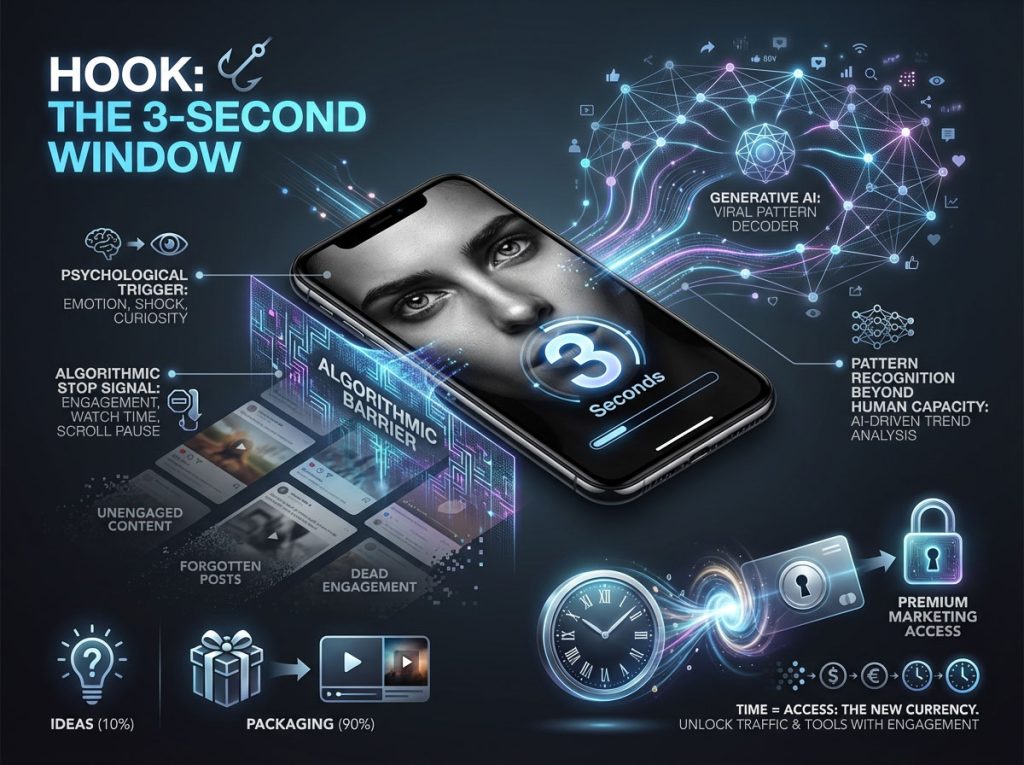
This is not just about writing faster. It is about accessing a level of pattern recognition that the human brain cannot achieve on its own. This comprehensive guide explores the neuro-linguistic mechanics of high-performing hooks, the sophisticated technology behind AI hook generator software, and how the innovative traffic-lock credit system is democratizing access to premium marketing tools by using time, not money, as currency.
The Neuro-Linguistic Science Behind High-Performing Viral Hooks
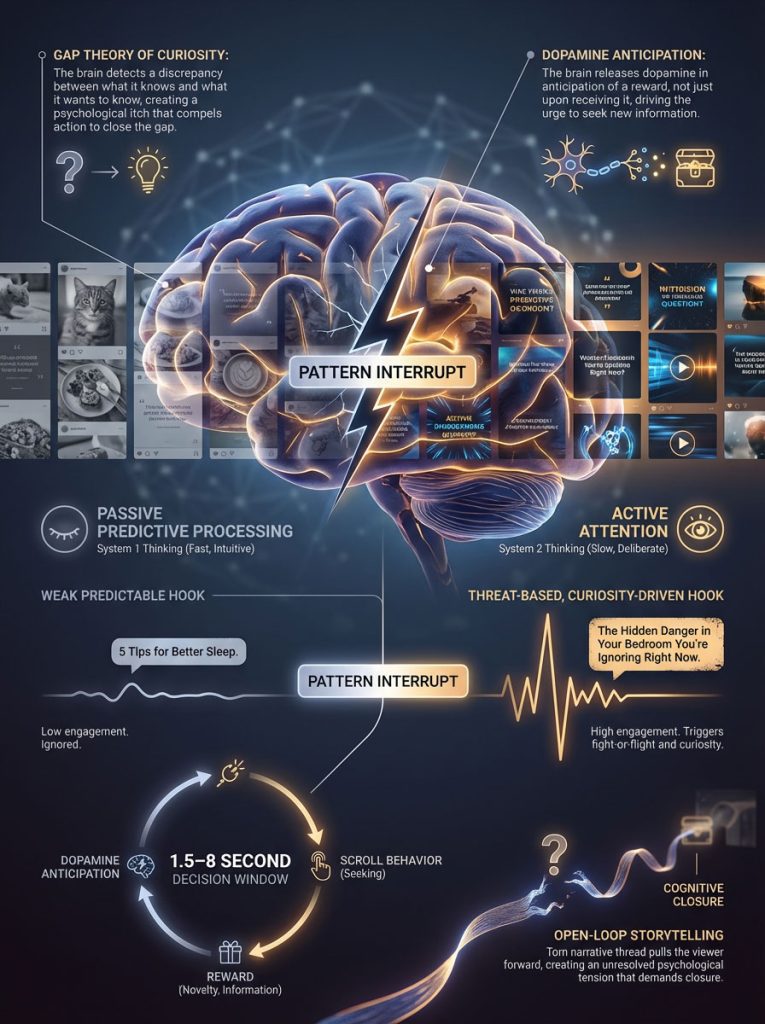
To understand why you need this tool, you must first understand the battlefield. The human brain is an efficiency machine, designed to filter out noise. When a user scrolls through TikTok, Instagram, or LinkedIn, their brain enters a passive state of “predictive processing.” It predicts what comes next to save energy. To break this trance, you need a weapon: the Pattern Interrupt.
Leveraging Pattern Interrupt Marketing to Hack User Attention
Pattern interrupt marketing is the science of presenting something unexpected that forces the brain to switch from passive scrolling (System 1 thinking) to active attention (System 2 thinking). A viral hook generator is specifically trained to create these interrupts.
If you write a caption that says, “Here are 5 tips for better sleep,” the brain predicts the content instantly: “I already know this; drink water, sleep early.” It scrolls past. However, if a social media hook creator generates the line, “Your pillow is slowly killing your deep REM cycle,” the prediction fails. The brain detects a threat and a knowledge gap. It effectively slams on the brakes.
This is the “Gap Theory of Curiosity” in action. We feel a mental itch when we perceive a gap between what we know and what we need to know. The AI is programmed to widen this gap just enough to earn the click, without making the content feel like clickbait.
The Dopamine Feedback Loop in Social Media Scrolling Behavior
Current behavioral data suggests the average human attention span on social media has compressed to roughly 8 seconds, with the critical decision-making window shrinking to 1.5 seconds. This is the “Goldfish Effect,” a phenomenon that dictates modern content strategy.
Social platforms are engineered to be dopamine dispensaries. When a user encounters a scroll-stopping caption, the brain anticipates a reward, the answer to the mystery or the punchline of the joke. This anticipation releases dopamine. If your hook is boring, the brain predicts no reward and commands the thumb to scroll.
An AI hook generator optimizes for this chemical reaction. It utilizes sentiment analysis to ensure words carry high emotional arousal (fear, surprise, joy, or anger), maximizing the potential for that dopamine release.
Cognitive Closure and the Open Loop Theory
On text-heavy platforms like LinkedIn or X (formerly Twitter), the “Open Loop” is king. An open loop is a storytelling technique where the narrative begins in the middle of the action, withholding the context until the reader commits.
Humans have a psychological need for “cognitive closure.” We hate unfinished tasks or stories. A viral hook generator exploits this by drafting the first two lines of a post to create tension.
- Weak Hook: “I learned a lot about business this year.” (Closed Loop: The brain feels the thought is finished).
- AI Generated Hook: “I lost $50,000 in one day, and it was the best investment I ever made.” (Open Loop: The brain demands the context).
Unpacking the Technology of an Advanced AI Hook Generator
How Large Language Models Analyze Viral Data Sets
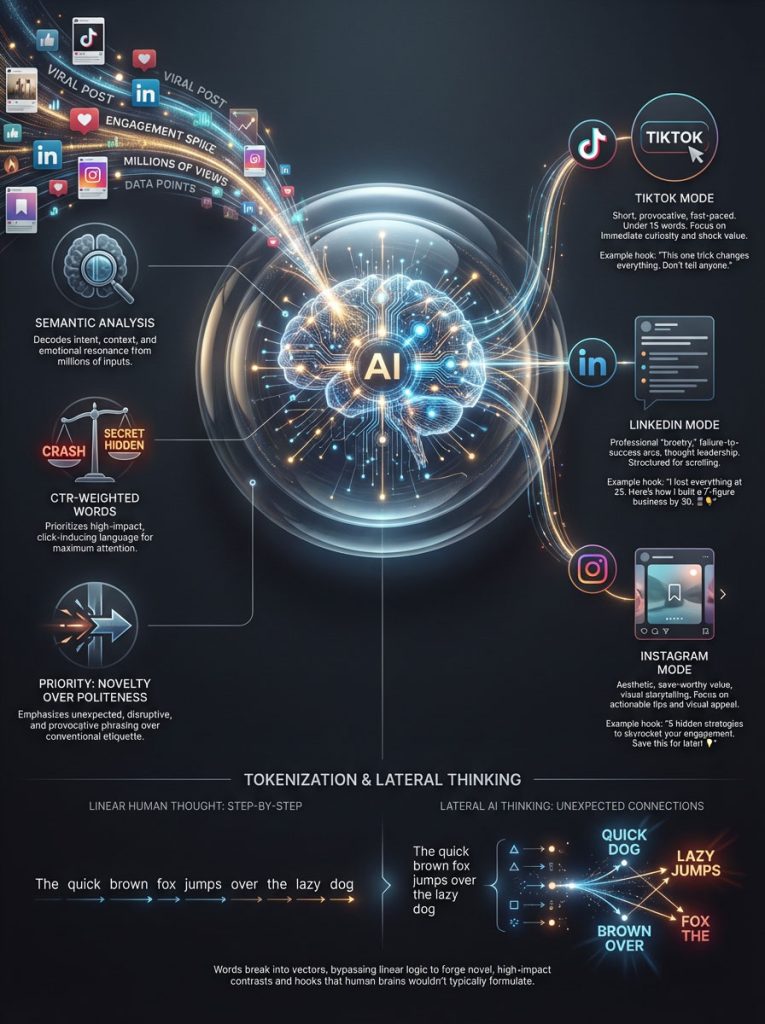
At the core of a viral hook generator lies a Large Language Model (LLM), typically fine-tuned on datasets comprising millions of high-engagement posts. When you input a topic, the AI does not simply act as a thesaurus. It acts as a data scientist.
It analyzes the semantic relationships between your topic and historical viral structures. It understands that for the topic “Real Estate,” the words “crash,” “secret,” and “hidden” have higher statistical probabilities of high CTR (Click-Through Rate) than words like “house” or “mortgage.”
The AI system prompt governing the model dictates these weights. It instructs the AI to prioritize “novelty” and “constraint” over grammatical correctness or politeness. This is why AI-generated hooks often sound punchier and more direct than what a human would politely draft.
The Role of Custom AI System Prompts in Tone Calibration
One size does not fit all. A hook that creates a frenzy on TikTok might look unprofessional and jarring on LinkedIn. Advanced content engagement tools utilize dynamic AI system prompts to adjust the output based on the selected platform.
- TikTok Mode: The system prompt restricts output to under 15 words, prioritizes “you” statements, and encourages controversial framing.
- LinkedIn Mode: The prompt encourages “broetry” formatting (short, line-broken sentences), professional anecdotes, and “failure-to-success” arcs.
- Instagram Mode: The prompt focuses on aesthetic relation and “saveable” value propositions.
Tokenization and Natural Language Processing for Human-Like Text
Early AI tools sounded robotic because they lacked nuance. Modern generative AI uses advanced Tokenization and Natural Language Processing (NLP) to understand slang, idiom, and cultural context.
Tokenization breaks down your input (e.g., “Vegan Diet”) into mathematical vectors. The AI then explores the vector space to find “adjacent” concepts that are surprising. It might connect “Vegan” with “Carnivore” to create a contrast hook: “Why my Carnivore friends are switching to Veganism.”
This ability to find non-obvious connections is what makes a social media hook creator indispensable for overcoming writer’s block. It moves laterally in thought, whereas tired humans tend to think linearly.
Mastering Platform-Specific Strategies with a Social Media Hook Creator
To dominate the algorithm, you must speak the native language of the platform. A generic hook is a failed hook. Here is how to utilize the viral hook generator for specific ecosystems.
Creating Visual-Verbal Mismatches for TikTok and Reels
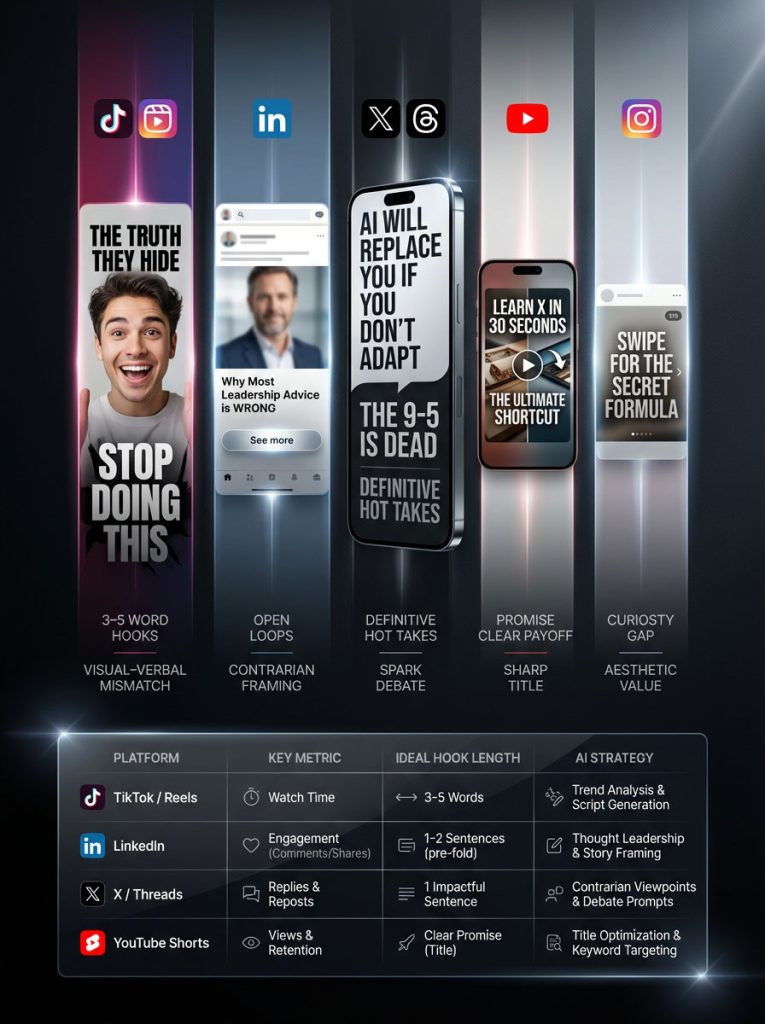
On vertical video platforms (TikTok, Instagram Reels, YouTube Shorts), the text hook must interact with the visual hook. The viral hook generator excels at creating “Visual-Verbal Mismatches.”
This strategy involves displaying text that contradicts or re-contextualizes the video.
- Visual: You are smiling and drinking coffee.
- AI Generated Hook: “The exact moment I realized my business was bankrupt.”
- Result: The brain detects a conflict between the happy visual and the tragic text. It stops to resolve the dissonance.
TikTok engagement hacks often rely on text-on-screen duration. The AI generates hooks short enough (3-5 words) to be read in 1.2 seconds, ensuring the viewer finishes reading before they decide to scroll.
Drafting Professional Open Loops with a LinkedIn Headline Generator
LinkedIn is unique. It is a professional network, but it craves vulnerability. The “See more” button is the most valuable real estate on the site. If a user clicks it, the algorithm signals that your content is high-quality.
The AI hook generator structures hooks here to hide the “payoff” behind the fold.
- Input Topic: Remote Work.
- AI Hook: “Everyone thinks Remote Work is the future. I think it’s creating a silent crisis in our industry.”
- Strategy: The contrarian stance forces the professional to click to see if they agree or disagree.
Engineering Controversial Hot Takes for X and Threads
X (formerly Twitter) and Threads are driven by “Hot Takes.” The algorithm rewards engagement, and nothing drives engagement like a polarized debate.
The viral hook generator uses “Definitive Statements” for these platforms. It avoids words like “maybe” or “sometimes.”
- Input Topic: SEO.
- AI Hook: “SEO is dead. If you are still building backlinks, you are wasting your client’s money.”
- Psychology: This triggers a “Fight or Flight” response in SEO professionals, compelling them to comment.
Optimizing YouTube Shorts for Maximum Retention
YouTube Shorts share the vertical DNA of TikTok but attract a slightly different demographic, one conditioned by long-form YouTube to expect value.
Here, the scroll-stopping captions must promise a specific payoff. The AI focuses on “The How-To Promise.”
- Input Topic: Video Editing.
- AI Hook: “Stop cutting your videos like this. It’s killing your retention.”
- Value Proposition: The user watches to learn the “correct” way, protecting their own retention metrics.
Comprehensive Hook Requirements by Platform
| Platform | Key Algorithm Metric | Ideal Hook Length | AI Style Strategy |
| TikTok | Watch Time (Secs) | 3-5 Words (Text-Overlay) | High Energy / Visual Mismatch / Curiosity |
| Dwell Time / “See More” | 12-20 Words (2 Lines) | Professional Storytelling / Contrarian | |
| Saves & Shares | 5-8 Words | Aesthetic / Relatable / Identity-Based | |
| YouTube | Click-Through Rate (CTR) | 10-15 Words (Title) | High Stakes / Value Promise / Urgency |
| X (Twitter) | Retweets / Replies | Under 280 Characters | Polarizing / Definitive / Thread-Starters |
| Threads | Discussion / Replies | 1-2 Sentences | Conversational / Question-Based |
The Innovative Traffic-Lock Credit System: Monetizing Free Tools via Engagement
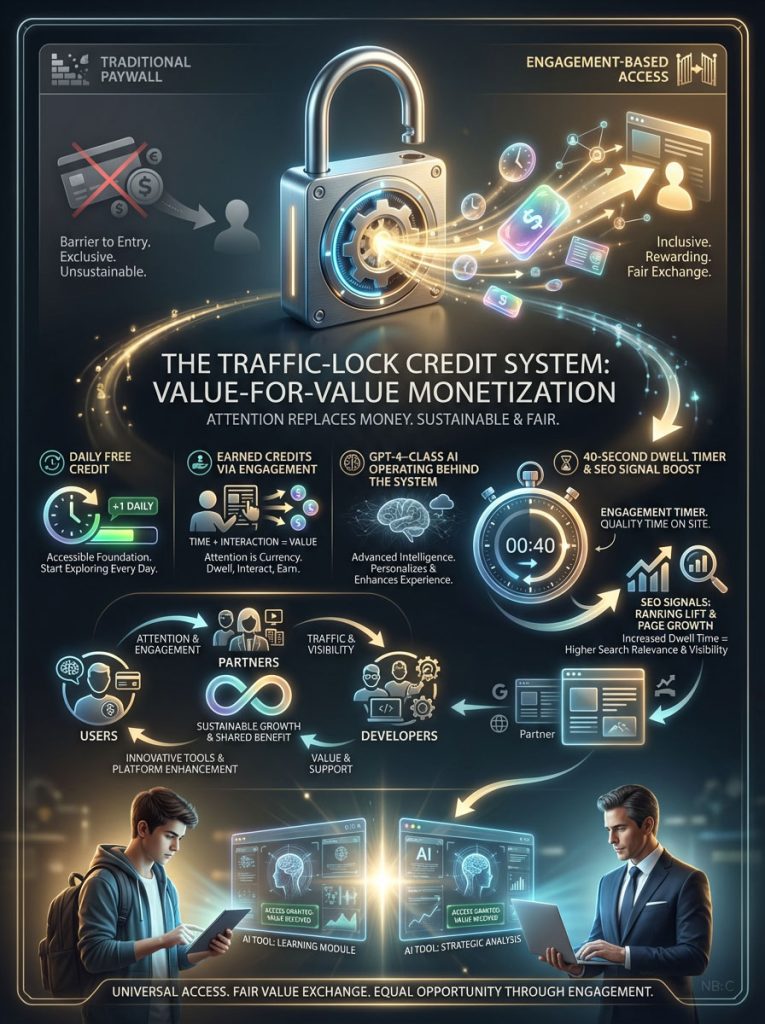
Understanding the Value-for-Value Exchange Model
In the SaaS (Software as a Service) world, “free” usually means “limited.” You get 3 days of access, and then a paywall hits. The viral hook generator disrupts this model with the traffic-lock credit system.
This system is built on a “Value-for-Value” exchange. We provide premium, GPT-4 class AI generation costs money to run. Instead of charging you a monthly subscription, we charge you in attention.
- Daily Allowance: You get 1 free credit every 24 hours.
- Earned Credits: You earn more by engaging with partner content.
This creates a sustainable ecosystem where the tool remains free for users, partners get exposure, and the developers cover API costs.
Why 40-Second Dwell Time Matters for SEO and Partner Growth
When you click “Unlock More Credits,” you are directed to a target URL where a timer counts down, typically for 40 seconds. This specific duration is calculated for maximum impact.
In the world of SEO (Search Engine Optimization), “Dwell Time” is a massive signal of quality. If Google sees users visiting a page and staying for 40+ seconds, it assumes the content is relevant and boosts its ranking. By using the traffic-lock credit system, you are not just waiting; you are actively contributing to the SEO health of the partner pages.
This makes the tool a powerful engine for content engagement tools and affiliate marketers who need to prove high-retention traffic to their sponsors.
How the Credit System Democratizes Access to Premium AI
Access to top-tier generative AI often creates a digital divide. Big agencies can afford expensive monthly tools; independent creators cannot.
The traffic-lock credit system levels the playing field. A student in a dorm room has the same access to viral-grade AI as a CMO at a Fortune 500 company, provided they are willing to trade a few minutes of their time. This democratization is vital for the health of the creator economy.
Technical Integrity: Ensuring Fairness with Cloudflare Turnstile Integration
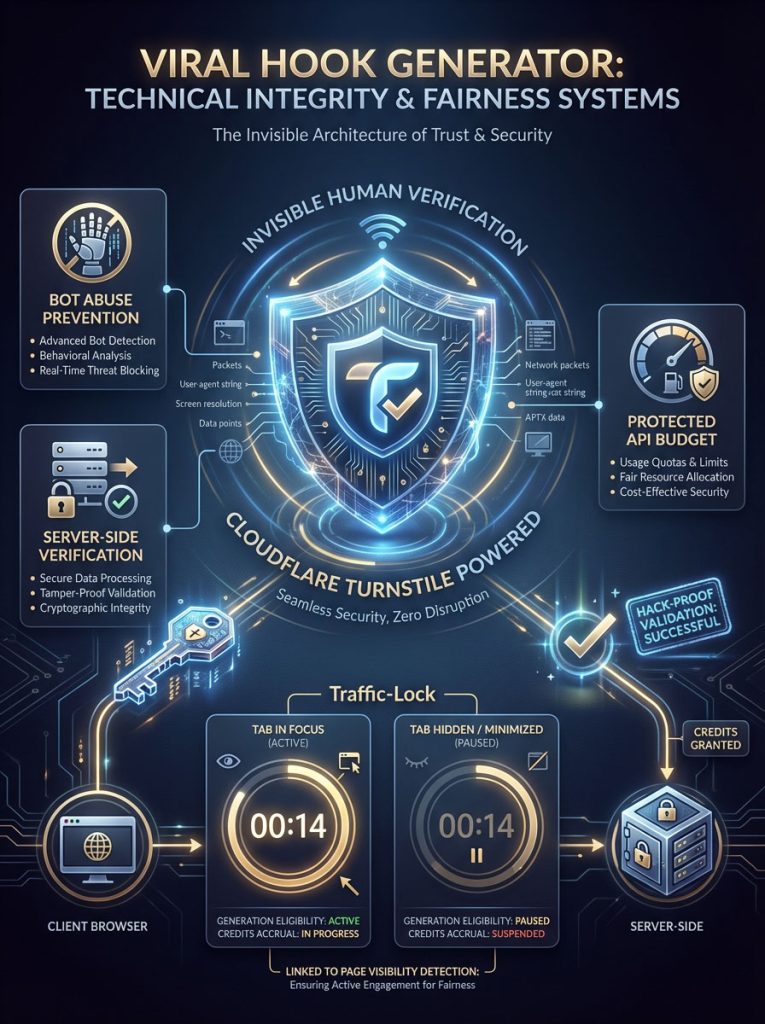
Preventing Bot Abuse with Advanced Server-Side Verification
Any system that rewards traffic is a target for abuse. Unscrupulous users might try to use bots to farm credits or spam the API. This is why the viral hook generator employs enterprise-grade security.
Cloudflare Turnstile integration is the first line of defense. Unlike traditional CAPTCHAs that frustrate users with blurry images of traffic lights, Turnstile uses “smart challenges.” It analyzes browser behavior and telemetry in the background to confirm humanity without user interaction. This protects the tool’s API budget from being drained by automated scripts.
The Anti-Cheat Mechanism: Tab-Switch Detection Explained
The integrity of the traffic-lock credit system relies on real attention. If a user opens a partner page and immediately switches tabs to watch a movie, the partner gets no value.
To solve this, the tool uses the Page Visibility API for Tab-Switch Detection.
- Active State: The timer runs only when the tab is in focus.
- Hidden State: If the user minimizes the window or switches tabs, the timer pauses immediately.
Furthermore, the credit verification is handled via server-side verification. When the timer ends, a cryptographic token is generated and sent to the server. The server validates this token before awarding the credit. This makes it mathematically impossible to “hack” the client-side code to grant unlimited credits.
Advanced Prompt Engineering to Maximize Your AI Hook Generator Results
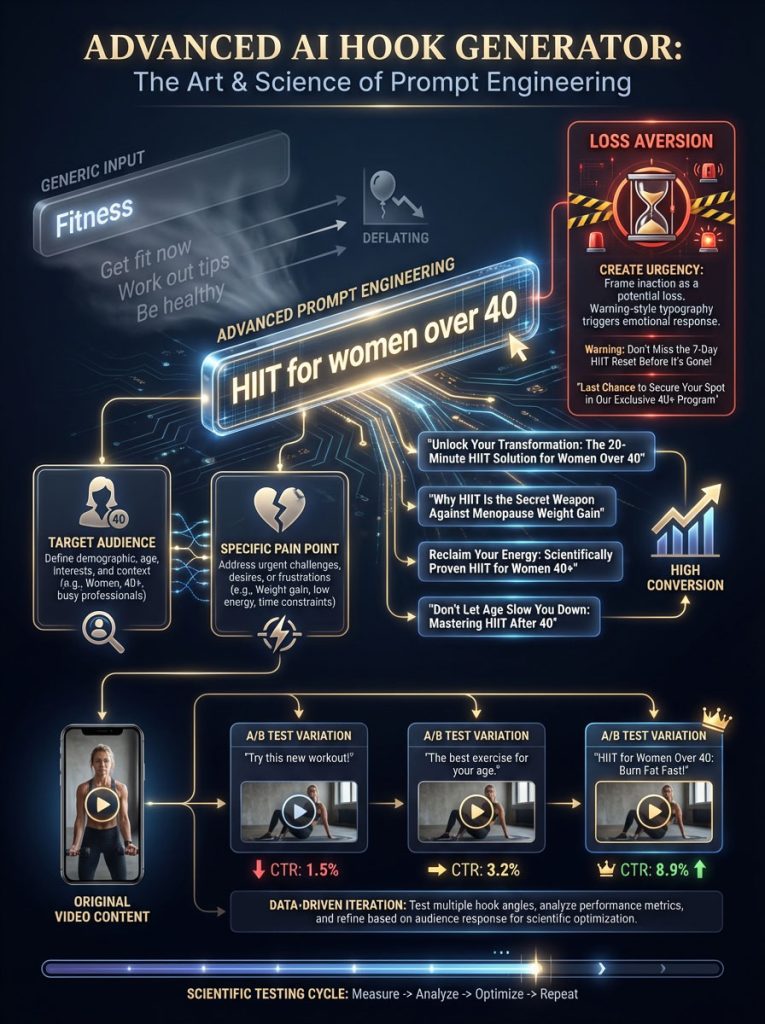
Transforming Generic Topics into High-Converting Inputs
The AI hook generator is powerful, but it is not a mind reader. The quality of your output depends heavily on the specificity of your input. This is known as “Prompt Engineering.”
If you input a generic term like “Fitness,” the AI scans generic viral patterns. You will get hooks like “5 tips for fitness.”
However, if you input “High-intensity interval training for women over 40,” the AI narrows its vector search. It will generate:
- “Why HIIT is failing women over 40 (and what to do instead).”
- “The one workout women over 40 need to stop doing immediately.”
Pro Tip: Always include the Target Audience and the Specific Pain Point in your input topic for the best results from the social media hook creator.
Using Negative Constraints to Trigger Loss Aversion
Psychologically, humans are more afraid of losing something than they are motivated to gain something. This is “Loss Aversion.”
You can force the viral hook generator to use this by phrasing your input topic with a negative bias.
- Input: “Mistakes in Investing.”
- AI Output: “Stop buying stocks until you read this.”
The AI system prompt recognizes the negative sentiment and constructs hooks that imply impending doom or failure if the user scrolls past. These are aggressive, but they are statistically the highest-performing pattern interrupt examples.
A/B Testing Generated Hooks for Data-Driven Growth
One of the key features of this tool is that it generates five hooks per credit. This is not just for variety; it is for scientific testing.
Do not guess which hook will work. Run an A/B test.
- Day 1: Post your video with Hook #1 (The Curiosity Angle).
- Day 3: Repost the same video (or a slight variation) with Hook #2 (The Negative Angle).
Analyze the data. You will often find that one specific style outperforms the others by a significant margin. This data helps you refine your future inputs into the viral hook generator.
From Hook to Conversion: Building a Holistic Content Strategy
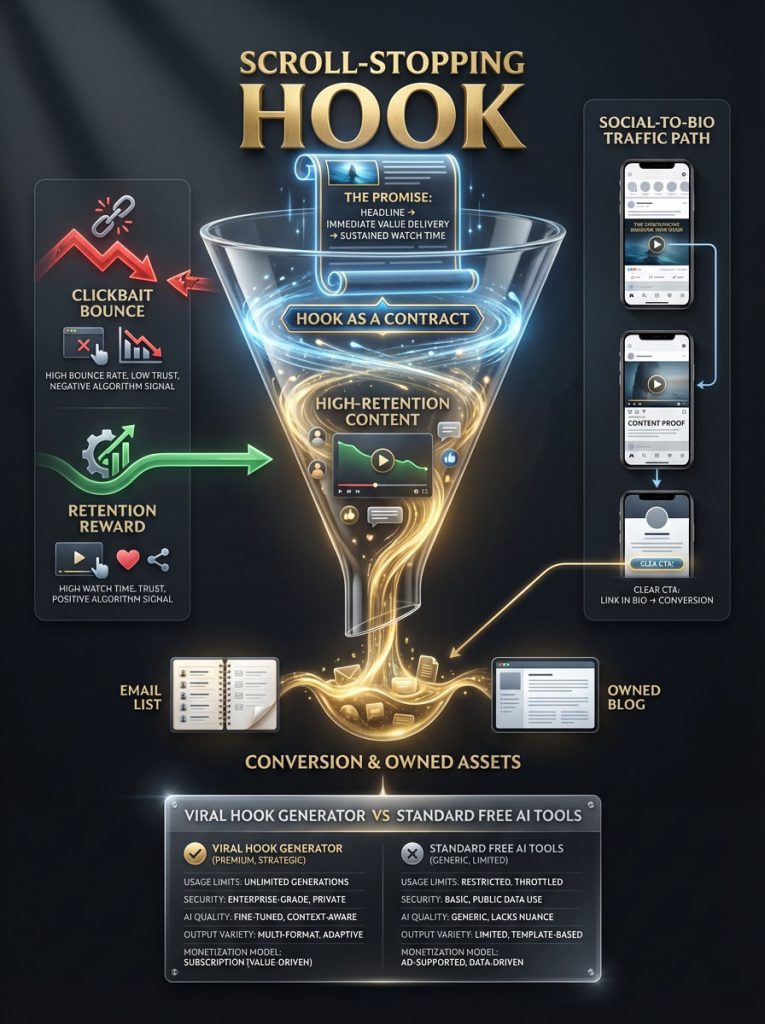
Delivering on the Promise to Boost Watch Time and Retention
A hook is a contract. When you use a scroll-stopping caption, you are making a promise to the viewer. “Watch this, and you will learn X.”
If you use a high-voltage AI hook but follow it with low-energy, irrelevant content, you are committing “Clickbait.” While this gets the click, it destroys your retention rate. Modern social media algorithms penalize “Click-and-Bounce” behavior.
Use the viral hook generator to set the stage, but ensure your content delivers the payoff immediately. If the hook is “The secret to weight loss,” the very next sentence should not be “Welcome to my channel, subscribe for more.” It should be “The secret is…”
Funneling Social Traffic to External Blogs and Landing Pages
The ultimate goal of social media for businesses is to own the audience. You want to move them from a rented platform (TikTok/LinkedIn) to an owned asset (Email List/Blog).
The traffic-lock credit system logic can be applied to your own marketing. Use the hook to drive traffic to your bio.
- Hook: “I built a free tool that generates viral hooks.”
- Body: Demonstrate the tool.
- CTA: “Try it for free at the link in my bio.”
By using the AI hook generator to sell the click rather than just the view, you transform passive followers into active website visitors.
Comparison: Viral Hook Generator vs. Standard Free AI Tools
| Feature | Viral Hook Generator | Standard Free AI Tools |
| Daily Free Usage | Yes (Daily Reset at Midnight) | Limited (One-time Trial or Credit Card req) |
| Anti-Bot Tech | Cloudflare Turnstile integration | Often Missing / Basic Text Captcha |
| Monetization Model | Content Engagement (Time-Based) | Aggressive Pop-up Ads / Data Selling |
| AI Model Quality | Latest GPT Class LLM | Legacy GPT-3 / Generic Instruct Models |
| Output Variety | 5 Variations per Credit | Usually 1 Single Output |
| Security | Server-Side Verification | Client-Side (Easily Bypassed by scripts) |
| Prompt Customization | Platform-Specific AI System Prompts | Generic “Write a Headline” prompts |
The Future of AI in Content Creation
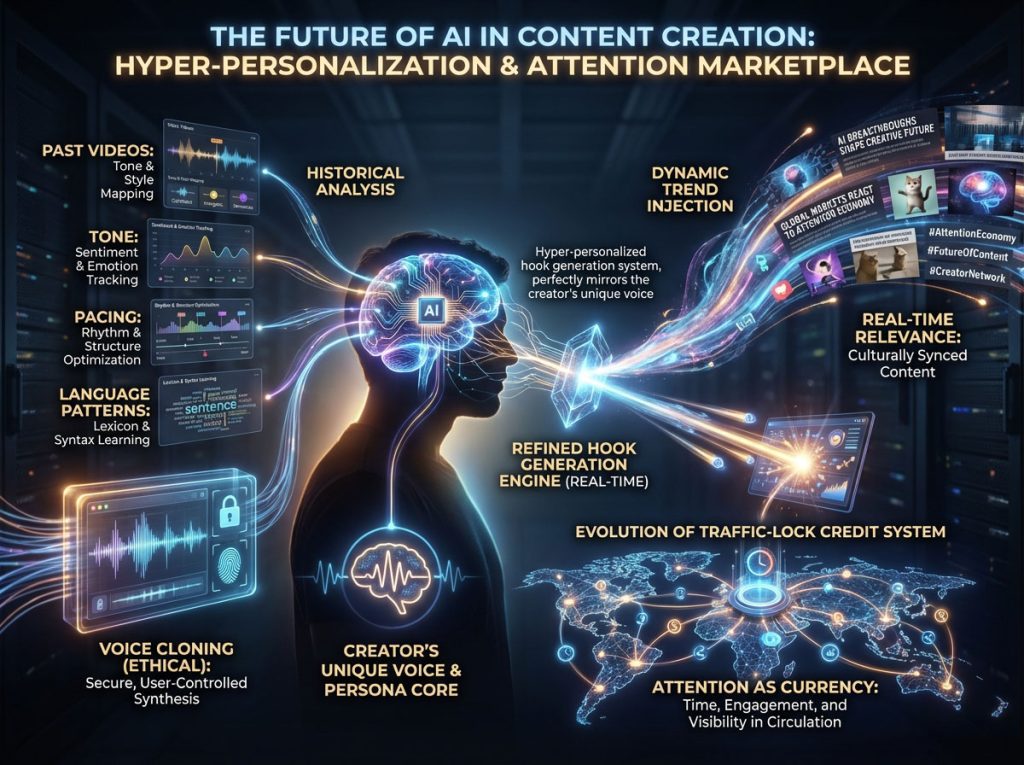
Hyper-Personalization and Dynamic Hook Generation
As we look toward the future of generative AI, tools like the viral hook generator will evolve from static inputs to dynamic analysis. Imagine a tool that connects to your TikTok account, analyzes your last 50 videos, identifies your unique voice, and generates hooks that sound exactly like you, but better.
We are also moving toward “Real-Time Trend Injection.” Future content engagement tools will likely scrape current trending topics (e.g., a major news event or meme) and automatically insert them into your hook suggestions, ensuring your content is always riding the wave of cultural relevance.
The traffic-lock credit system may also evolve, potentially allowing users to “bank” time or trade engagement across a decentralized network of creators, creating a true “Attention Economy” marketplace.
Summary & Key Takeaways
The war for attention is fierce, and the casualties are creators who refuse to adapt. To win, you must weaponize psychology and technology. The Viral Hook Generator provides the ammunition you need to break through the noise.
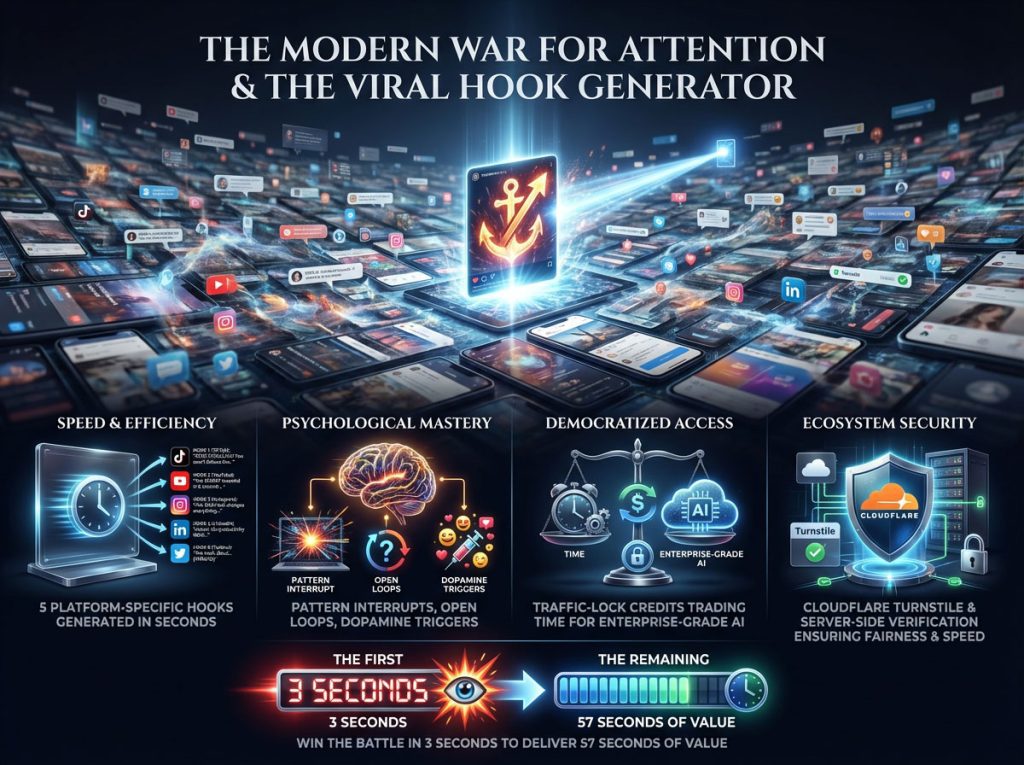
- Speed & Efficiency: Generate 5 platform-specific, viral-optimized hooks in seconds using an AI hook generator, saving hours of brainstorming time.
- Psychological Mastery: Leverage pattern interrupt marketing and Open Loops to stop the scroll and trigger dopamine responses.
- Democratized Access: Use the traffic-lock credit system to access enterprise-grade generative AI tools for free, simply by trading your time and engagement.
- Ecosystem Security: Trust in Cloudflare Turnstile integration and server-side verification to keep the platform fast, fair, and safe for genuine human users.
Stop staring at a blinking cursor. Let the AI handle the first 3 seconds so you can focus on delivering life-changing value in the remaining 57.
Frequently Asked Questions (FAQs)
Is the Viral Hook Generator truly free, or is there a hidden cost?
The tool operates on a “Freemium via Engagement” model. You receive a daily allowance of free credits every single day. If you need more, you can earn them via the traffic-lock credit system by visiting partner pages. There is no requirement to enter a credit card or pay cash.
What exactly makes a “scroll-stopping caption” effective?
An effective caption utilizes a pattern interrupt, a statement that defies the user’s subconscious prediction. By creating a curiosity gap or breaking a visual pattern, the hook forces the brain to switch from passive scrolling to active processing, resulting in a stop.
Why does the timer pause when I switch tabs to another window?
The traffic-lock credit system is built on a fair exchange of value. Partners pay for real human attention. The Tab-Switch Detection ensures that users are actually engaging with the content (dwell time) rather than gaming the system, which keeps the tool free for everyone.
Can I use the generated hooks for LinkedIn headlines?
Yes. The social media hook creator features a specific “LinkedIn” mode. When selected, the AI system prompt adjusts the tone to be professional, insightful, and story-driven, specifically designed to trigger the “See more” expansion on text-only posts.
How does Cloudflare Turnstile integration protect my experience?
Cloudflare Turnstile integration works in the background to verify that requests are coming from real humans, not automated scrapers or bots. This prevents server overload, ensuring the AI hook generator remains lightning-fast for legitimate users.
What are the best prompt engineering tips for this specific tool?
Specificity is key. Instead of inputting a broad topic like “Marketing,” input “B2B Marketing strategies for small budgets.” This allows the AI hook generator to use its vector analysis to create highly targeted, relatable, and painful hooks for that specific avatar.
How many hook variations do I get per credit?
For every single credit redeemed, the generator produces five unique pattern interrupt examples. This allows you to A/B test different psychological angles (e.g., Fear vs. Greed vs. Curiosity) for the same piece of content to see what resonates.
Does this tool work effectively for YouTube Shorts?
Absolutely. YouTube Shorts share the same “vertical video” algorithm dynamics as TikTok. Hooks generated with the “TikTok” setting on this tool work exceptionally well as scroll-stopping captions for YouTube Shorts, focusing on visual-verbal mismatches.
Can I use these hooks for paid social advertising (Facebook/Instagram Ads)?
Yes. In fact, using a viral hook generator for ad copy can significantly lower your Cost Per Click (CPC). By increasing your CTR (Click-Through Rate) with a better hook, the ad platforms assign a higher “Relevance Score” to your ad, lowering your costs.
Do my earned credits expire or roll over to the next day?
No. The system performs a hard reset at midnight server time. This ensures the database remains optimized. It is highly recommended to use your free daily credit and any earned credits within the same browsing session.
Is the generated content unique to me?
The AI generates content dynamically based on your specific topic input and the current stochastic parameters of the LLM. While short viral phrases may occasionally coincide, the combination of your specific niche and the AI’s angle generally produces unique results.
How does the Traffic-Lock system benefit the partner websites?
Partners receiving traffic from the traffic-lock credit system benefit from guaranteed “Dwell Time.” Because the timer enforces a 40-second stay, it sends positive user-behavior signals to search engines like Google, which can help improve the partner’s SEO rankings.
Disclaimer: The strategies, psychological concepts, and tools mentioned in this article are for educational and informational purposes. While AI hook generator tools can significantly aid in content creation, viral success is also dependent on the quality of the underlying content, video production, and the ever-changing algorithms of social media platforms.
References:
- Microsoft Corporation. Attention Spans: Consumer Insights.
- Facebook IQ. Capturing Attention in Feed: The Science of Stopping the Scroll.
- HubSpot Research. The State of Marketing & Trends Report.
- Google Search Central. Understanding Dwell Time and User Engagement Signals.